This is my 20th year in education, and before I stepped into my first leadership role, I kept returning to a question that I share in my book The Leader Inside:
“Lauren, what type of leader do you want to be?”
My answer was simple:
“The type of leader I always needed.”
When I think back to the observation process as a classroom teacher, I never viewed it as a professional learning opportunity because it was never presented to me as one. Instead, it often felt anxiety-driven, overwhelming, and unnatural. And many times, it felt more like a compliance exercise than a meaningful learning experience.
I would spend hours planning lessons, searching for ways to impress the administrator walking into my classroom, only to sit down afterward for a post-observation conversation that often sounded something like this:
“What do you think went well? What could have gone better?”
Then many of the ideas I shared during the conversation would ultimately find their way into the formal observation write-up aligned to the Danielson Framework.
When taking my leadership courses years ago, it was eye-opening to learn that Charlotte Danielson never intended for her framework to be used primarily as an evaluative tool. Rather, it was designed as a blueprint for reflection, growth, and professional learning.
As Danielson has shared:
“The Framework for Teaching is not a checklist for evaluation. It is a roadmap for professional learning and growth.”
And honestly, that made sense when I took a closer look at the four domains. As a teacher, I never had the opportunity to unpack the framework in that way. I rarely used it as a reflective tool to strengthen practice or deepen my understanding of teaching and learning.
In their recent blog, The Danielson Group shared the following: “Think back to the teacher who changed something in you. Maybe they saw potential you hadn’t claimed yet. Maybe they asked a question that lodged in your mind for years. Whatever it was, they were doing something far more complex than delivering a lesson — they were practicing a craft.”
As I finish my 20th year in education, I find myself returning to this topic once again—not only because I remain deeply passionate about it, but because it is igniting deeper reflection as I read through our teachers’ end-of-year reflections for the Domain 4 section of the Danielson Rubric. Domain 4 focuses on Professional Responsibilities, including reflection, communication, collaboration, professional growth, and the many ways educators contribute to the larger school community beyond daily instruction.
Domain 4 also captures the meaningful ways educators contribute to the larger school community beyond daily instruction.
One of my colleagues recently used AI to capture the key themes that emerged from the reflective question our teachers answered as part of their end-of-year reflection. This year, the reflection was grounded in New York State’s Portrait of a Graduate and the ways in which teachers’ planning, preparation, instruction, and student learning experiences aligned with the six components: Academically Prepared, Creative Innovator, Critical Thinker, Effective Communicator, Global Citizen, and Reflective and Future-Focused.
That idea has stayed with me because it reminds me that learning cannot end with knowing. It has to move toward application, creation, contribution, and meaning. It is also an idea I reflected on in my recent blog post, Making Learning Matter.
I thought the idea was brilliant and decided to do the same for my secondary English departments. You can find the themes HERE, curated with support from ChatGPT.
As I have written before, this connection immediately brought me back to George Couros’s work in The Innovator’s Mindset, which has continued to influence the way I think about teaching, learning, and leadership. Long before many states began shaping Portraits of Learners and Graduates, Couros was writing about the importance of helping students do more than know information. He wrote, “The ability to innovate—to create something new and better—is a skill organizations worldwide are looking for today.” He also referenced Thomas Friedman’s article, “How to Get a Job at Google,” where Friedman wrote, “The world only cares about—and pays off on—what you can do with what you know. And it doesn’t care how you learned it.”
When leaders approach classrooms with curiosity, presence, and purpose, they begin to see the magic that unfolds inside them every day. They are able to recognize and elevate teacher expertise, connect effective practices to schoolwide priorities, and foster a shared ownership of learning.
So, I continue to wonder:
What if observations were less about evaluation and more about learning alongside one another?
What if classroom visits became opportunities to connect, reflect, and make learning come alive?
Years ago, I wrote a post titled Observing Through a Coaching Lens: 8 Ideas to Lift the Level of Conversation and Transform Practice. It became one of my most widely read posts and eventually found its way into my book. It is still widely read and shared and since then, I have continued to revisit and refine these ideas because the work continues to evolve.
Today, as schools and districts embrace a variety of educational priorities, they define the attributes they hope students will carry into the future, observations can serve as a powerful vehicle for examining whether those aspirations are coming to life in classrooms. If collaboration, communication, critical thinking, adaptability, and learner agency matter for students, they should also matter in the conversations we have with teachers.
The moment educators and leaders stop refining their practice is the moment they risk losing sight of their purpose.
That idea has stayed with me throughout my career because I deeply value the work of instructional coach and author Jim Knight. On the Instructional Coaching Group website, “Knight divides leadership into two parts: leading ourselves and leading others. To lead ourselves, we need to know our purpose and principles, how to use our time effectively, how to take care of ourselves, and how to develop habits that enable us to do these things. To lead others, we need to make good decisions, interact with others in ways that expand our capacities, foster deep knowledge and deep implementation, and create alignment with others.”
To me, that is the heart of leadership. It is not about having all the answers. It is about remaining committed to our own growth while helping others discover their strengths, refine their practice, and move closer to their purpose. That work begins with reflection, curiosity, and a willingness to keep learning.
If you asked me why I remain in education after twenty years, my answer is simple and is shared in my book The Leader Inside: To recognize the gifts in others that they may not yet see in themselves.
That’s it.
I want to pay forward what so many others have done for me. Along my journey, there have been people who illuminated the path ahead and served as lanterns guiding me toward my next destination.
That said, let me be clear: I have never embarked on this work alone.
It began when I was an assistant principal. I had countless conversations with the principal I worked with about the impact of the observation process, and I have carried those conversations into the work I do today as a curriculum leader with fellow administrators, curriculum leaders, and central office colleagues. I also lean heavily on my professional learning network because learning from educators outside of our own organizations challenges our thinking and strengthens our practice.
I am especially grateful for the time I spent as an instructional coach. It provided me with an opportunity to step outside the four walls of my own classroom and see the magic happening inside countless others.
Grounding the Work
I have always valued the role of a coach, a thought partner, a trusted colleague, and someone who helps me see what I might otherwise miss.
Jim Knight defines an instructional coach as:
“A dedicated partner for teachers, providing evidence-based practices that improve teaching and learning so students everywhere can be more successful.”
And while the work of observation is never done in isolation, it is a shared journey. My commitment to viewing observations through a coaching lens has only deepened over time.
Recently, I read The Coaching Habit by Michael Bungay Stanier. At its core is a simple but powerful idea: resist the urge to solve problems immediately and instead stay curious a little longer.
That idea resonates deeply with me because great coaching is not about having all the answers. It is about asking the kinds of questions that help others discover answers for themselves.
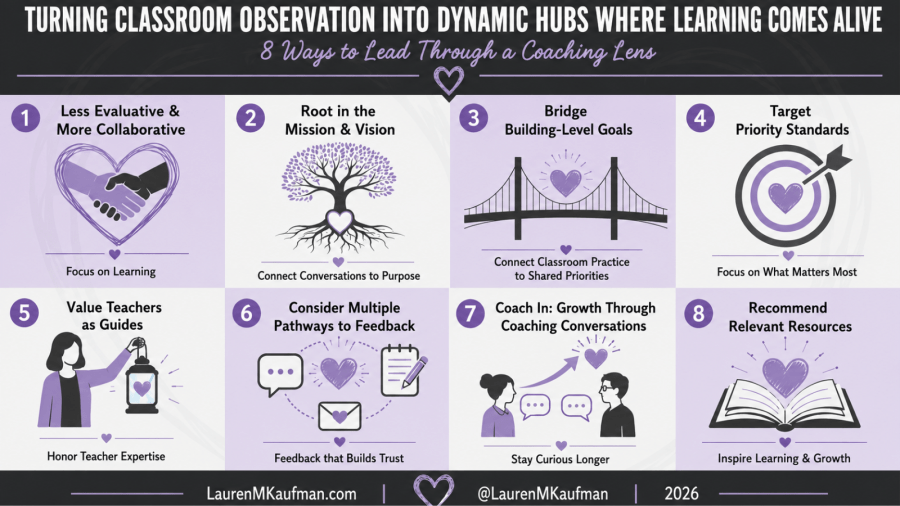
With that in mind, here are eight ideas that continue to shape the way I approach classroom observations and coaching conversations:
CLICK HERE TO USE THE IMAGE BELOW WITH YOUR TEAMS
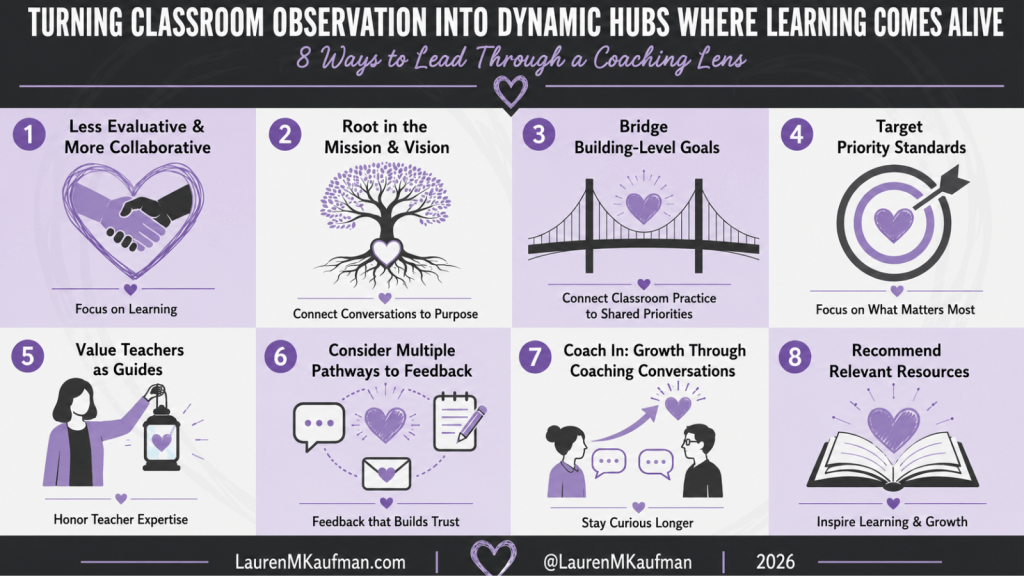
1. Less Evaluative and More Collaborative
Approach conversations as a thinking partner. There are no titles in teaching and learning discussions. Keep the conversation focused on the learner and the learning.
In Innovate Inside the Box, George Couros and Dr. Katie Novak identify three critical areas for educator learning:
- Learn about our students
- Learn for our students
- Learn from our students
The same applies during collaborative conversations between administrators and teachers:
- Learn about our teachers
- Learn for our teachers
- Learn from our teachers
There is no one who knows themselves and their learners better than the teacher.
2. Root in the Mission and Vision
When I was onboarded into my first administrative role as an assistant principal, one of the first documents my principal shared with me was the district mission and vision.
I am still in awe of the time, thought, and collaborative effort that went into creating it.
This is not a document that simply lives on a website. It is a document that lives and breathes in every conversation we have. The language and meaning are embedded in observations, informal conversations, professional learning experiences, and presentations.
When discussing teaching and learning with teachers, we intentionally look back at the mission and vision and reflect on student outcomes.
Is the planning, process, and evidence a reflection of what we believe as a district?
3. Bridge Building-Level Goals
When discussing the mission and vision, it is essential to connect building-level goals to the conversation.
Whether the focus is student-generated questioning, evidence-informed practices, intentional small-group instruction, or another priority, these goals help ground the conversation and keep planning focused.
In my current role, these discussions often connect to the Big Six skills and competencies outlined in the New York State Science of Reading Literacy Briefs: oral language, phonemic awareness, phonics, fluency, vocabulary, and comprehension.
They also connect to the attributes outlined in our Portrait of a Graduate and the learning experiences we hope students encounter every day.
4. Target Priority Standards
It is no secret that students are expected to master a significant number of standards throughout a school year.
In Fearless Instruction, the authors write: “There are too many standards with too little time to teach them all effectively.”
Start by asking:
“What should students know and be able to do by the end of this lesson?”
Then zoom in on the priority standards that matter most.
From there, ask:
“How will you know students are accessing and working toward mastery during and after the lesson?” The conversation naturally shifts from coverage to impact.
5. Value Teachers as Guides
Allow teachers to guide observation conversations.
Let them talk about the teaching and learning happening in their classrooms. Encourage them to share diagnostic, formative, and summative data, along with observational evidence they gather every day.
When teachers share what they are most proud of and where they see opportunities for growth, conversations become more authentic and meaningful.
Most importantly, it communicates that their expertise is valued.
6. Consider Multiple Pathways to Feedback
After an observation, I never leave a classroom without naming the goodness I saw.
I do not make teachers wait for a formal write-up to learn about the impact they had during a lesson.
As a former teacher, I remember how the waiting often created unnecessary anxiety.
Instead, I talk directly with teachers and students before leaving.
I might say:
“It was amazing to see you using accountable talk stems to lift the level of discussion and build on one another’s thinking. I can see you and your teacher have been working hard to actively listen so you can contribute in meaningful ways.”
I also follow up with a digital note, handwritten message, or quick Voxer, a walkie-talkie app.
These small gestures communicate something powerful:
I see you. I value your work. I am learning alongside you.
7. Coach In: Growth Through Coaching Conversations
Ask questions that spark reflection and ownership.
One of the biggest takeaways from the book, The Coaching Habit by Michael Bungay Stanier is the importance of staying curious longer.
Stanier encourages coaches to ask questions such as:
- What’s on your mind?
- And what else?
- What’s the real challenge here for you?
- What do you want?
- How can I help?
These questions shift conversations away from compliance and toward deeper thinking.
If you have built rapport with the teacher, consider using these questions as you are observing the lesson in action. You may be hearing and seeing interactions and students engaged in learning that can be strengthened in the moment, and you do not want to let those opportunities pass by. Coaching into the work while it is happening can create powerful moments of reflection and growth.
Additional reflective questions might include:
- What worked well for you during our collaboration and observation process?
- How has your teaching been positively impacted?
- How do you feel our collaboration has impacted students?
- What were some challenges or missed opportunities?
- What are your next steps?
Good questions create opportunities for growth. They help educators identify problems of practice and uncover pathways forward that are meaningful to them.
8. Recommend Relevant Resources
Like teachers, every instructional leader should have a “bag of tricks” ready to support and grow educators.
Staying current on articles, books, research, and practical resources is an investment in teaching and learning.
Outside the observation cycle, I regularly share articles and resources with colleagues. And when I cannot find something that captures my thinking, I write.
I recently did this in a post titled Bringing the Portrait of a Graduate to Life Through the Canon, which explored how the six attributes of our Portrait of a Graduate can come alive in the English classroom.
One of our greatest resources, however, is each other.
Visiting classrooms and seeing colleagues in action remains one of the most powerful forms of professional learning.
Some observation lenses might include:
- Lesson structure and pacing
- Classroom culture and management
- Student engagement
- Teacher language
- Learning experiences and pathways
- Assessment practices
- Student ownership of learning
And what about the seasoned teacher who is already a master educator?
A few years ago, I recommended Evolving Education by Dr. Katie Martin to a teacher after observing a lesson that was highly learner-driven, personalized, and innovative.
I was not looking for her to overhaul her practice.
I was looking for opportunities to help her make small but meaningful refinements.
As she read the book, she began sharing which ideas resonated with her and how she was applying them. One example stood out. Using the learner profile exemplar from the book alongside our district mission and vision, she created a customized learner profile that reflected the values of her classroom community.
That is the power of thoughtful recommendations. They do not prescribe. They inspire.
Moving Forward
This post has stood the test of time because the message remains simple and true: Every interaction is an opportunity to build trust, deepen dialogue, and transform practice.
As I revisit these words at the end of my twentieth year of education, my belief in this work is stronger than ever.
Observing through a coaching lens is not about evaluation. It is about partnership, presence, and possibility.
So I invite you, whether you are a teacher, coach, or administrator, to step into classrooms with curiosity. Engage in authentic conversations. Name the strengths you see. Build on what is working. Create spaces where educators feel seen, valued, and supported.
As my colleague and former principal once shared with our staff:
“Michael Phelps’ coach is not better than him at swimming; he is there to help him see what he cannot see himself.”
To me, that is the essence of leadership.
Helping others recognize their strengths, uncover new possibilities, and see the gifts within themselves that may have been there all along.
And that is how we continue leading like a coach, turning classroom observation into dynamic hubs where learning comes alive.
Discover more from Empower. Collaborate. Connect.
Subscribe to get the latest posts sent to your email.

