For much of my time as a student, learning often felt like the consumption of information.
Read the chapter. Listen to the lesson. Take notes. Study for the test. Repeat.
Can you relate?
To be clear, knowledge matters. Learners need background knowledge. They need vocabulary. They need the foundational literacy skills of reading, writing, speaking, and listening. They need experiences that help them build a foundation for future learning. As Blake Harvard reminds us in his book, Do I Have Your Attention?, learning is a change in long-term memory. If students do not retain information, they have little to draw upon when faced with new situations and challenges.
But knowledge alone is not enough. Learners also need opportunities to do something with what they know.
I have been thinking about this for years. In many ways, the wondering began when I was a student. I remember sitting in class and noticing when learning felt connected and when it didn’t. Why did some experiences stick while others felt isolated? Why did some lessons help me see connections across ideas while others remained confined to a single classroom or unit of study?
These questions followed me into my own classroom and continue to shape my thinking as a curriculum leader. Then, years ago, when I read George Couros’s The Innovator’s Mindset, the idea that students should be creators and contributors, not simply consumers of information, began to shape my thinking in new ways.
Couros’s book and work have continued to influence the way I approach teaching, learning, and leadership. His ideas became deeply embedded in the work I have done and continue to do. In his book, Couros shares, “The ability to innovate—to create something new and better—is a skill organizations worldwide are looking for today.” He goes on to reference Thomas Friedman’s article, “How to Get a Job at Google,” in which Friedman writes, “The world only cares about—and pays off on—what you can do with what you know. And it doesn’t care how you learned it.”
That idea continues to stay with me because it reminds me that learning cannot end with knowing. It has to move toward application, creation, contribution, and meaning. This is an idea Couros captured and wrote about before many states began shaping their own Portraits of Learners and Graduates, and it is clearly reflected in The Innovator’s Mindset.
The eight characteristics of The Innovator’s Mindset, have become part of who I am as an educator and leader. Many times, when I write, those ideas are deeply embedded in my thinking. So much so, that I highlight them in my book, The Leader Inside, and in countless other pieces of writing because I believe in the work so deeply.
So, one of my greatest hopes is that the learning experiences we design help students not only remember what they learn, but also apply it in meaningful ways. Learning should stick, but it should also be useful. It should help students develop the skills they need to navigate an increasingly complex world.
In many ways, that is what this work is really about.
Making learning matter.
Recently, I found myself revisiting these ideas as our team develops an interdisciplinary writing curriculum for middle school students. As part of this work, students will engage with science and social studies content through multiple sources, including articles, videos, infographics, images, charts, graphs, and primary source documents and then write about it.
As I sit with this living curriculum, I find myself reflecting on my own experiences as a learner. In many ways, I do this whenever I design curriculum or professional learning. I often find myself asking: What will make this learning stick? More importantly, what will students do with it once it does?
When I was in school, subjects often lived in separate spaces. Science was science. Social studies was social studies. Math was math.
Yet one area often felt different…English class.
Many of the texts we read were deeply connected to the historical periods we were studying. Understanding the historical context behind a novel often helped me better understand the themes, conflicts, and decisions made by characters. The learning felt more connected. It felt purposeful. I’ll admit, I still need to revisit many of those classic novels I wasn’t ready for. But I now have an understanding about why I need to revisit them as I have many more experiences to draw from as I transact with those texts.
And then there was the writing. Writing was rarely about recalling information. It was about making sense of it. It was where I had to connect ideas, synthesize information, and communicate my thinking.
Looking back, I realize those experiences were not simply about reading and writing. They were about application. They helped make learning matter.
And today, I believe application matters more than ever.
The world our students are entering rarely presents information one source at a time. We read articles. We watch videos. We analyze data. We encounter visuals. We listen to different perspectives. We determine what is credible. We make connections. Then we use that information to find and solve problems, make decisions, and communicate our thinking.
With that said, shouldn’t our classrooms provide students with opportunities to do the same? Increasingly, I believe the answer to that question is shaping how we think about teaching, learning, and assessment.
As I continue to explore New York State’s Portrait of a Graduate, I have found myself returning to this question. The Portrait identifies six components our learners will need to thrive in college, careers, and civic life: Academically Prepared, Critical Thinker, Effective Communicator, Creative Innovator, Global Citizen, and Reflective and Future Focused.
What resonates with me is that none of these competencies can be developed through memorization alone. For example:
- A critical thinker does not simply recall information.
- An effective communicator does not simply repeat information.
- A creative innovator does not simply consume information.
Each of these competencies requires students to apply what they know in meaningful ways.
A Framework for Moving from Consumption to Application
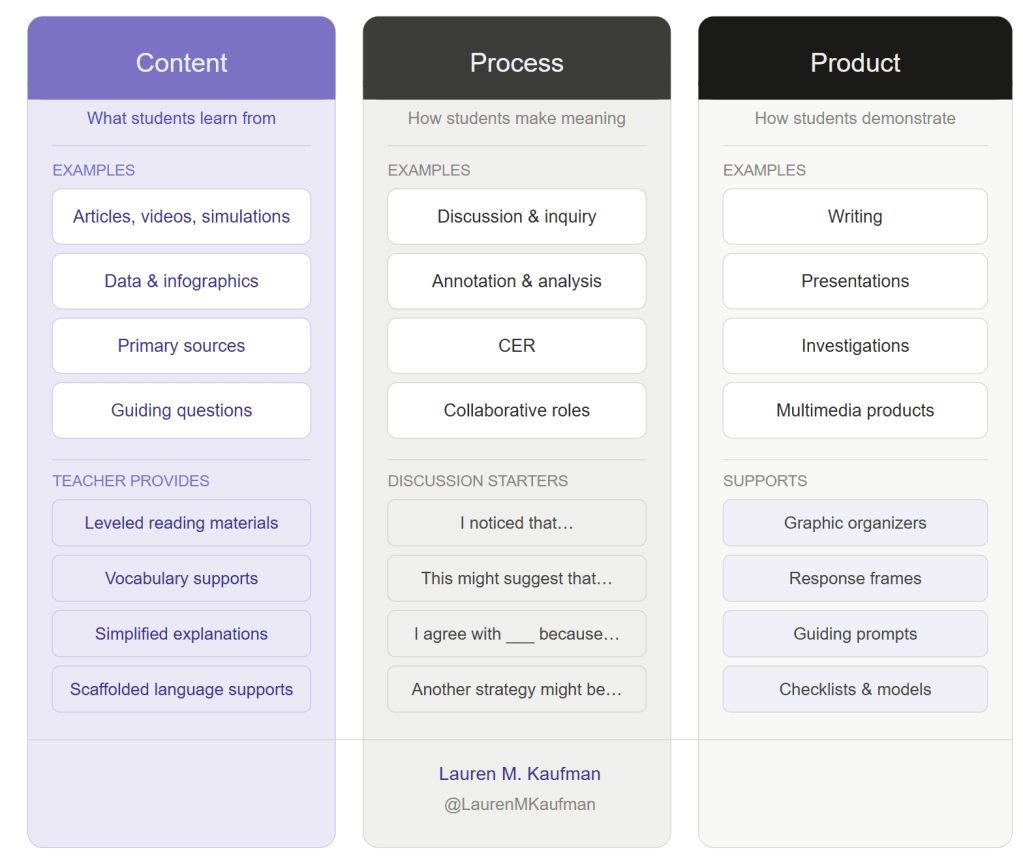
In my recently published Edutopia article titled, A Streamlined Strategy for Differentiating Instruction, I wrote about personalizing learning through differentiating instruction through content, process, and product framework. While this framework is often discussed as a way to personalize learning, I also believe it provides a practical way to move students from consuming information to applying it. The learning goal remains the same. What changes is how students access information, make sense of it, and demonstrate understanding through performance based learning experiences and reflected on them through performance based assessments.
What This Looks Like in Practice
Perhaps that is why I have been so intrigued by the shift occurring within New York State science assessments. The redesigned Earth and Space Sciences Regents includes cluster questions that ask students to analyze multiple sources of information connected to a common phenomenon. Students examine diagrams, data, models, and evidence before drawing conclusions and explaining their reasoning.
When I first looked at these questions, I realized they were measuring something much larger than science content.
They were measuring transfer.
They were asking students to take what they know and use it. That same idea sits at the center of the interdisciplinary writing work our team is creating.
Students begin with an anchor text and engage in a shared learning experience. Teachers model how readers gather information, ask questions, identify evidence, and make connections across sources. From there, students explore a collection of texts, videos, infographics, images, and media sources connected to the same topic.
Now, returning to George Couros’s message in The Innovator’s Mindset that learners should be creators rather than consumers, I am reminded that:
Their task is not simply to consume information. Their task is to make meaning from it.
One structure that supports this work is CER: Claim, Evidence, and Reasoning.
Students develop a claim, support it with evidence gathered from multiple sources, and explain the reasoning behind their thinking.
At first glance, CER may appear to be a writing framework. But it is really a thinking framework.It asks students to analyze. To synthesize. To evaluate. To communicate.
In other words, it creates opportunities for students to do something meaningful with what they know.
It helps make learning matter.
A Simple Protocol for Educators
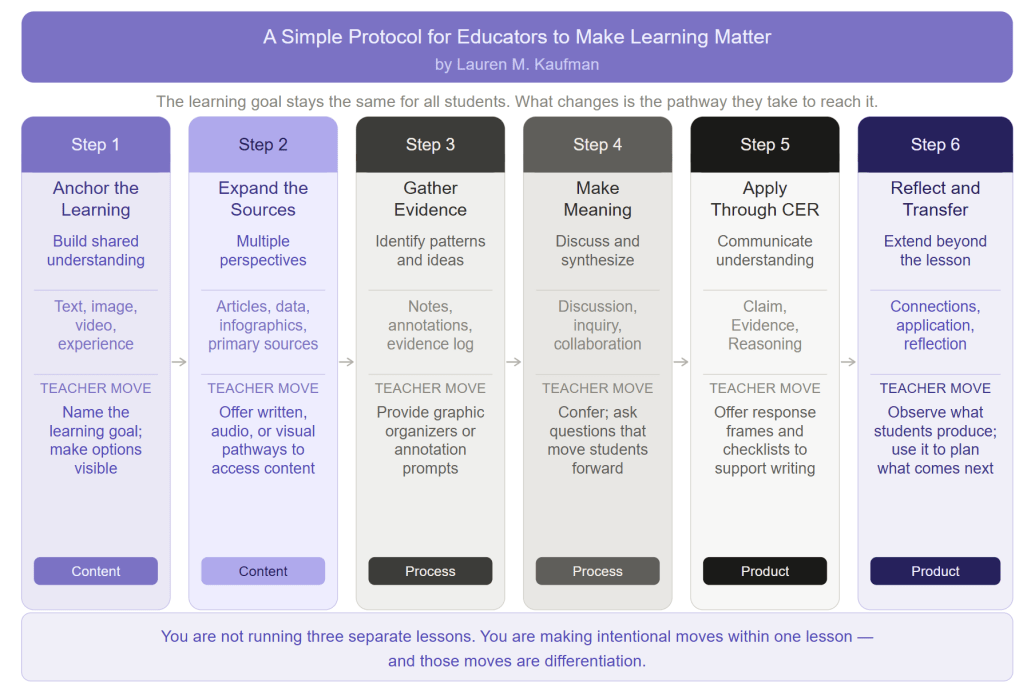
If you are interested in helping students make learning matter and move from consumption to application, consider the following process:
CLICK HERE TO DOWNLOAD THE IMAGE
In many ways, this process creates opportunities for students to demonstrate the competencies found within the Portrait of a Graduate.
They become critical thinkers as they evaluate information and identify patterns.
They become effective communicators as they articulate their thinking through speaking and writing.
They become creative innovators as they generate new ideas from multiple sources.
They become global citizens as they engage with topics and perspectives beyond their own experiences.
They become reflective and future focused as they revise their thinking and consider how learning applies beyond a single task.
And throughout the process, they continue building the academic knowledge necessary to be academically prepared.
When I look at the interdisciplinary writing work our team is creating, the redesigned science assessments, and the competencies outlined in New York State’s Portrait of a Graduate, I see a common thread.
Students are being asked to do more than consume information. They are being asked to analyze, connect, communicate, create, and apply what they know in meaningful ways.
As we continue to design learning experiences, assessments, and opportunities aligned to the Portrait of a Graduate, perhaps the question is not simply:
“What do we want students to know?”
Perhaps the more important question is:
“How often are we creating opportunities for students to do something meaningful with what they know?”
Because perhaps that is how we make learning matter.
Discover more from Empower. Collaborate. Connect.
Subscribe to get the latest posts sent to your email.


Pingback: Turning Classroom Observation into Dynamic Hubs Where Learning Comes Alive – Empower. Collaborate. Connect.