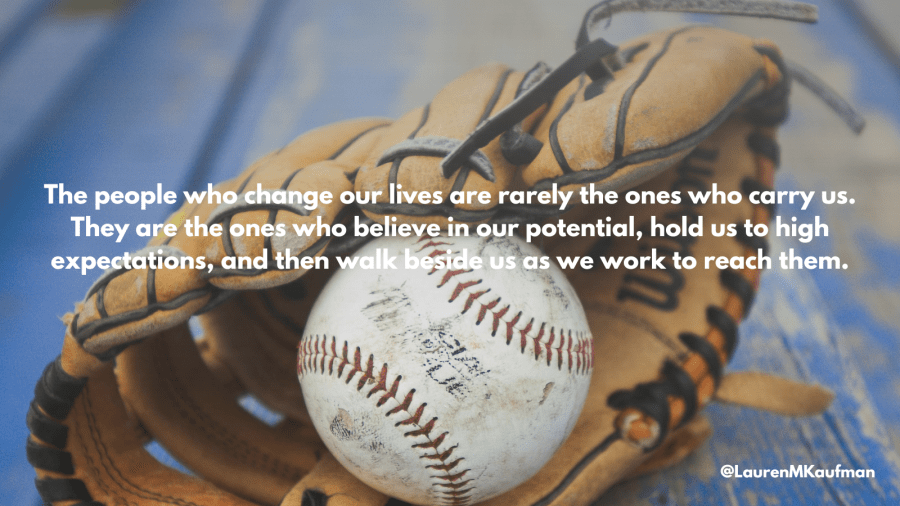
My husband has been coaching our boys in sports for years. He loves baseball. He loved it as a child, played Little League and throughout high school. Like many kids growing up in New York, he idolized Don Mattingly and spent countless hours watching the Yankees.
But perhaps what shaped him most wasn’t what happened on the field. It was what was missing off of it.
His mom worked incredibly hard to provide for him, and his father was not actively involved in his life. Because of those experiences, my husband made a decision long ago that he wanted to be deeply present for our children. Whatever path they chose, he wanted to be involved. As it turned out, sports became a big part of that journey.
When our boys were young, we exposed them to many things including every sport imaginable. My oldest son will be 17 in a few weeks, and my youngest turns 15 this week. Over the years, they played basketball, baseball, travel teams, recreational leagues, and just about every variation in between.
Then one day, my older son called me from his second JV baseball tryout during his freshman year of high school. He told me he wasn’t interested anymore and that his baseball career would end that day. I know my son well and could clearly hear the conviction and confidence in his voice. He went on to say that he had already spoken with the coach and explained that he didn’t want to take a spot from someone who truly wanted to be there. He now wanted to focus exclusively on basketball.
While my husband was heartbroken, I found myself feeling proud. I remember thinking, This kid knows himself and knows what he wants. He knew baseball wasn’t his passion. He knew what he loved, and he was willing to make a difficult decision in order to pursue it.
Maybe that perspective comes from my own upbringing. My dad was an All-State basketball player in high school. He later became the girls’ varsity basketball coach in the same high school where he taught English for 39 years. Basketball was woven into the fabric of our family. We watched games together, I attended the games my dad coached, waved at him from the bleachers, we talked about basketball together, and cheered together watching the Knicks.
As I write this, the Knicks are in the Finals against the Spurs. They’ve already won two games on the road, and I find myself smiling as I watch my boys experience the same excitement I felt as a kid sitting beside my dad.
Although I was more of a theater kid myself (I get that from my Mom), I am always intrigued with how sports has a wonderful way of connecting generations. And now as a “Sports Mom” I can appreciate the way sports can teach some of life’s hardest lessons.
One of the most challenging days I experienced as a parent came when our boys had very different outcomes on the same day. One had something to celebrate, while the other was processing disappointment of his own. As a parent, I wanted to fully honor the joy while also being present for the hurt. It was one of those moments that reminded me how difficult it can be to hold two emotions at once, especially when both belong to people you love.
Brené Brown writes in her book Atlas of the Heart just about the best definition of disappointment I have seen. She shares that disappointment is unmet expectations. That line seems simple right? But, it has always stayed with me because disappointment can be one of the hardest feelings to overcome. And yet, different aspects of life can disappoint us. Events can disappoint us. People can disappoint us. Decisions can disappoint us. Sometimes the outcome does not match the picture we had in our minds or the hope we were holding in our hearts.
That is what can make disappointment so difficult. It can force us to sit in the space between what we wanted and what actually happened. As a parent, that space can feel especially difficult when it belongs to your child.
I remember my husband sitting beside him and saying they would work on his game together. And they did. They spent countless hours practicing, playing in other leagues, and continuing to improve. Eventually, he chose to focus more of his time and energy on baseball, but the lesson stayed with me.
Disappointment hurts, especially when it involves something you care deeply about. But it can also teach us. Sometimes it helps us build resilience, find a new path, and carry lessons forward into life.
That is probably why a conversation my husband and I had this weekend is hitting me particularly hard.
He has been coaching my younger son’s travel baseball team for years and is currently looking for another player to round out the roster. Several boys have tried out and some were clearly not the right fit. I wish I could explain that in greater detail, but I do not know enough about the process to speak to it fully.
Maybe because I still remember what it felt like watching one of my own children walk through disappointment a few years ago. Truthfully, those moments can stay with us as parents long after they have passed for our children.
My husband sees it through a coach’s lens. From what I do understand is that he knows the level at which the team plays. He worries about kids getting hurt when they are not ready to compete alongside players who are throwing harder, hitting harder, and playing at a different level.
But there was one player he couldn’t stop thinking about. This young man didn’t have the strongest technical skills. Yet. But apparently what he did have was work ethic. He had passion. He had grit.
I found myself encouraging my husband to give him an opportunity to practice with the team. He seemed open to the idea. His assistant coach and others involved seemed less convinced.
After we talked about it, I stumbled upon a social media post Sahil Bloom shared from his book, The 5 Types of Wealth. He calls it The High Shoulders Theory. I believe the whole post is worth reading if you have a moment. It is emotional, meaningful, and deeply connected to the way we can think about support, growth, and the people who help us see further than we could on our own.
Bloom references Sir Isaac Newton’s famous quote: “If I have seen further than others, it is by standing on the shoulders of giants.” But he points out something we often overlook.
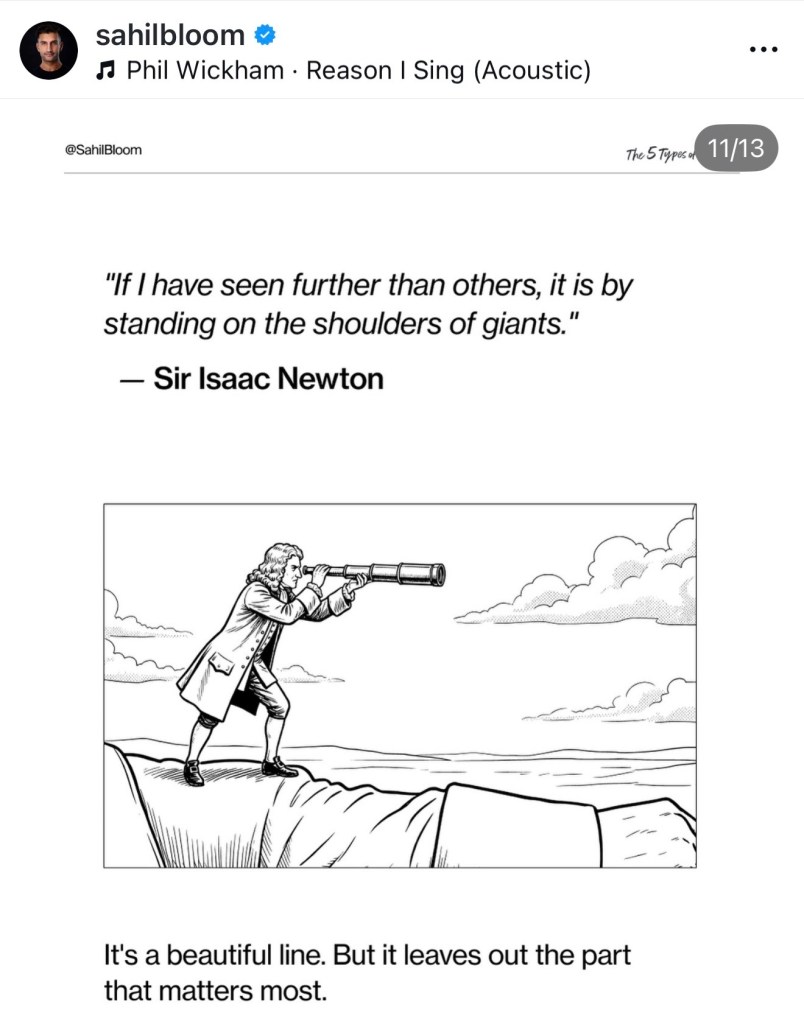
The giants had to bend down first. They had to make themselves available. They had to choose to invest their time, energy, and attention in someone else’s growth.
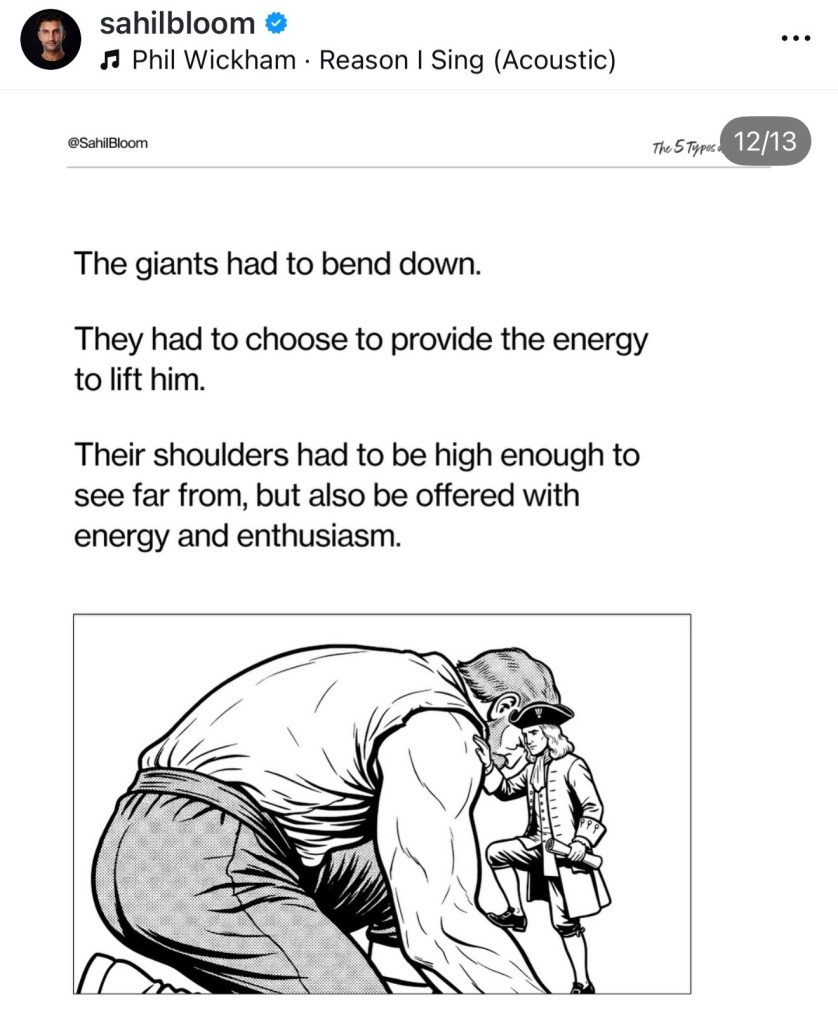
These images are staying with me because they perfectly capture what great parents, coaches, teachers, and leaders do every day. They hold high expectations while simultaneously providing high levels of support.
One without the other is never enough.
As educators, we see this play out constantly.
When expectations are low and support is low, students can disengage. There is little challenge, little encouragement, and little belief that they are capable of more.
When support is high but expectations are low, students may feel cared for, but they are not always pushed to grow. Sometimes we unintentionally lower the level of thinking, remove productive struggle, or do too much for learners instead of helping them develop independence.
When expectations are high but support is low, frustration often follows. Students are expected to achieve more but are not given the tools, feedback, instruction, or guidance necessary to get there.
So, perhaps the sweet spot is where both exist together: high expectations and high support.
That is where growth happens.
In The Innovator’s Mindset, George Couros shares a quote from Dylan Wiliam that captures this idea beautifully: “If we create a culture where every teacher believes they need to improve, not because they are not good enough but because they can be even better, there is no limit to what we can achieve.”
That mindset is not about telling people they are not enough. It is about believing they are capable of more and creating the conditions that help them get there.
We see this in the teacher who believes every student can learn and then provides the instruction, feedback, intervention, and encouragement necessary to help them succeed. We see it in the principal who challenges teachers to grow while also providing coaching, resources, and time. We see it in the instructional coach who asks thoughtful questions while standing alongside teachers through the learning process. We see it in the parent who acknowledges disappointment but refuses to let it define a child and in the coach who sees potential before performance.
As I thought about my husband’s dilemma with the player trying out for the team, I realized that was exactly what he was wrestling with. The easy answer would have been to focus only on where the child is today. The harder question is whether someone is willing to invest in where that child could be tomorrow.
That doesn’t mean every child makes every team. Just as it doesn’t mean every student earns every grade or every teacher receives the same evaluation. High support is not the absence of standards. In fact, it requires standards.
The magic happens when someone looks at another person and says, I believe you can do this, and I am willing to help you get there. This sentiment reminds me of this clip from an interview Adam Grant and Jennifer Garner had together. Garner asks Grant, “Do you have wisdom for one who mentors younger members of a team?” Grant responds, by saying that research shows you can say 19 words and people become dramatically more receptive to what you are about to deliver: “I’m giving you these comments because I have very high expectations and I am confident you can reach them.”
The people who have influenced me most throughout my life were never the ones who simply cheered from the sidelines. Nor were they the people who demanded that I reach my highest potential without helping me reach it. They were the people who challenged me to become more while standing beside me in the process.
As educators, that may be one of the most important questions we can ask ourselves: Are we creating conditions where students experience both high expectations and high support? Are we helping them see farther than they can currently see on their own?
Because every child deserves someone willing to bend down, offer a shoulder, and help them rise. Have you ever watched Rita Pierson’s Ted Talk? She passionately says, “Every child deserves a champion: an adult who will never give up on them, who understands the power of connection and insists they become the best they can possibly be.”
And every one of us can probably point to a teacher, coach, mentor, parent, or leader who did exactly that for us.
When I think about my husband now, I realize that is exactly what he has been trying to do all along. He shows up. He coaches. He encourages. He teaches. He challenges. He stays.
The people who change our lives are rarely the ones who carry us. They are the ones who believe in our potential, hold us to high expectations, and then walk beside us as we work to reach them.
Those are our high shoulders people.
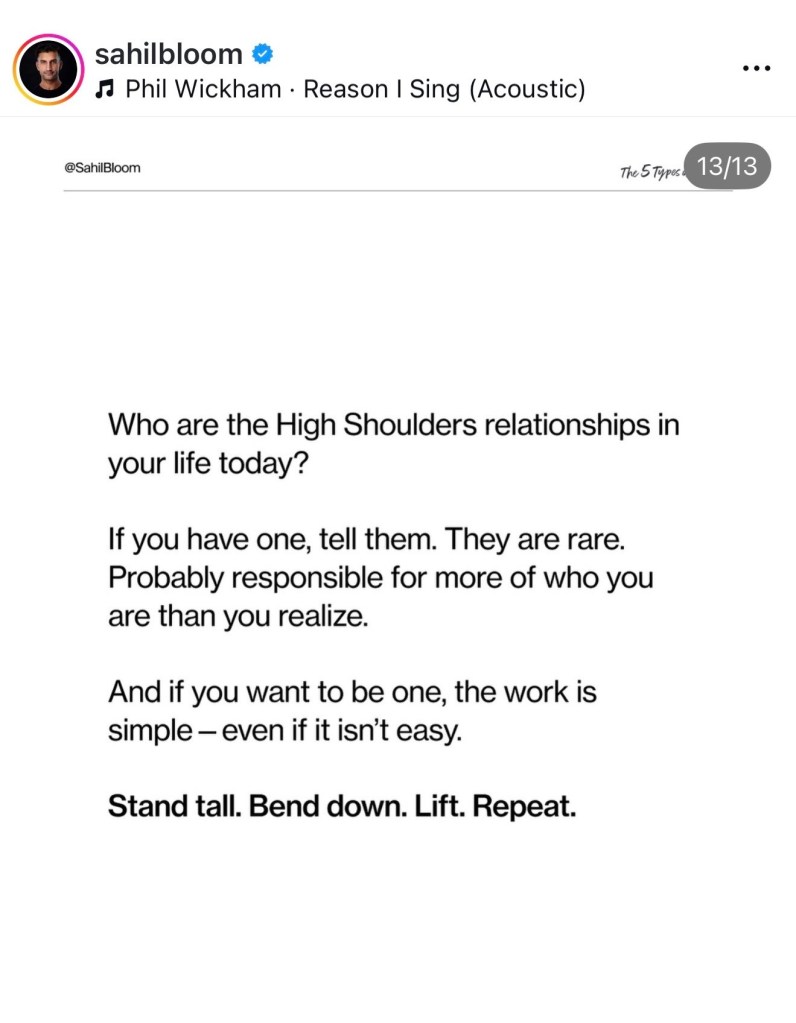
And perhaps the challenge for all of us is not simply to identify them, but to become one. In Bloom’s words:
Stand tall.
Bend down.
Lift.
Repeat.
Discover more from Empower. Collaborate. Connect.
Subscribe to get the latest posts sent to your email.

