This week, I walked into a kindergarten classroom and noticed children helping one another with the writing process. They were sketching, talking, making approximations, and learning together. They have been in school for less than a month and no one had assigned them leadership roles. They simply understood that the people around them could help them think, grow, and move their learning forward.
That moment stayed with me because, throughout the week, I watched different versions of it unfold across our schools.
At a teacher requested lunch and learn, I watched our literacy coaches help teachers unpack the first unit of our new literacy resource. They answered questions, facilitated conversation, and responded to the needs that naturally arise when people are navigating change. The coaches were not waiting for someone else to lead the learning. They recognized what teachers needed and created a space where everyone could make sense of something new together.
At our middle school, teachers worked alongside one another to examine student data and worked together to identify strengths and opportunities for growth. Then, they developed the next steps for instruction to implement right away.
At our high school, teachers shared their knowledge about how to use a few digital tools to more intentionally support student and teacher organization. The conversation that followed was thoughtful and productive. One person’s experience sparked another person’s question, which led to a new idea someone else could bring back to the classroom.
The learning continued in less formal moments, too.
A colleague helped me map out a complicated professional learning schedule. She has a technical way of thinking and sees details and possibilities differently than I do. As we worked, I learned strategies from her that I will carry into future planning.
Our literacy coaches also spent time troubleshooting how to create their next coaching cycle using a modeling structure that would best support teachers as they begin using our new resource. They asked questions, considered different possibilities about how they can maximize their time and get into the most classrooms, and refined their thinking together. There was no perfect answer waiting in the wings. The answer began to take shape because they were willing to think together.
Each experience reminded me that expertise exists everywhere in an organization. The question is: Do we create the conditions for leading to live within our learning ecosystems?
Our Situation
As I reflected on these moments, I found myself thinking about Angela Duckworth’s new book Situated. Duckworth draws our attention to the influence of the circumstances surrounding us: the people, spaces, cultural norms, mentors, and opportunities that shape how we think and act.
She describes “situational agency” as recognizing that we have the power to change our situations for the better. While we cannot control every circumstance, we can make choices about the cultures we build, the people we bring together, and the opportunities we create.
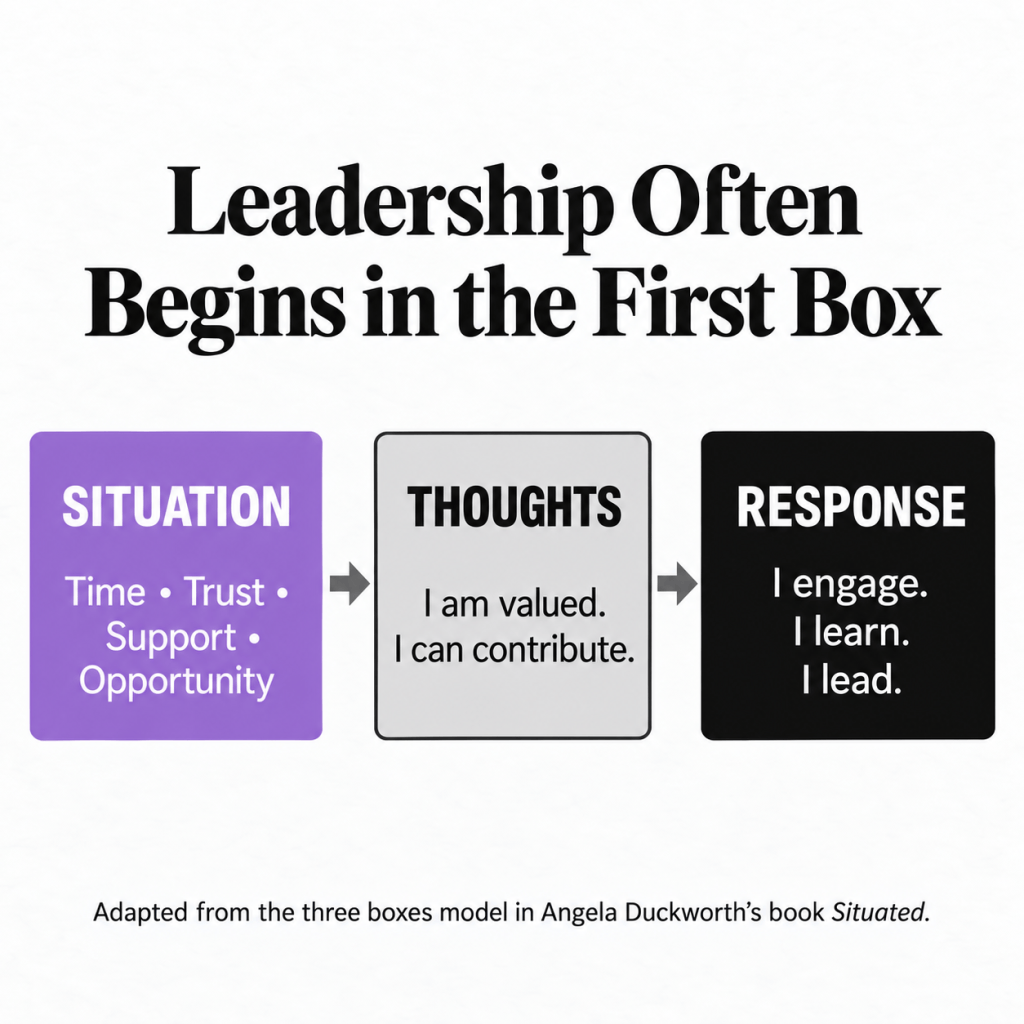
Duckworth illustrates this through three simple boxes: situation, thoughts, and response. Our situation shapes how we think, and our thinking influences how we respond. We often focus on changing someone’s response or encouraging them to think differently. But leaders can intervene earlier. By changing the situation and creating more time, trust, support, and opportunity, we can influence the thinking and responses that follow.
Perhaps leadership often begins in the first box.
I believe this idea has important implications for leadership.
We often encourage people to work harder, be proactive, collaborate, or step into leadership. But effort alone is not always enough. People are more likely to contribute when they know their thinking is valued. They are more willing to take risks when questions are welcomed. They grow more confident when someone gives them an authentic opportunity to lead.
Leaders may not be able to manufacture collaboration, but we can create the conditions in which it is more likely to take root.
We can make time for people to think together. We can invite someone to share an area of expertise. We can create space for questions before offering our own answers. We can connect colleagues who approach a problem differently. Most importantly, leaders can step back without stepping away.
Learning to Step Back
I felt this during an assessment conversation facilitated by one of our literacy coaches. We are making shifts within our assessment suite, and she was guiding teachers through the changes, answering questions, and helping them understand the thinking and process behind the work.
At one point, she looked at me and asked, “Lauren, do you have anything to add?”
I replied, “No. I am just watching you lead a wonderful conversation, and I am learning from it.”
I meant it. It reminded me of how I was given those same opportunities to lead by leaders who opened that door for me, especially when I was a coach.
There are moments when leadership requires us to speak, clarify, and provide direction. There are also moments when leadership asks us to listen, observe, and allow someone else’s strengths to move the work forward.
In her book The Pivot Year, Brianna Wiest writes, “Sometimes all anyone really needs is someone who sees.” Perhaps creating the conditions for others to lead begins there: Seeing what they bring, listening without rushing to solve, and trusting their thinking to move the work forward.
Leaders are learning, too.
We can unintentionally limit an organization’s collective capacity when we believe our role requires us to have every answer or lead every conversation. When we remain curious and listen more than we speak, we begin to notice the knowledge that already exists around us.
Duckworth shares the words of swim coach Nicolas Castel: “Performance is individual. Success is collective.”
That idea captures what I witnessed throughout the week. Each person brought individual knowledge, experience, and perspective, but the learning became more powerful when it was shared.
Moving Forward
This reflection is deeply connected to my own leadership journey and the story I share in my book, The Leader Inside.
My path to leadership did not begin when I received a title. It began when I was a child and people placed opportunities on my path. They recognized something in me before I could fully recognize it in myself. They trusted me to contribute, encouraged me to use my voice, and created situations in which my confidence could grow.
As a struggling reader, I was sent by my fourth grade teacher, Mrs. Roth, to read to younger students in kindergarten classrooms. She could have focused only on what was difficult for me. Instead, she created an opportunity for me to experience myself differently. By trusting me to support younger learners, she helped me begin to see something within myself that I could not yet name.
That moment became part of my path to leadership.
Later, other leaders invited me to sit at tables I never imagined being part of. They trusted me to present my learning, facilitate conversations, and contribute to work that extended beyond the boundaries of my formal role. Those experiences did more than help me develop new skills. They strengthened my confidence and helped me recognize possibilities in myself that I could not yet see on my own.
In The Leader Inside, I wrote: “Gifts live within exceptional educators, waiting to be unwrapped in the right place, at the right time, with the right people.”
Those gifts do not always emerge on their own. Sometimes someone has to notice them. Someone has to extend an invitation, open a door, or create an opportunity. Someone has to say, “I trust you to lead this.”
The people who supported me did not simply tell me I was capable of leading. They created situations in which I could experience myself as a leader.
Now, I recognize the responsibility to create those same opportunities for others.
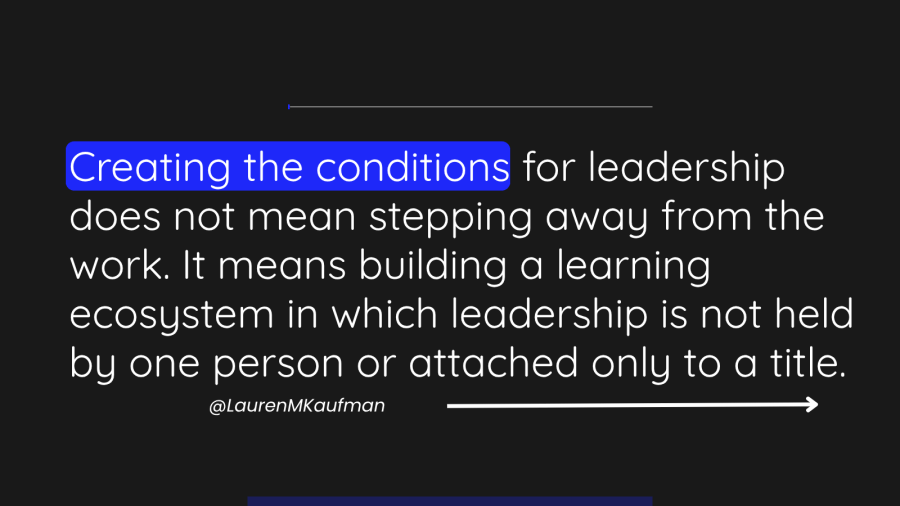
Creating the conditions for leadership does not mean stepping away from the work. It means building a learning ecosystem in which leadership is not held by one person or attached only to a title. It means noticing what people do well, inviting them to contribute, and ensuring they know their knowledge matters.
At the beginning of the week, I watched kindergarten students lean toward one another as they sketched, talked, and made approximations on the page.
Years ago, someone created an opportunity for me to enter a kindergarten classroom and support younger learners. That experience helped me begin to discover the leader inside myself. Now, I find myself returning to kindergarten classrooms as a district leader and witnessing children create those same kinds of opportunities for one another.
That full circle moment means a lot to me.
Those children did not hesitate to share an idea, ask for help, or offer what they knew. Perhaps they already understood something we sometimes forget as adults: learning was never meant to happen alone.
Our role as leaders is to protect that instinct. Great leaders provide time, trust, and space for people to turn toward one another, share what they know, and discover what they are capable of becoming.
That is what becomes possible when everyone leads the learning.
Three actionable ideas leaders can implement tomorrow:
- Invite Someone to Lead
Ask a colleague to facilitate, model, or share an area of expertise. - Step Back and Listen
Pose a thoughtful question and create space for others to shape the conversation. - Name a Gift and Open a Door
Tell someone the strength you see in them and offer a meaningful opportunity to use it.
Discover more from Empower. Collaborate. Connect.
Subscribe to get the latest posts sent to your email.


I love this philosophy. I believe that leaders can learn so much from listening to those around them instead of constantly taking charge and leading a conversation. This mindset is valuable and could be a great strategy to encourage in young students to carry with them through the rest of their lives.
LikeLiked by 1 person
Thank you so much for taking the time to read and share your insights! I appreciate it!
LikeLike