If there is one thing we know about education, it is that there is always something new to navigate. The world continues to evolve, and so do the skills learners need to thrive within it. In every year I have served as an educator, something has felt a little different. Priorities shift, new possibilities emerge, and our understanding of teaching and learning continues to deepen.
Yet through all of those shifts, some things remain steadfast: the foundational skills students need and our commitment to the students and communities we serve. Literacy, in particular, is an area I am deeply passionate about and have devoted much of my career to.
In Forward, Together, George Couros reaffirms the importance of that foundation: “Basics are the foundation for the skills that are critical for our success and innovation in today’s modern world.”
This perspective is an important reminder that creating broader opportunities for students to demonstrate their learning does not mean moving away from the basics. It means giving students more opportunities to use them.
I have also watched my own children, who are both in high school, navigate changes in education. My oldest son is a senior, and my younger son is a sophomore. It has been fascinating to teach and lead in education while experiencing the system through their eyes.
My oldest son would have benefited greatly from more opportunities to demonstrate his learning in different ways, while my younger son will likely benefit from this transition. Both thrive when they can show what they know through approaches that extend beyond standardized assessments. At the same time, I recognize that other students thrive when taking a standardized assessment. I honor both experiences. Together, these experiences raise an important question: How might a more balanced system create opportunities for different strengths to become visible without elevating one way of demonstrating learning over another?
That personal perspective has stayed with me as I reflect on the direction New York State is taking through NY Inspires and what it may mean for teaching, learning, and assessment.
In her message about NY Inspires, Commissioner Betty A. Rosa acknowledges the important role Regents examinations have played in providing a common statewide measure of student learning. She also explains that the world students are preparing to enter requires a broader range of knowledge and skills, including critical thinking, communication, collaboration, technical expertise, and adaptability.
Statewide assessments will continue to provide important information about student achievement. At the same time, New York is moving toward a multiple-measures approach that recognizes rigorous coursework alongside other meaningful demonstrations of learning.
Between that direction and its implementation, however, I see important space for learning, conversation, and thoughtful design. That is the space many school districts have already begun navigating.
The larger vision asks us to consider how we can help students graduate academically prepared and ready to apply their learning in thoughtful and meaningful ways. As we build learning experiences that make those abilities visible, perhaps the first question is not, “What performance tasks should we create?” but:
What should every student know, be able to do, and be prepared to demonstrate at different points in their learning journey?
George Couros has encouraged educators to reflect on questions like this for years. In his best-selling book, The Innovator’s Mindset, Couros challenges us to move beyond doing things simply because they have always been done that way and to create better learning experiences for students than the ones we may have experienced ourselves.
He writes, “With access to a plethora of digital resources and information, it’s important to foster a culture of creation versus consumption.” That idea was relevant then and feels even more relevant now.
Knowledge remains essential. Students need something meaningful to think about, draw upon, and work with. But learning also becomes visible when they are asked to use that knowledge to create, solve, investigate, explain, make decisions, and communicate their understanding.
This also raises questions about how these skills develop over time, across classrooms, content areas, and grade levels.
Rather than turning every learning experience into an elaborate project, we can look carefully at where students are already being asked to do more than recall information.
- Where are they applying their learning?
- Where are they solving problems, making decisions, or explaining their thinking with evidence?
- Where are they creating, presenting, investigating, revising, or transferring what they have learned?
These questions also help us recognize what is already happening in our schools. My colleagues and I have already begun exploring and implementing performance-based learning and assessment, and many of the essential elements of this work are already in place.
I can speak personally to the work I have done alongside our secondary English teachers. Together, we have been thinking about how students can layer their learning by engaging with a variety of sources, including written texts, visuals, and media, and then synthesizing that information to demonstrate their understanding in different ways.
Our teachers have shared some fascinating observations. In several of these experiences, students who typically thrive on standardized assessments encountered greater cognitive struggle when asked to apply their learning through a more open-ended performance task.
At the same time, some students who have historically struggled with standardized assessments began to shine. They approached the task with confidence, drew upon different strengths, and even helped guide their classmates through the process.
I found this both fascinating and reaffirming because it reflects something I have long believed about learners: the way we ask students to demonstrate their understanding can influence whose strengths become visible.
Of course, none of this is entirely new. Educators have been creating opportunities for students to apply knowledge, solve problems, and demonstrate their learning in meaningful ways for years.
Taken together, these observations reinforce the value of a balanced system, one that recognizes the distinct purposes of different assessments and allows students to build knowledge, apply it, and demonstrate their learning in increasingly complex and independent ways.
Dr. Mary Hemphill captures this balance in her new book, Future-Proof: “Standardized assessments will continue to exist, and leaders must navigate them with clarity. They are one measure, not the full measure.”
That framing reflects the heart of a multiple-measures approach: no single assessment can tell the full story of what a student knows and can do.
As you examine the continuum below, consider how different forms of assessment can work together within a balanced, multiple-measures system, each serving a distinct purpose while supporting deeper learning:
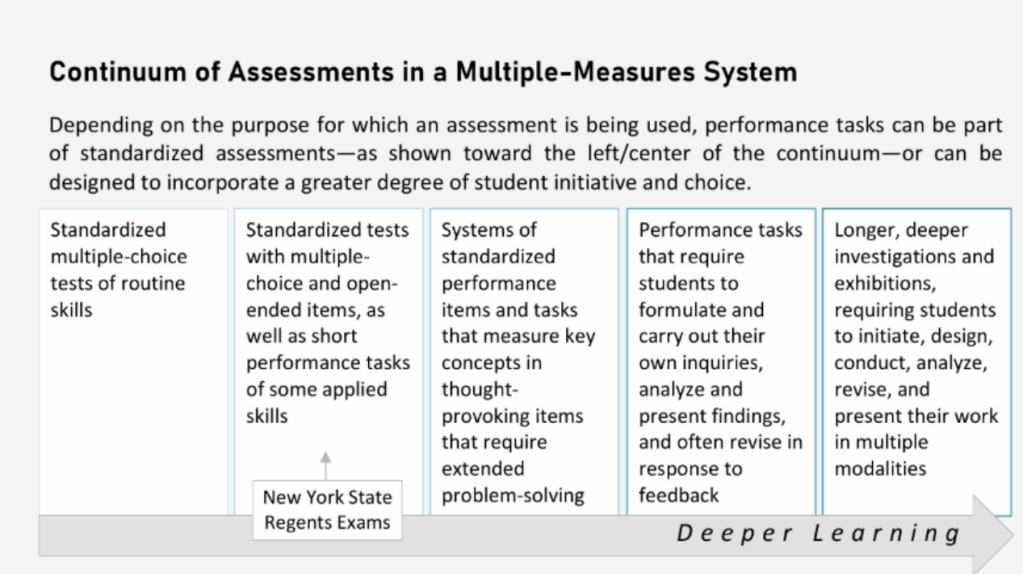
Continuum of Assessments in a Multiple-Measures System
Elements of this work are already taking shape across our classrooms. Our curriculum leadership teams have begun mapping where performance-based learning might strengthen existing units. I have continued exploring these possibilities through curriculum work completed with teachers this summer, which will be implemented during this school year.
As I continue exploring these possibilities, I find myself returning to a few important questions:
Where are students building knowledge and practicing skills? Where are they applying that learning? Where are they working more independently or transferring their understanding to a new situation?
The goal would be to identify what should remain, what could be strengthened, and where one or two existing learning experiences might become more performance-based.
Sometimes what matters most is not adding something new, but seeing more clearly what is already there.
As we consider this work, there are important questions to explore. How do we maintain academic rigor while offering students multiple ways to demonstrate learning? How do we establish shared expectations while preserving meaningful opportunities for creativity and choice? What time, collaboration, and professional learning will educators need?
These are questions worth continuing to explore as this work evolves.
These questions have also led me to think more deeply about content and how we ensure that every student receives what they need and deserve. How do we build performance-based learning upon strong content instruction? How do we provide every student with access to the knowledge, materials, technology, guidance, and support needed to succeed? And how do we design each experience to provide authentic evidence of what an individual student knows and can do?
Moving Forward
In Forward, Together, George Couros extends the conversation from creating better learning experiences to considering how communities can build the direction together.
He writes, “When people feel heard, they are more likely to commit. When they help build the direction, they are more likely to walk the path.”
That feels like an important reminder for the work ahead.
NY Inspires is helping to establish a direction while also inviting us to consider how that direction might come to life within our own educational communities. Perhaps this work is strongest when it creates opportunities to listen to educators, students, families, and communities; recognize the meaningful work already underway; ask thoughtful questions; and build shared ownership of what comes next.
In my own educational community, I am continuing to work through these ideas with curiosity, openness, and a willingness to learn together. That is why I keep returning to the space between direction and design.
It is not an empty space waiting to be filled. It is already rich with questions, experience, promising practices, and educators who care deeply about what students know and what they can do with that knowledge.
It is where we listen, notice what is already working, appreciate how far we have come, and imagine what might come next.
Perhaps this is exactly where the work belongs.
Ready to Make It Actionable?
I am always interested in actionable ideas that can be implemented right away. CLICK HERE to explore a few small moves that can help bring this work to life in the classroom.
Discover more from Empower. Collaborate. Connect.
Subscribe to get the latest posts sent to your email.


This is quite an article. I think it’s an article that every educator should read. I think the article is the foundation for a workshop with a variety of groups, including parents, administrators, and perhaps even the Board of Education
LikeLiked by 1 person
Thank you for your unwavering support and uplifting feedback. It is so appreciated!
LikeLike