Can you relate to the feeling of wanting to be in two places at once?
The first few weeks of school can feel like a whirlwind. There is the anticipation of a new year, the excitement of seeing colleagues and students, and the pressure of trying to navigate personal and professional responsibilities well.
As a district leader working across a K–12 continuum, there are times when I simply cannot be in all of the places I want to be.
That happened during our first few days of school.
I needed to help launch a new literacy resource with our primary and elementary teachers and leaders while, at the exact same time, our Middle School and High School English Department was scheduled to meet.
Both mattered. Both needed thoughtful leadership. And I could only physically be in one room.
So what did I do?
I thought back to the opportunities I had been given as a teacher…opportunities that helped build my confidence, stretch my thinking, and develop the leader I was becoming.
So, I distributed leadership. I leaned on our lead teachers.
In many ways, I wanted to do for others what other leaders had so generously done for me: create space, offer trust, and give them the opportunity to lead.
But I also knew that asking them to facilitate the meeting could not mean simply handing them a list of topics and hoping for the best.
Around the same time, I was slowly reading Made to Stick by Chip and Dan Heath. In the chapter on simplicity, they focus on the importance of finding the core. One line that stayed with me was:
“When you say three things, you say nothing.” And that made me think about meetings.
It is so easy to keep adding one more topic, one more slide, one more announcement, one more thing people need to know.
Before long, the most important message can get buried.
So I asked myself a different question:
What absolutely needed to happen in this meeting?
From there, I built backward. I started with two intended outcomes:
To strengthen shared understanding of key English Department expectations and priorities for the year ahead.
To reflect on the experiences we want students to have consistently in our English classrooms and identify concrete ways our practices, texts, and structures can help create those experiences.
Those outcomes became the filter for the entire meeting.
Then I created the structure. There were several priorities that needed to be addressed: Portrait of a Graduate, Professional Learning Opportunities, Google Classroom and communication expectations, syllabus expectations, and time for our Middle School and High School teachers to review their novel documents (texts they teach and why)…but I also wanted to make sure the meeting created space for reflection, not just information. So we opened with a reflective prompt about what had “stuck” with us from our own educational experiences and closed by inviting teachers to share what they hoped students would experience consistently in their classrooms this year.
I timestamped the meeting to help keep the pace moving, without making the timing feel rigid. From there, I created the slides, embedded live links to the resources they would need, prepared folders with materials, and wrote the reflective prompts that would guide the conversation.
Most importantly, I made sure the lead teachers understood the purpose behind each section, not just what came next.
That mattered.
The goal was never to create a script. It was to make the destination clear enough that they could lead with confidence, make decisions in the moment, and bring their own strengths to the meeting.
In Made to Stick, the Heath brothers describe the idea of Commander’s Intent: people need to understand the goal clearly enough that they can make decisions even when circumstances shift.
That is what I wanted for this meeting. And then I had to trust.
In my book The Leader Inside, I wrote:
“Leadership is not a title, but an opportunity to recognize the greatness that lives inside others.”
This was one of those moments when I had to live that belief. And the feedback was that the meeting went quite well without me in the room.
It was shared that meaningful conversation was sparked between teachers. They reflected, clarified expectations, worked together, and moved the work forward. If there were any lingering questions, I addressed them afterwards.
That mattered more to me than whether every slide was delivered exactly as I might have delivered it. Because distributed leadership is not about replication. It is about clarity, trust, and creating the conditions for others to lead.
Something to Try Tomorrow
If you are a leader trying to be in two places at once, here are five things you can do right away:
- Find the core. Ask: What absolutely must happen?
- Name the outcome. Be clear about what you want people to understand, experience, or accomplish.
- Build the path. Create the agenda, timestamps, links, prompts, and resources people need.
- Clarify the intent. Make sure people understand why the work matters, not just what to do next.
- Trust the people. Give them enough structure to lead, then step back.
At the beginning of this post, I asked how leaders can possibly be in two places at once when there is only one of us.
Maybe we cannot. And maybe that is not actually the goal.
Perhaps the better question is:
How can we create enough clarity, structure, and trust that meaningful work continues even when we are not in the room?
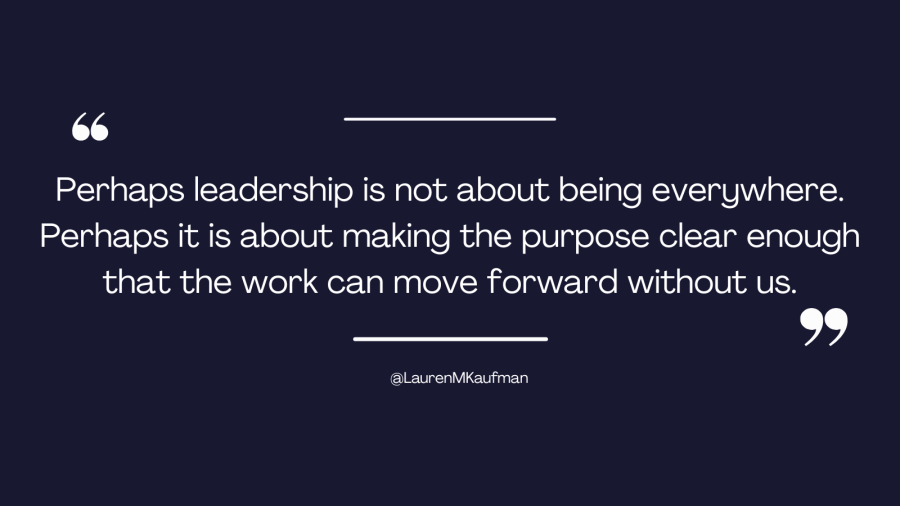
Because perhaps leadership is not about being everywhere.
Perhaps it is about making the purpose clear enough that the work can move forward without us.
Discover more from Empower. Collaborate. Connect.
Subscribe to get the latest posts sent to your email.

