What sticks with people long after an interaction with us has ended?
Last weekend, I visited a store I frequent. The person who usually helps me was busy with another customer. We made eye contact, and I could tell she was disappointed that she couldn’t help me. But I understood completely. Why shouldn’t someone else benefit from the help of someone so generous?
Within moments, another person rushed over to me.
“I know I don’t usually help you, but I would love to today if you’d like.”
“Of course,” I replied.
And then I asked her name.
“Aimee.”
Before I knew it, Aimee had done an outstanding job helping me find exactly what I needed. At the end of our exchange, I thanked her.
“Thank you, Aimee. You were absolutely incredible.”
Her face transformed into a tremendous smile. She looked genuinely surprised.
“I can’t believe you remembered my name.”
I was grateful I remembered her name. But her reaction is what stayed with me.
Something so small. Something that required almost no additional time or effort. Yet somehow, it mattered.
Fast-forward a few days to the first formal day back in my school district. I was greeting some of the new teachers I had met the week before at New Teacher Orientation. There were many new faces, and I’ll admit that I didn’t remember every name.
But I remembered a few. And that meant something.
When I greeted those teachers by name, I noticed something familiar: the reaction.
A smile. A little surprise. That moment of recognition that seemed to say, You remembered me.
It brought me right back to Aimee.
Then later in the week, a colleague sent me a text thanking me for a shout-out I had given her and her team during professional learning with more than 100 teachers and administrators. I had acknowledged the success of their curriculum implementation and shared how much we had learned from their experience as we navigated our own literacy pilot and now implementation.
To me, the acknowledgment came naturally. Their work had helped us. Why wouldn’t I name that?
But she told me that hearing it publicly meant the world to her.
Three moments. Three different settings. And one common thread.
People want to know that we see them.
In Made to Stick, Chip and Dan Heath challenge us to find the “essential core” of an idea. They remind us that simplicity does not mean stripping an idea of its meaning. Sometimes the simplest ideas can be the most profound.
So, maybe there is an essential core here for leadership, too.
Remember the name. Acknowledge the contribution. Give the credit. Say the thank you. Turn the light toward someone else.
As George Couros reminds us, “When you have the spotlight shining on you as a leader, the best thing you can do is turn it around to shine that light onto others.”
This idea has always resonated with me. In my book The Leader Inside, I write about leadership as something that is not reserved for a title or position. Leadership lives in the choices we make every day and in how we choose to show up for the people around us.
Sometimes those choices are significant and visible. But I’m increasingly convinced that some of our most meaningful leadership happens in moments that could easily go unnoticed.
A name remembered. A contribution acknowledged. A spotlight redirected. A person reminded that what they did mattered.
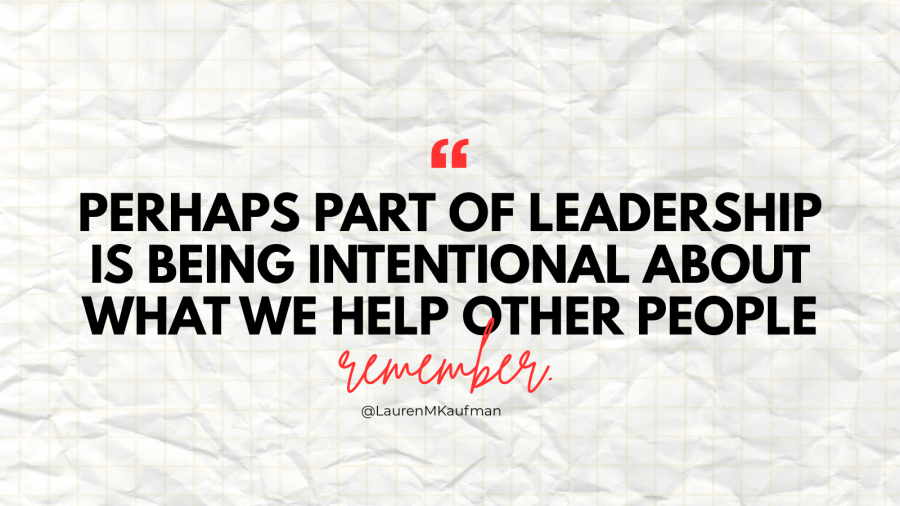
Chip and Dan Heath write, “What sticks is what we remember.” But I keep thinking about the other side of that idea. Perhaps part of leadership is being intentional about what we help other people remember.
And then, as I was writing this very reflection, my phone buzzed. It was another text.
This time, a colleague was reaching out to me after a day spent launching our new literacy resource with teachers. She thanked me for the work that had gone into organizing the day and getting the implementation off the ground.
And then she wrote something that made me smile: “I appreciate all of your hard work and just know it doesn’t go unnoticed.”
I had to smile at the timing. Here I was writing about Aimee. About our new teachers. About my colleague whose work I had acknowledged. About the importance of making sure people know that their contributions matter.
And in that exact moment, someone had done the same for me, and I felt it. It reminded me that this isn’t really about leaders recognizing others. It is about people recognizing people.
No matter our role, our title, or how long we have been doing the work, there is something powerful about another person taking the time to say: I see you. I noticed what you did. It mattered.
Maybe that is what I have been trying to understand through all of these moments.
Aimee may not remember everything about our interaction last weekend. Those new teachers may not remember everything that was shared during orientation. My colleague may not remember every slide from a professional learning session with more than 100 people. And eventually, I may not remember every detail of the day that prompted that text.
But perhaps what sticks isn’t simply that someone remembered. What sticks is the feeling of knowing that someone noticed.
A name remembered. A contribution acknowledged. An effort noticed. A light turned toward someone else.
I began by wondering what sticks with people long after an interaction with us has ended.
I think I’m beginning to understand.
Discover more from Empower. Collaborate. Connect.
Subscribe to get the latest posts sent to your email.

