I have a routine…Every morning, I read a few pages from a book to spark my thinking and frame my day. Recently, I returned to The Pivot Year by Brianna Wiest and paused at this line:
“Comfort becomes a vice when what’s familiar becomes the only thing that feels possible.”
As a district leader planning for the upcoming school year, I have been thinking about how easily professional learning can become familiar. Leaders can identify a need, choose a topic, create a presentation, and deliver the learning to teachers.
Sometimes this is necessary. New resources, instructional practices, and district priorities require clarity and consistency. But when this becomes the only way we imagine professional learning, we may overlook the questions, experiences, and expertise already living inside our schools.
What might become possible if we asked teachers what they need before deciding what they should learn?
Designing and creating meaningful, relevant professional learning is a big part of my role as a curriculum leader and recently, a colleague sat in my office and began sharing some exciting ideas for professional learning experiences we could create for teachers this year. The ideas were thoughtful and connected to important priorities. The possibilities were endless and we were getting excited just thinking about them.
As we talked, I had to interrupt the conversation. “Our teachers absolutely need to be part of this.” I shared. “Not only as participants, but as partners in shaping and leading the learning.”
She couldn’t agree more. And when I think back to my 15 years in the classroom before I stepped into a building leadership and now district leadership role, I remember that the most successful professional learning experiences were the ones where I felt equipped, empowered, supported, and trusted to tell our leadership what I needed. Being told what I needed was not always the most impactful answer although I do understand that there are certain district priorities that need to be addressed.
To this day, I am the kind of learner who wants to take ownership of my professional growth because I usually have a strong sense of what I need. I am also not a fan of others assuming what those needs are.
I feel so strongly about this that, a few years ago, I co-wrote an Edutopia article with Stephanie Rothstein titled Taking Control of Your Professional Growth. In it, we wrote:
“With so many professional learning mandates handed down by schools, districts, and states, finding ways as educators to take some control of this process can help make professional learning personal.”
I believe that teachers and leaders need opportunities to name what they need, identify the challenges emerging in their classrooms and school systems, share the practices that are working, and learn from colleagues across grade levels, buildings, and content areas.
In a previous district, I led a mentor program that spotlighted the work happening inside classrooms and created opportunities for teachers to learn from one another. The learning felt relevant because it came directly from the real work of teaching. I have carried that idea with me ever since and continue to find great joy in highlighting the work of others and cross pollinate those ideas.
One leadership habit I am committed to continue to practice intentionally is listening before deciding.
For example, during our elementary literacy pilot process, which was multifaceted, layered, and very complex, we gathered perspectives from teachers, students, families, administrators, and coaches. We also studied classroom visits, student work, surveys, and site visits. We slowed down long enough to listen for patterns and understand how the work would actually live inside classrooms.
The process mattered as much as the final decision because it built shared understanding, trust, and ownership.
The same should be true of professional learning. Before planning the next experience, leaders can ask:
Where are you feeling confident?
Where are you feeling uncertain?
What are you noticing in student work?
What support would help you take the next meaningful step?
What are you doing that others could learn from?
Listening does not mean abandoning the vision. Leadership still requires clarity, coherence, and focus. But a vision becomes more sustainable when it is shaped with the people responsible for bringing it to life.
This year has also reinforced the importance of staying close to the work. Implementation does not happen in theory. It happens in classrooms, planning conversations, small decisions, moments of uncertainty, and the support teachers receive along the way.
As I shared in a recent talk, when leaders stay close to classrooms, professional learning becomes more practical, more responsive, and more of a shared responsibility—one where ownership can truly take flight.
A walkthrough trend can become a short learning cycle. A teacher question can lead to co-planning. A strong classroom practice can become a lab site or intervisitation. A challenge with a new resource can lead to modeling, co-teaching, or side-by-side coaching.
A student work sample can also become the starting point for meaningful professional learning. Rather than looking at data from a distance, teachers can place student work at the center of the conversation and ask: What does this student understand? Where is the thinking breaking down? What patterns are we noticing across the class? What might this work be telling us about our instruction? From there, teachers can identify a specific next step, co-plan a response, try a strategy, and return to new student work to see what changed. In this way, student work becomes more than evidence of learning. It becomes a tool for reflection, collaboration, and instructional decision-making.
The goal is not simply to provide more professional learning. It is to create the right support at the right time.
Peter DeWitt’s Education Week article, Does Self-Efficacy Really Matter?, adds another layer to this thinking. He shares John Hattie’s definition of self-efficacy as:
“The confidence or strength of belief that we have in ourselves that we can make our learning happen.”
That belief matters for the adults in our schools, too.
When teachers are consistently positioned as recipients of professional learning, the experience can begin to feel like compliance. When they are invited to identify needs, contribute ideas, model practices, reflect, solve problems, and lead, we strengthen their confidence and the collective capacity of the organization.
DeWitt reminds us: “If leaders truly want to see students meet their full potential, then they need to have teachers that reach their full potential as well.”
Teacher voice should not be something we add after the learning has already been designed. It should help shape the learning from the beginning.
This can happen through lab sites, intervisitations, co-planning, short coaching cycles, student work analysis, teacher-led sessions, and reflection conversations. These structures make professional learning job-embedded and connected to what teachers and students are actually experiencing.
As I wrote in my book The Leader Inside: “Leadership is not a title, but an opportunity to recognize the greatness that lives inside others.”
Perhaps one of our greatest responsibilities as leaders is to recognize what teachers already know, remain curious about what they need, and create the conditions for their expertise to move from one classroom to another.
So, as you plan for the upcoming school year, I return to the question:
What might become possible if we asked teachers what they need before deciding what they should learn?
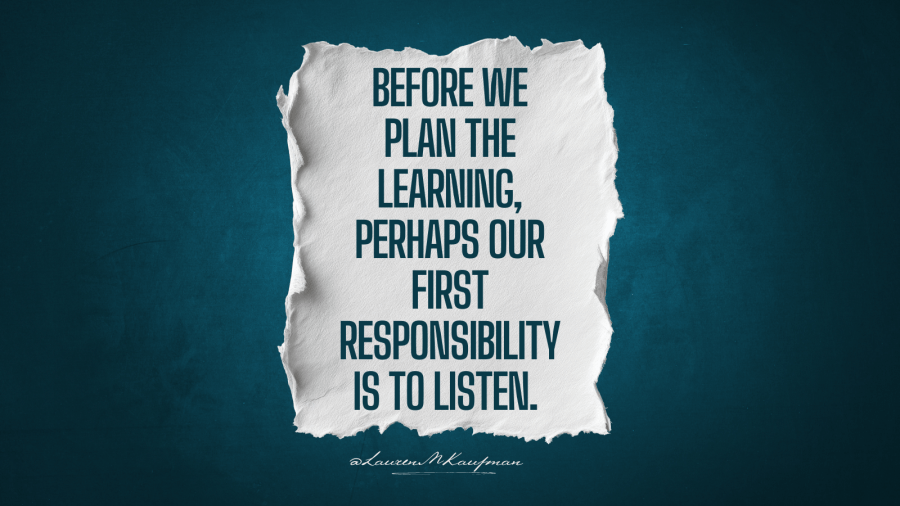
Before we plan the learning, perhaps our first responsibility is to listen.
When we do, we strengthen teachers’ confidence, deepen their ownership, and recognize that much of the expertise we need may already be in the room.
Discover more from Empower. Collaborate. Connect.
Subscribe to get the latest posts sent to your email.


Well done! Really well done! Such a gift to receive your blog!Sent from my iPhoneOn Jul 17, 2026,
LikeLike
Thank you always… I appreciate you so much!
LikeLike