Who recognized a gift in you that you could not yet see in yourself?
Not the accomplished version of you.
Not the leader you have grown into.
Not the title you hold today.
But the earlier version.
The person you were.
Take a moment. Really take a moment.
Picture that person.
Because someone did.
There’s a quote by Dr. James Rouse that I often come back to:
“Imagine all of the past versions of yourself –standing right in front of you. They are smiling– looking back at you… They are so proud of you.”
We don’t arrive where we are on our own.
There are people placed along our path who help shape us, often before we fully understand who we are becoming.
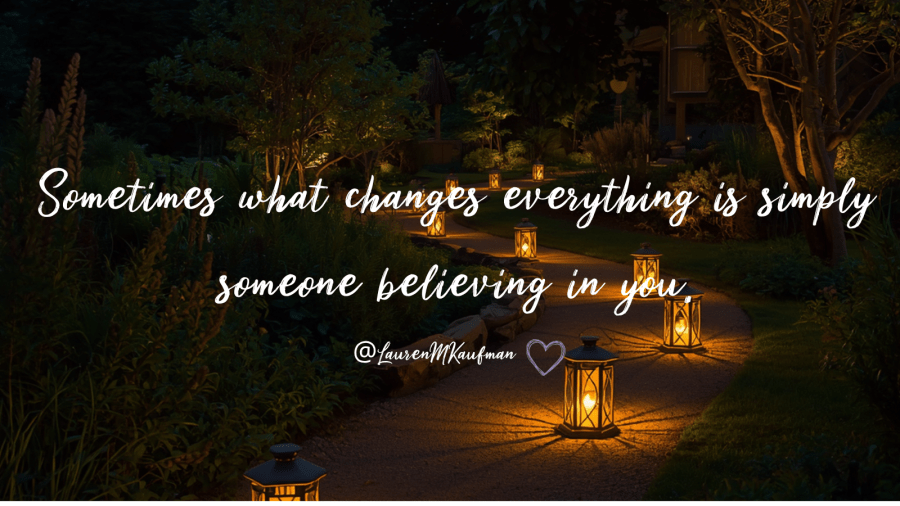
When I think about mentorship, I don’t think about titles or formal roles. I think about people who are like lanterns placed along our path, lighting the way just enough for us to take the next step.
Not the entire journey.
Just the next step.
And that is enough.
There is a moment that I have been thinking a lot about lately. It’s the moment before something happens. The moment before we take a risk. Before we speak up. Before we try something new.
It’s often not loud. Sometimes uncertain. And it’s often where mentorship matters most. Because that is the moment when someone can help us see what we cannot yet see in ourselves.
The People Who Help Us Become
In my book The Leader Inside, I wrote:
“Gifts live within exceptional educators, waiting to be unwrapped at the right place, at the right time, with the right people.”
I believe that deeply because I have lived it.
As a young student, I struggled with reading. I doubted myself. Leadership was not something I saw in my future. But there were people placed on my path who saw something in me before I had language for it. And I know that young, school-aged Lauren would be surprised by the path she would eventually take.
One of those people was my fourth grade teacher, Mrs. Roth.
She didn’t hand me a roadmap. She didn’t script my entire future. She simply illuminated something.
As a struggling reader, she would send me to the kindergarten classrooms so I could build my confidence reading to younger students. In those moments, she wasn’t just teaching me to read. She was helping me see myself differently.
Years later, when I began pursuing my leadership journey, I reached out and asked if she would mentor me. She didn’t hesitate. She said yes.
And now, decades later, we still speak regularly. She even wrote a chapter with me in my book The Leader Inside, which makes that connection even more meaningful.
Looking Back to Move Forward
In his book Forward, Together, George Couros writes:
“After all, isn’t true growth measured by our ability to look back on who we were and appreciate how far we’ve come?”
That idea stays with me.
Because when I think about Mrs. Roth, I don’t just think about who I was in fourth grade. I think about the distance between that version of me… and who I am still becoming. And I realize something important. Growth did not happen in isolation. It happened because someone saw something in me first.
The Lanterns We Don’t Realize We Are
A few months ago, I was sitting at my son’s basketball game with my dad.
My son now plays in the same high school where I went… the same school where my dad taught English and coached girls varsity basketball for 39 years.
Thirty-nine years.
While we were waiting for the game to start, I noticed a woman making a beeline toward him. During halftime, she approached us, gently tapped him on the shoulder, looked him in the eye, and said, “Hi, Mr. E.”
I could see a brief moment of uncertainty cross his face. After nearly four decades of teaching, there have been so many students. He smiled warmly and asked her name.
“It’s Wanda,” she said. “I played on your girls varsity basketball team. You changed my life. You believed in me. You kept me focused.”
I felt myself getting emotional watching the exchange. Then she turned to me. “I remember you,” she said. “You used to sit in the bleachers watching him coach the way you’re watching your son now.”
She shared how his expectations and belief helped keep her in school and shaped who she became. In that moment, I realized something simple and profound.
My dad lit the path for her and for so many others. That is mentorship.
What Mentorship Really Is
In Forward, Together, George Couros shares a short video clip titled “Girl’s First Ski Jump.”
In it, a young girl stands at the top of a ski hill for the first time. You can hear the fear in her voice as she imagines everything that could go wrong. Beside her is someone who has done this before. Someone who remembers exactly what it feels like to hesitate at the top.
She isn’t pushed. She isn’t rushed. She is guided.
That video stayed with me.
And it brought me to another image I’ve been thinking about.
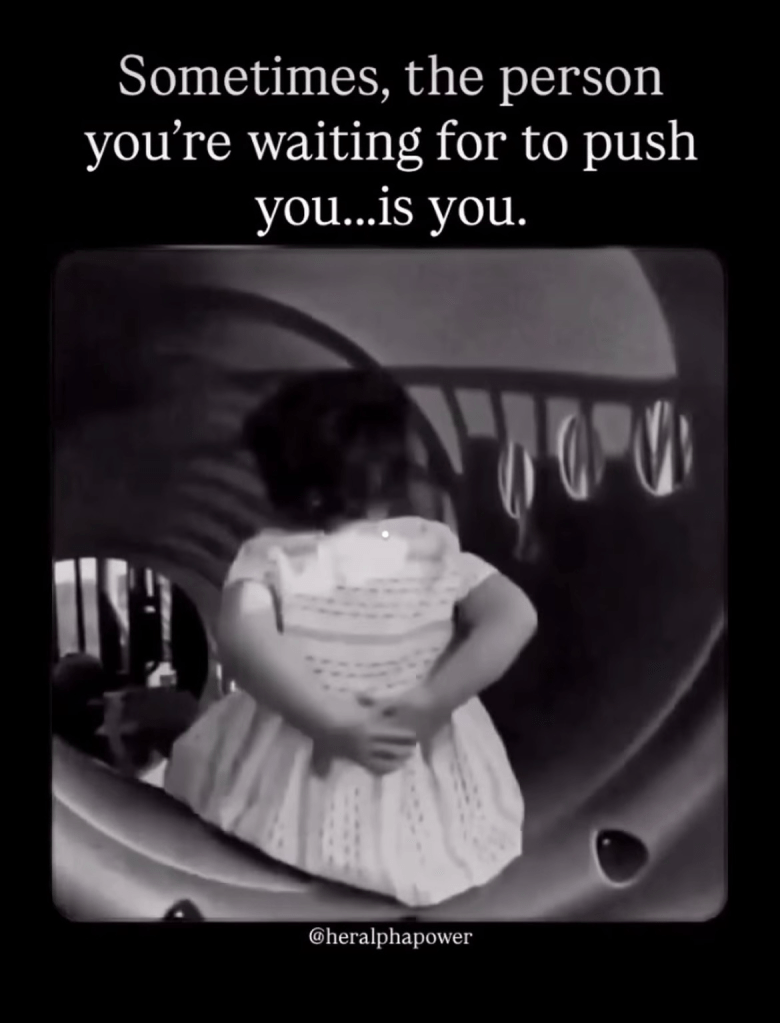
A young girl sitting at the top of a playground slide. No one telling her what to do. No one standing beside her.
Just a pause…
a breath…
and then she pushes herself forward.
The caption reads, “Sometimes, the person you’re waiting for to push you… is you.”
What connects these two moments isn’t the movement downward. It’s the moment before.
Both girls are standing in that in-between space. Between fear and courage. Between hesitation and action. One has someone beside her. One is ready on her own. Both are exactly where they need to be.
And as educators, we have to recognize where our students are in that moment… and meet them there, not where we want them to be.
When Mentorship Becomes Instruction
Inside schools, mentorship is happening all the time. In conversations. In feedback. In the way we respond to students in moments of uncertainty.
But what if mentorship didn’t only live in relationships? What if it also lived in instruction?
This matters across all classrooms, including CTE classrooms where students are preparing for real-world pathways.
The World Economic Forum tells us that resilience, flexibility, curiosity, and lifelong learning are becoming even more essential.
If that is true, then we have to ask:
How are we modeling lifelong learning for our students?
How are we creating opportunities for them not just to receive information…but to think, connect, and grow?
I Am a Student Again
I’d like to share this: I am a student again. I know what you may be thinking, as an educator, you are always a student. And, I would agree with that. But, I am a formal student in a doctoral program.
And I will tell you, it is very different being on the other side of the learning experience. It can be challenging and at times, overwhelming. Sitting in lecture-style formats virtually, trying to consume so much information in one particular way.
But what I have realized more than ever is this: Learning becomes alive when we connect.
When we collaborate.
When we communicate.
When we hear each other’s thinking.
That is when learning becomes meaningful. I have also realized that I am constantly learning from mentors.
Not just people.
Podcasts.
Articles.
Media.
A few months ago, I wrote an article in Edutopia to memorialize my learning process because it has shaped the way I learn and write.
When I read something that challenges me, it stretches my thinking. When I hear someone explain an idea in a podcast, it helps me make meaning in a different way.
This practice has shaped how I learn. In an article I co-wrote for Edutopia with Elisabeth Bostwick, we share some of the educational podcasts we listen to, and in a separate blog post, I highlight 10 podcasts outside of education that continue to inform my thinking.
I am constantly layering learning and that layering has changed how I think, reflect, and grow. Those experiences have become mentors for me. And it made me wonder: What if our students had access to that same kind of mentorship?
A Practical Way to Bring Mentorship Into Classrooms
This is where we can be intentional.
One way to do this is through what I call the Mentor Media Protocol:
Illuminate – Expose students to expert thinking through articles, podcasts, interviews, and real-world examples.
Collect – Capture ideas, questions, and language before they disappear.
Connect – Make meaning by linking ideas to their own thinking and work.
Apply – Use what they’ve learned to improve something real.
This is not about adding more. It is about using what we already have in more meaningful ways. It is about embedding mentorship into instruction.
Reading.
Writing.
Speaking.
Listening.
Reasoning.
These are not just school skills. They are life skills. Across every classroom. Across every pathway.
When we use written texts, media, and real-world voices as mentors, we are not just teaching content.
We are helping students learn how to think, communicate, and grow.
Lighting the Way
Books can guide thinking. Media can expand perspective. But people illuminate possibility.
And sometimes, all it takes is one moment, one sentence, one interaction to remind someone who they are becoming.
So I’ll come back to where we began.
The person you were.
The person you are.
The person you are continuously striving to be.
Who recognized a gift in you that you could not yet see in yourself?
And whose path are you lighting now? Because in classrooms, in conversations, and in the moment before…
We light the way.
Discover more from Empower. Collaborate. Connect.
Subscribe to get the latest posts sent to your email.

