What do you want your department and faculty meetings to feel like?
Have you ever sat in a meeting that felt like a list of updates? Are those updates important? Yes. And sometimes there is no choice but to deliver information in that format. But it’s not always as impactful long term.
I’ve never fully believed that department and faculty meetings should be entirely filled with nuts-and-bolts messages. Those messages can live in an email. They can be read, revisited, and referenced when needed.
What I do believe is that when we come together, that time should feel different.
I’ve written often about time…how it is our greatest resource, and one we never seem to have enough of. That’s why the time we do have together matters so much. We have the opportunity to be intentional with it, to protect it, and to design it as a true professional learning experience.
A space where we read, think, discuss, reason, and share ideas for best practice. Because that is what moves instruction forward. And high impact instruction move students forward.
The people sitting in the room are not empty vessels waiting for information. They are the ones living inside our educational ecosystems every day.
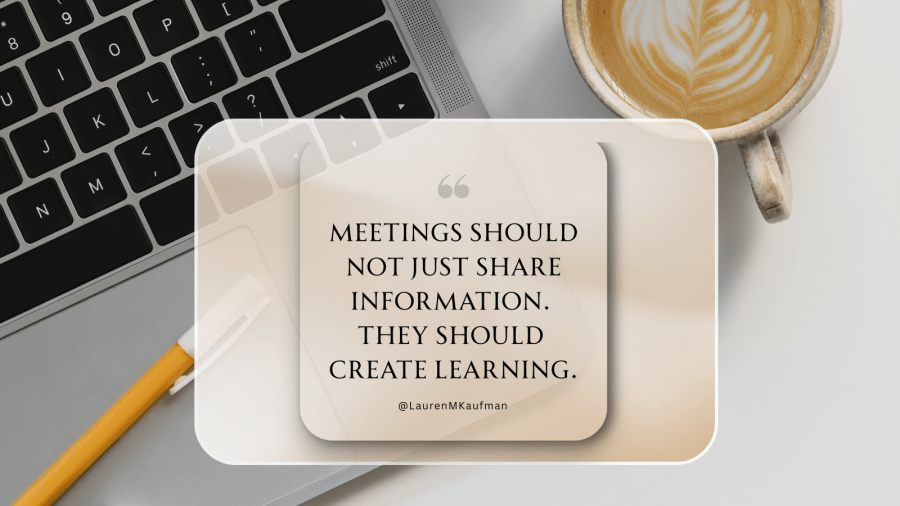
They hold the knowledge. They carry the stories. They know what is working for students and where the work needs to go next. A meaningful meeting creates space for that to evolve and surface. Meetings should not just share information. They should create learning.
Starting With Inspiration, Not Information
Recently, I had the opportunity to attend a conference session with Timothy Shanahan focused on high impact reading instruction. I always feel grateful for the chance to learn from the expertise of others in a shared learning space.
One of the many ideas that stayed with me was this:
Reading is not about answering questions at the end of a passage. I think many of us can relate to that practice. It is about making sense of ideas.That idea was reaffirming and has been shaping my thinking for years.
Because if reading instruction is truly in the service of comprehension, then everything we do, every strategy, every routine, every decision leads students toward unlocking meaning.
And instead of bringing that idea back as something to tell teachers, I continue to ask myself:
How can I design meetings where teachers experience this thinking for themselves?
Designing the Meeting as a Learning Experience
So, rather than creating slides, I prefer to design meetings around accessible protocols. I appreciate the Harvard Project Zero routines. They are tried and true and from my experience always initiate meaningful dialogue and teachers have shared that they can bring the protocol into their practice immediately.
This is something I’ve come to value deeply, not just as a facilitator, but as a learner.
Because when teachers experience a protocol as learners, they are far more likely to bring it into their own classrooms. It becomes something they don’t just understand, but something they’ve felt.
So, with that in mind, during a meeting this week, I implemented the protocol below.
Protocol: Jigsaw + Word, Phrase, Sentence
The structure began with individual thinking.
Each teacher read one of three short articles, all grounded in the idea of students reading more complex text to strengthen comprehension. This connected directly to our district priorities and what we are seeing in student learning trends and outcomes.
As they read, they captured:
- A word
- A phrase
- A sentence
- And why it mattered for students
This step matters because it ensures that everyone enters the conversation with something to contribute. It honors the process of thinking before discussing and sharing ideas.
From there, teachers moved into small groups to synthesize:
- One word
- One phrase
- One sentence
Not everything. Just what matters most. That narrowing creates clarity.
When the Thinking Starts to Move
Then came the jigsaw. Groups mixed, and ideas began to travel from one person to another. Teachers shared across perspectives, listened, and built on one another’s thinking. The conversation naturally shifted from:
What did this article say?
to
What does this mean for what we do?
And without needing to be told, patterns began to emerge:
- Comprehension requires language, knowledge, and reasoning
- Students need strategies to monitor and repair understanding
- Comprehension must be taught explicitly
The protocol made the thinking visible.
More Than a Meeting
What I value most about this approach is that it does two things at once.
It creates a meaningful professional learning experience and it gives teachers a structure they can bring back to their students.
They don’t just leave with ideas. They leave with a protocol they’ve experienced, one they can use to support student thinking, discussion, and understanding.
That matters because the same conditions that support adult learning are the ones that support student learning.
Moving Forward
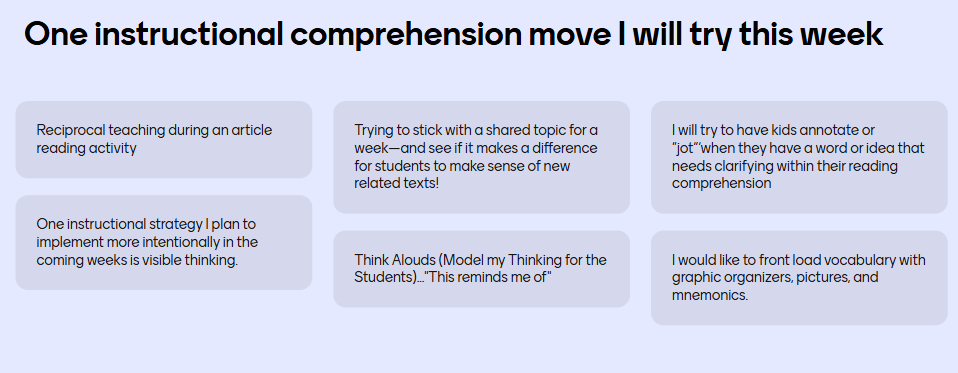
At the end of the meeting, we didn’t rush to the next item. We paused and asked: What is one move you can try this week? Not ten. Not a complete overhaul. Just one intentional step forward.
We then used the digital tool Mentimeter to capture those ideas. Some examples of teacher responses are below. We will revisit and share reflections on those instructional moves at our next meeting.
In my book, The Leader Inside, I write, “It’s the small wins that add up to the big things.” That is how practice grows. That is how capacity grows. So I come back to where I started:
What do you want your department and faculty meetings to feel like?
Not just efficient. Not just organized. But meaningful.
When meetings are designed as learning experiences, when they create space for reading, thinking, discussing, and sharing, they don’t just fill time.
They become meetings that move practice forward.
Discover more from Empower. Collaborate. Connect.
Subscribe to get the latest posts sent to your email.

