“The right conversation, at the right moment, can change everything.” — Charles Duhigg, Supercommunicators
Recently, I started reading Supercommunicators by Charles Duhigg. It’s been sitting in my “to be read” pile for a few months. In some cases, I consider myself a “slow reader.” What I mean by that is I can read several books at once. A chapter here and a chapter there. I do that because I read what I need at the moment. And, if a book really captures my attention, I could read the whole thing in one or two sittings. I often reread books. I reread the books that are resonating with me multiple times because each time I read them, I can see something in them that I haven’t seen before. This quote on social media reaffirmed the sentiment I shared:

I’d like to add that the best readers also write about their learning as a way to reflect, grow, and evolve as human beings. Whether it’s jotting notes in the margins of a book, writing down thoughts digitally or in a notebook, or sharing reflections through a blog, writing helps deepen understanding. From there, they can choose to share their learning with the world in hopes that others might take a piece of it with them.
And then, a few days later, I heard a segment from The Big Deal podcast with Codie Sanchez and her guest Bill Gurley. She asked him, “What is the biggest life hack of all time?” He responded, “Read, like read, read, read, read and don’t stop reading. People write down stuff they have learned over a lifetime and you can consume it in a day.”
Think about that. Let that sink in.
That said, it made me think about how I have always known how essential communication is to our personal and professional lives. So much so that I observe it and seek to learn more about it. I have seen myself learn from the best communicators and from the types of communicators whose messages can fall flat or never arrive at all.
Over the last several years, I have specifically been observing various types of communication. Whether they are in person, through email, text, video, social media, or other types of mediums, I look at the way people communicate their message and try to determine their tone, purpose, and impetus for that type of communication. In this context, I still stick with how we communicate in education since this blog centers around my own observations, learning, and experiences.
And above all, what I have learned, and what Duhigg reaffirms in his book, is that the most important goal of any conversation is to connect.
Does it always happen? No, I can’t say that it has. Sometimes messages are misunderstood, emotions get in the way, or people are simply having different conversations at the same time. Sometimes people react instead of respond, and other times responses do not come in the timing the situation or context calls for. Sometimes we are waiting on others, and sometimes others are waiting on us.
Duhigg shares the following: “Every meaningful conversation is made up of countless small choices. There are fleeting moments when the right question, or a vulnerable admission, or an empathetic word can completely change your dialogue.”
So if that’s true, how can we use those small choices to be more intentional in the way we communicate, even if our communication doesn’t always land as intended? The goal is to reflect on how we can stick to our core values while keeping an open mind for shifts that can create connection.
As I continued reading, another idea invited me to stop and think. In the book, Duhigg shares that in order to understand how supercommunicators do what they do, it is essential to explore what happens inside our brains when we are having conversations with others. “Researchers have studied how our minds function during different sorts of discussions and have found that various neural networks and brain structures become active during different types of dialogue” (p. 18).
Duhigg explains that there are generally three kinds of conversations happening beneath the surface of most discussions.
He explains that these conversations connect to decision-making, emotional, and social mindsets and can be captured in three questions:
What’s This Really About? (Decision-making)
How Do We Feel? (Emotional)
Who Are We? (Social)
The more I sat with this idea, the more I realized how often all three show up in education at the exact same time.
For example, I have seen this show up when a building or district leader walk into a meeting focused on the practical conversation:
What’s the next step?
What systems need to be strengthened?
How do we solve the problem?
Meanwhile, a teacher in the same meeting may be having an emotional conversation:
Do people understand how hard this feels?
Am I being supported?
Do I feel overwhelmed?
And another person may be having a social conversation:
Where do I fit in this work?
Is my perspective valued?
Who are we becoming as a team?
And the reality is, all three conversations can exist simultaneously. And perhaps that is why communication in education is so complex. Because schools are deeply human places.
I think about professional learning sessions I have facilitated over the years. Sometimes I would leave a session thinking the practical structures were clear:
The protocol made sense.
The instructional strategy was modeled.
The expectations were communicated.
But over time, I learned that clarity alone does not always create connection. People also need space for the emotional conversation. Here are some questions to think about:
How does this feel?
What concerns do we have?
What excites us?
What feels uncomfortable?
And they need space for the social conversation.
How do we build this together?
How do we ensure people feel seen throughout the process?
What kind of learning culture are we creating?
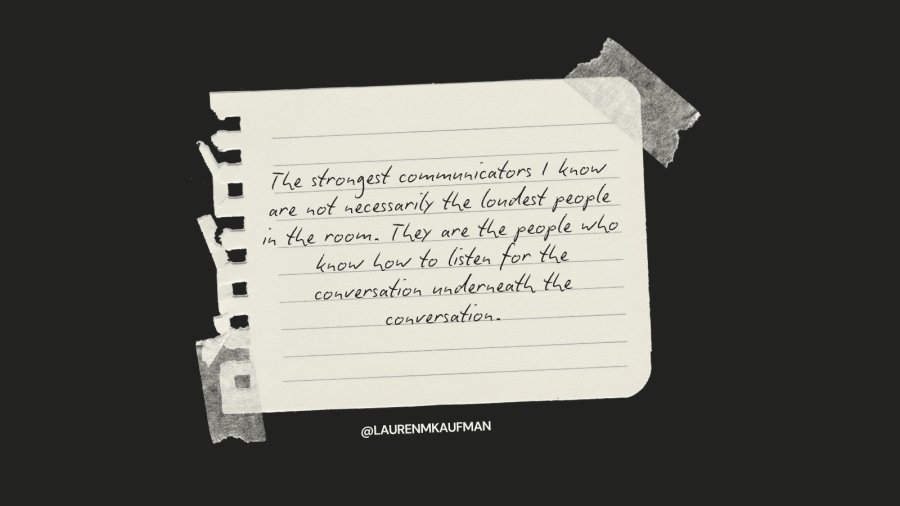
The strongest communicators I know are not necessarily the loudest people in the room. They are the people who know how to listen for the conversation underneath the conversation.
A teacher says:
“I just don’t think this resource works.”
At first glance, it sounds practical.
But perhaps underneath is:
I feel uncertain.
I feel disconnected from the change.
I am worried about whether I can do this well.
A student says:
“I hate reading.”
Maybe the practical interpretation becomes:
The student is disengaged.
But perhaps the emotional conversation is:
Reading feels hard.
I feel embarrassed.
I do not yet see myself as successful.
And the social conversation might quietly ask:
Who am I as a learner in this classroom?
Duhigg also explains that miscommunication often occurs not because people are poor communicators, but because they are having different kinds of conversations at the same time. One person may be speaking practically while another is speaking emotionally. One may be seeking solutions while another simply wants empathy and understanding.
That idea is eye opening to me.
Because matching does not mean agreeing with everything someone says. It means slowing down enough to understand what they need in the moment.
Sometimes people need solutions. Sometimes they need empathy. Sometimes they need reassurance that they belong. And often, they need all three.
The more I reflect on communication, the more I realize that connection is not built through perfect words. It is built through intentional listening. Through the pause before responding. Through curiosity instead of assumption. Through questions that invite people in rather than shut conversations down.
What’s this really about?
How do we feel?
Who are we?
Perhaps those three questions have the power to transform not only conversations, but classrooms, leadership, coaching, and relationships altogether.
Because when people feel heard, understood, and valued, conversations begin to move from surface-level exchanges to meaningful connection.
And maybe that is where real communication begins.
Discover more from Empower. Collaborate. Connect.
Subscribe to get the latest posts sent to your email.


Brilliant message. Thank you Lauren.
Perhaps one might also intentionally listen for what is not being said.
LikeLike
Thank you for reading, Sylvia! I appreciate those sentiments and I agree!
LikeLike