I believe one of the most important responsibilities we share in educational leadership is creating the conditions for others to do important work.
Creating systems and structures may not always be the most inspiring part of leadership, but it is the work beneath the work. It doesn’t always feel visible or highlighted on a social media reel. But it is essential. Meaningful change doesn’t happen by accident. It happens when there is intention behind how people are brought together, how their voices are honored, and how the work is supported.
In my own context, as we began the work of selecting new literacy resources to pilot this year, the process was layered and complex. It required committee collaboration, logistics, coordination across buildings, ongoing communication with building and district leadership, teachers, and families, continuous questions and conversations with vendors, opportunities for stakeholder feedback, and the creation of tools such as rubrics that established clear criteria to guide our thinking and decision making. We gathered perspectives through multiple lenses and synthesized that information to determine next steps.
Building the Conditions for the Work
Let me be clear. This post isn’t about every step of a literacy review or pilot process. It’s not about timelines, tools, or individual decisions along the way. Each of those pieces mattered deeply and could easily stand alone as their own posts. This reflection is about something just as important. It’s about the systems and structures leaders create so that people can show up fully, feel included in the work, and move forward collectively.
An important part of creating those conditions was choosing not to rush a process that matters. That meant actively listening to stakeholders, engaging in learning alongside others, and staying open to perspectives that helped shape the work as it unfolded. When we rush, we often lose sight of the people on the frontlines with our most important stakeholders, our students.
As Shawn Achor writes in Big Potential, “Success is not just about how creative or smart or driven you are, but how well you are able to connect with, contribute to, and benefit from the ecosystem of people around you.” That idea guided this work. Progress depended not on speed, but on connection.
If our educators are the ones implementing instructional practices in classrooms every day, they need time, space, and support to feel calm, capable, and confident in doing so.
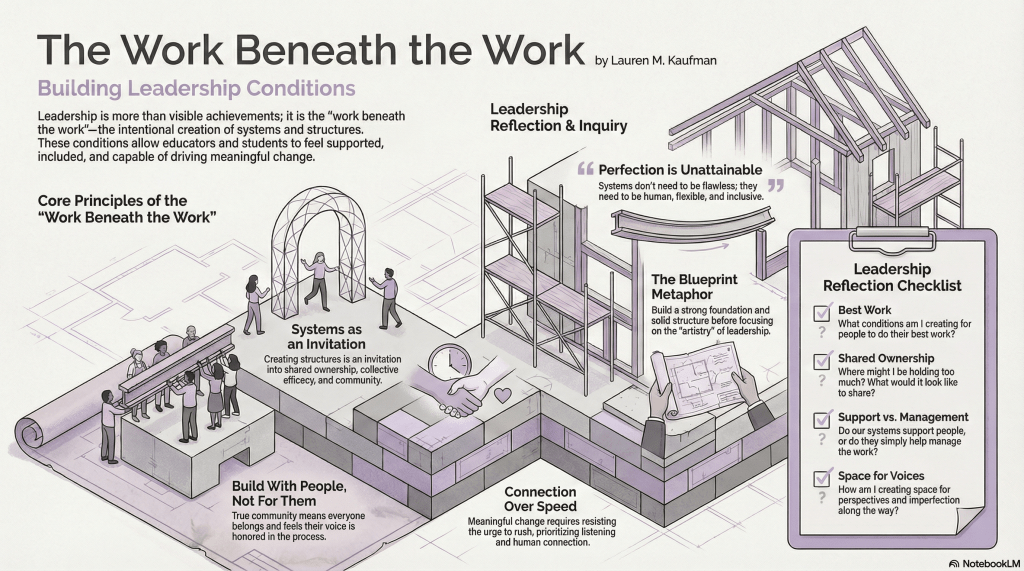
I often use the metaphor of building a house when I talk with stakeholders about moving work forward. You need a plan and a clear blueprint. You build a strong foundation and a solid structure before you ever think about decorating. This isn’t just true of a pilot process. It’s true of any effort aimed at meaningful change in education. The artistry comes later, but only if all of the shared ideas exist to build the structures first.
Sometimes that work looks like clear timelines, shared criteria, and intentional space for feedback. Simple structures that help people feel steady as the work unfolds.
In a K-12 role, all of this work lived alongside my other professional responsibilities. It didn’t replace them. It wove itself into days already filled with classrooms, conversations, coaching, writing, problem solving, and decision making. That reality mattered. Because building systems isn’t about creating more work. It’s about creating clarity, so the work can live and breathe within everything else we carry.
Building Systems With People at the Center
In his new book Forward, Together, George Couros writes,
“When we are trying to move people forward, you can’t change anyone. The only thing you can do is create the conditions where people are more likely to change themselves. That starts with you. Not only what you do, but what people see you do.”
That idea has stayed with me throughout this process. Because implementing something new isn’t just about selecting a resource. It’s about building trust. It’s about making space for perspective. It’s about ensuring people know their voices matter.
Building community doesn’t mean everyone agrees. It means everyone belongs. It means building something with people, not for them.
Couros goes on to share the following sentiment: As leaders, part of the artistry is knowing when to lead from the front, when to guide from the side, and when to stand behind your people and let them lead. Knowing when to step in and when to step back is not accidental. It’s intentional.
Once we identified the resources we would pilot, the work shifted again. We had to establish clear criteria, plan pilot launch and implementation windows, and intentionally create space for feedback. While one pilot was launching, we were already preparing for the next—gathering materials, coordinating professional learning, and building systems to support teachers and coaches simultaneously.
That support matters. Teachers need to feel fully supported as they implement something new. Coaches need to feel supported as they support others. And as a leader, I needed to intentionally harness the strengths, expertise, and leadership of the people around me, because no system works if it depends on one person to hold it all.
Student learning remained at the center throughout. Collecting student work. Studying engagement. Listening closely to what students showed us through their reading, writing, and discussions. Those small moments mattered. As I wrote in my book The Leader Inside, “It’s the small wins that add up to the big things.” Those wins, often quiet and easy to overlook became essential data points in moving the work forward.
Leadership doesn’t require perfection. In fact, it demands the opposite. In The Leader Inside I also share, “Regardless of our roles, we must show up and realize that perfection is unattainable. It’s our imperfections that shape us as leaders.” Systems don’t need to be flawless. They need to be human. Flexible. Built with people, not around them.
Moving Forward
And that brings me back to where I started.
I believe one of the most important responsibilities we share in educational leadership is creating the conditions for others to do important work. Creating systems and structures may not always feel inspiring or visible, but when done with intention, they become an invitation. An invitation into shared ownership. An invitation into collective efficacy. An invitation into community.
As I reflect on this work, these are questions I continue to sit with and invite other leaders to consider as they think about the systems they are creating:
What conditions am I creating for people to do their best work?
How am I harnessing the strengths and leadership of the people around me?
Where might I be holding too much, and what would it look like to share ownership more intentionally?
Do our systems support teachers, coaches, and students, or do they simply help manage the work?
How am I creating space for voices, perspectives, and imperfection along the way?
Because in the end, the conditions we create belong to all of us.
Click HERE, or on the image below, to explore a resource created with NotebookLM for conversation with your leadership teams.
 Empower. Collaborate. Connect.