What helps you lead well when the days feel full and the expectations feel high?
If you’re reading this, it’s likely because you care deeply about your work. You care about doing it well. You care about the people you serve. You care about growing, even when growth feels uncomfortable or unclear. And while many days in education feel full, there are also days filled with purpose, connection, and the quiet impact of knowing you are making a difference.
There are also days when full doesn’t quite capture it.
For example, there are many days when I find myself juggling a multitude of things at once, answering emails while talking to text because it’s faster, responding to questions, anticipating potential obstacles and solving them before they happen, and setting up logistics for big meetings, all while holding personal responsibilities too, like my kids’ schedules and what’s happening in their own school lives.
Feel familiar?
Sometimes I pause and think, Wait… what am I doing again? None of these things are insignificant. They are all part of leading well. But on days like these, it can be hard to pause long enough to think about how we’re leading, not just what we’re getting done. But, full days don’t ask for perfection. They ask for presence.
That’s the lens I was in when I listened to an episode of The Big Deal podcast, hosted by Codie Sanchez, featuring Ryan Holiday titled How to Build Self Discipline for 2026.
I’ve been reading Ryan Holiday’s work for years. His writing has shaped the way I think about leadership, resilience, and growth, and I reference his ideas in my own book, The Leader Inside. He has a way of taking timeless ideas and making them feel immediately applicable to real life and to leadership in schools.
As I listened to this conversation, I kept thinking about what it really means to lead well on full days. Not perfect days. Not calm days. Full ones.
So, here are three ideas I’m carrying with me right now, and how they can show up in education. I invite you to think about how these ideas may show up in your world and in your own context.
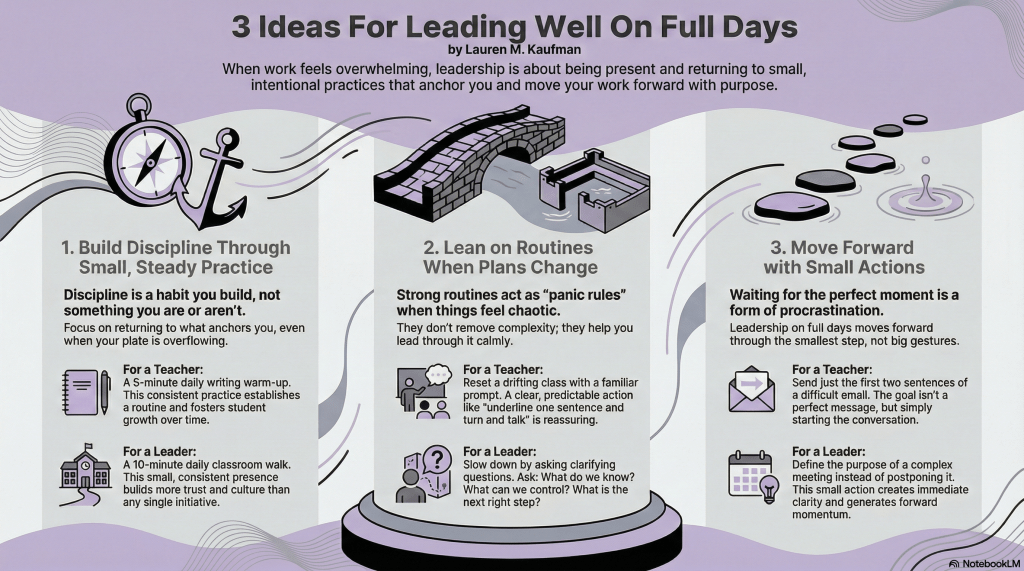
1. Discipline is built through small, steady practice
One idea from the conversation about discipline that stayed with me was this reminder:
“It’s a habit or a practice that you build, not a thing that you are or aren’t.”
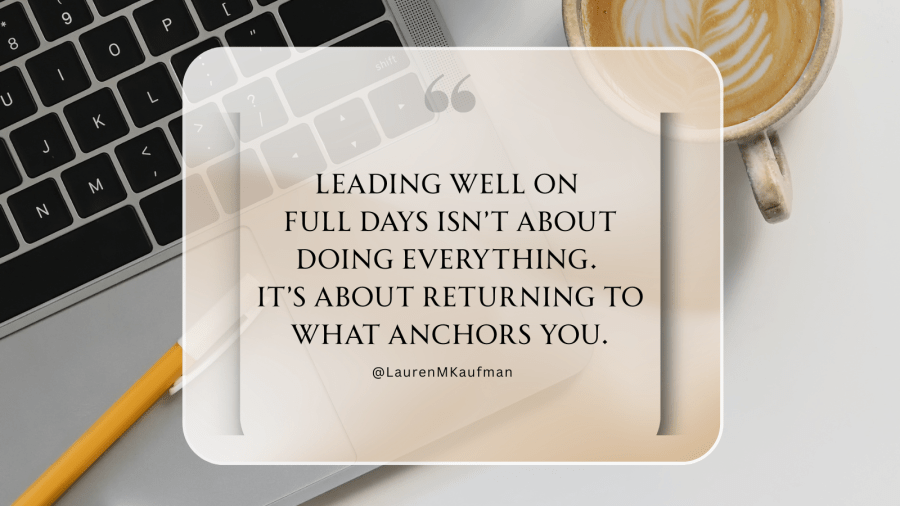
Leading well on full days isn’t about doing everything. It’s about returning to what anchors and sustains you even when your plate is overflowing.
What this can look like in education:
If you’re a teacher, it might be committing to a five-minute daily writing warm-up. Same time. Same structure. Not a full writing workshop. Just five minutes that quietly says, writing lives here. Over time, those minutes add up, and students grow because the practice is steady.
If you’re a leader, it might be a daily ten-minute classroom walk. Not evaluative. Not performative. Just a consistent presence. Over time, that small practice builds trust and culture far more effectively than any single initiative.
In my book The Leader Inside, I wrote: “The setbacks and obstacles you face are not the sum total of your life; they are mere moments of discomfort that bridge your past to your future.”
Those moments often show up on our fullest days. Discipline is choosing to keep the practice anyway.
2. Strong routines support leadership when the day doesn’t go as planned
Do your days ever go as planned? Rarely does the calendar I looked at the night before stay the same the following day.
Ryan also talked about what he calls “panic rules,” the simple practices we return to when things feel chaotic. As he said:
“Just because they’re simple doesn’t mean they’re easy.”
That idea feels especially relevant in schools.
On full days, when lessons don’t turn out the way you had hoped, emotions run high, or something unexpected demands your attention, leadership isn’t about reacting faster. It’s about returning to what you’ve rehearsed.
What this can look like in education:
If you’re a teacher and a class starts to drift, routines become the anchor. You pause. You name the next step. You bring students back to something familiar.
It might sound like:
“Everyone, let’s pause. Take a breath. Close our eyes and reset. When we open them, we’re going to read the next paragraph, underline one sentence, and turn and talk.
Clear. Predictable. Reassuring.
If you’re a leader facing an unexpected challenge, your routine might be how you slow yourself down just enough to think clearly:
What do we know right now?
What can we control?
What is the next right step?
These routines don’t remove complexity. They help you lead through it.
3. Small Actions Move Leadership Forward
Another honest moment from the conversation came when Ryan said:
“I’ll do it in the morning is probably the most insidious lie there is. It also presumes that there is a later.”
On full days, procrastination doesn’t usually look like avoidance.
It looks like waiting.
Waiting for time.
Waiting for space.
Waiting for the perfect moment.
But leadership rarely gives us that.
What this can look like in education:
If you are a teacher and you’ve been putting off a parent conversation because you want to get it just right, the smallest action might be sending the first two sentences of the email. Not the perfect message, just the opening that begins the conversation. “Hi ___, I wanted to reach out to share a few observations about how ___ has been doing in class. I’m looking forward to connecting with you so we can think together about how to best support them.”
If you are a leader and you’ve been delaying a team conversation because it feels complex, the small action might be naming the purpose of the meeting instead of postponing it again.
“When we meet, I’d like us to talk about what’s working, what’s getting in the way, and one adjustment we can try next.”
Leadership doesn’t always move forward through big gestures. On full days, it often moves through the smallest step that creates clarity and momentum.
Moving Forward
In his book The Obstacle Is the Way, Ryan Holiday writes: “If we do our best, we can be proud of our choices.”
And later he reminds us: “We will be and do many things in our lives. Never look at any of it as beneath us. Respond with hard work, honesty, and helping others as best as we can.”
That feels like leadership on full days. Doing the next right thing, with care.
And maybe this is where it all comes together.
On the days when you are holding a lot.
When you’re thinking three steps ahead.
When your work life and home life blur together.
When leading well feels less about vision statements and more about follow-through.
Leading well on full days doesn’t mean doing more.
It means returning to what you practice.
Leaning on routines that support you.
Taking one small step forward instead of waiting for the perfect moment.
So I’ll return to the question I started with:
What helps you lead well on your fullest days?
Chances are, the answer isn’t something new you need to add.
It’s something small, steady, and already within reach.
Resource to Use With Your Teams Tomorrow
Click HERE to print the infographic created with Notebook LM to use with your leadership and teacher teams.
 Empower. Collaborate. Connect.