When leadership and learning feel heavy, what helps us decide how to move people forward with care and intention? This is a question that continuously rests on the shoulders of those leading complex work in schools. And if you are reading this post, perhaps this resonates with your own thinking.
In his new book, Forward, Together, George Couros reminds us that leadership is not about pushing people to change faster. It is about understanding what it takes to move people forward, together. Couros shares the following:
“If you want to help move people from their point A to their point B, you have to remember you were probably at that point A once yourself.”
I know what you may be thinking.
This sounds right, but what if the work feels urgent?
I would like to share my thinking about this.
To me, empathy for people and the work does not slow progress. It is what makes progress sustainable. The way leaders move people forward is not just through decisions. It is through the questions they ask themselves when the work feels complex.
In Forward, Together, Couros also emphasizes the importance of building community through dialogue. After sharing ideas with groups, he often asks three questions that continue to stay with me:
- Do you have any questions you want to ask?
- Do you have any ideas you want to share?
- And most importantly, do you want to challenge me on anything I shared?
Those questions do more than invite feedback. They signal trust. They open the door for real conversation. And they remind us that leadership is not about having the final word, but about creating the conditions for collective learning.
Recently, I heard Tony Robbins share a powerful reminder on Codie Sanchez’s The Big Deal podcast:
“Everything ends, everything changes, and something new begins.”
That feels especially true in education. The work we are leading requires us to honor what has been, acknowledge what is changing, and thoughtfully support what is taking shape. None of that happens overnight.
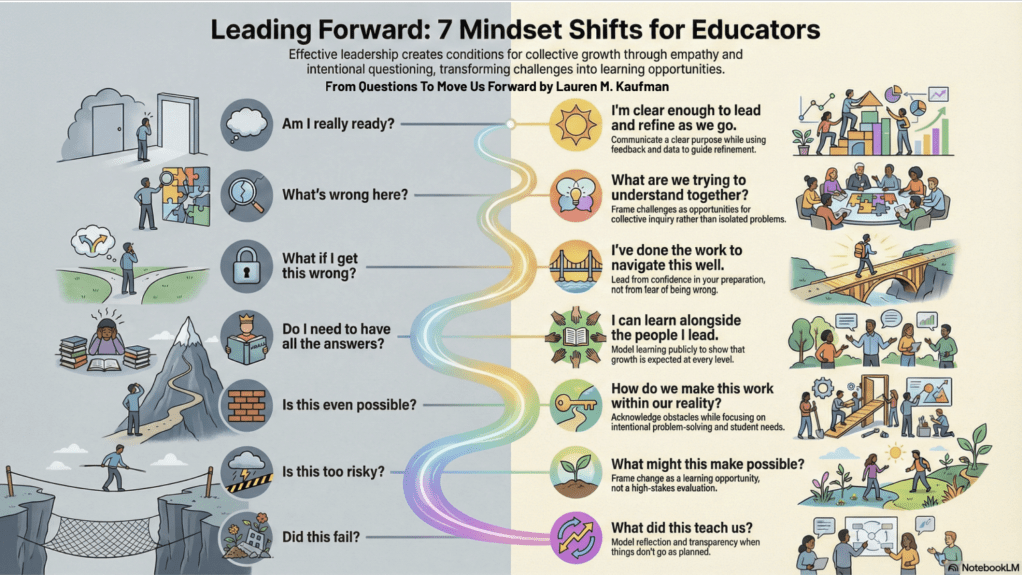
That said, as I (and we) continue to navigate an ever evolving educational landscape, I have developed seven reframes shaped by lived experience in schools that I have turned into guiding questions for my leadership practice.
Below, I share what each can look like in education, along with concrete examples drawn from my own work, and invite you to consider what this might look like in your own context.
1.
Leadership shift: Moving from self-doubt to clarity grounded in purpose and reflection.
“Am I really ready?” → “I’m clear enough to lead and refine as we go.”
What this can mean in education:
When rolling out a new instructional resource, leaders communicate a clear purpose and timeline, while naming upfront that teacher feedback, classroom observations, and data will guide refinement along the way.
Example:
A district introduces a literacy resource pilot and clearly outlines what will be implemented this year, what evidence will be gathered, and when decisions will be revisited so teachers understand this is a learning phase, not a final verdict.
Leadership reflection:
How clearly have I communicated what is fixed and what is still open for learning?
2.
Leadership shift: Moving from problem-solving in isolation to shared understanding.
“What’s wrong here?” → “What are we trying to understand together?”
What this can mean in education:
Leaders frame challenges as opportunities for collective inquiry rather than isolated problems requiring quick fixes.
Example:
After assessment data shows uneven progress across grade levels, leaders bring teams together to analyze student work, instructional practices, and pacing, asking shared questions instead of assigning blame.
Leadership reflection:
Do my questions invite collaboration or defensiveness?
3.
Leadership shift: Moving from fear of mistakes to trust in preparation and relationships.
“What if I get this wrong?” → “I’ve done the work to navigate this well.”
What this can mean in education:
Leaders rely on experience, relationships, and professional grounding to guide difficult conversations and decisions.
Example:
During conversations about instructional shifts, a leader acknowledges uncertainty, explains the rationale clearly, and facilitates dialogue grounded in classroom visits and ongoing communication.
Leadership reflection:
Am I leading from fear of being wrong or confidence in my preparation and purpose?
4.
Leadership shift: Moving from needing certainty to modeling curiosity.
“Do I need to have all the answers?” → “I can learn alongside the people I lead.”
What this can mean in education:
Leaders model learning publicly, reinforcing that growth is expected at every level of the system.
Example:
A leader participates in professional learning sessions with teachers, asks questions, and reflects openly, signaling that learning does not stop with title or role.
Leadership reflection:
When was the last time others saw me learning, and not just leading?
5.
Leadership shift: Moving from limitation-focused thinking to intentional problem-solving.
“Is this even possible?” → “How do we make this work within our reality?”
What this can mean in education:
Leaders acknowledge obstacles while staying focused on what matters most for students and teachers.
Example:
With time constraints, leaders align pilot cycles for new resources to existing units and schedules, helping teachers integrate new practices without adding to their workload.
Leadership reflection:
Am I naming obstacles or using them as a reason to stop progress?
6.
Leadership shift: Moving from risk avoidance to possibility thinking.
“Is this too risky?” → “What might this make possible?”
What this can mean in education:
Leaders frame change as learning, not evaluation.
Example:
Instructional walkthroughs are introduced as reflective conversations rather than compliance checks, creating safety for teachers to try new strategies.
Leadership reflection:
Do people experience my presence as pressure or possibility?
7.
Leadership shift: Moving from judgment to learning.
“Did this fail?” → “What did this teach us?”
What this can mean in education:
Leaders model reflection and transparency when something does not land as intended.
Example:
If professional learning misses the mark with some educators, leaders gather feedback, revise the approach, and communicate next steps, reinforcing trust and shared ownership.
Leadership reflection:
How openly do I model learning when things do not go as planned?
Moving Forward
From my own experience, leadership is not about changing people.
What I have learned is that you cannot force growth. You can only create the conditions where people feel supported enough and challenged enough to grow themselves.
So, this brings me back to the question I opened with: When leadership and learning feel heavy, how do we decide how to move people forward with care and intention?
That is why I keep returning to George Couros’ message in his book Forward,Together and why it matters so deeply right now. In a time of constant pressure and competing demands, progress does not come from pushing harder alone. It comes from remembering our own Point A, honoring where others are, and choosing again and again to move forward together.
Resources to Share With Your Team Created with Notebook LM in Podcast and Infographic Formats
CLICK HERE to listen to a PODCAST VERSION of this post.
CLICK HERE to print the infographic below with the Questions to Move Your Teams Forward
 Empower. Collaborate. Connect.
WOW – wh
LikeLike