I’ve been reading two books this summer that speak directly to the important work we’ve been doing, while also sparking new thinking and reaffirming what it means to be in education. Fearless Instruction by Creative Leadership Solutions highlights research and high-impact practices from an all-star group of leaders and educators, and Instructional Innovation: Cultivating Teacher Teams Through Action Research by sought-after speaker and instructional mastermind Dr. Jorge Valenzuela offers a practical blueprint for collaborative growth. Both center on keeping learners at the heart of every decision and innovation at the core of an evolving world. As I reflect on their messages, one truth is clear: it starts with us. When leaders create the right conditions, teachers can do their best work, and students thrive.
As Fearless Instruction reminds us, “The most important resource in schools is our staff. Period. They shape the school’s culture, care for students’ physical and mental wellness, lead critical learning, and build bridges with families in the community” (17). That truth is why this year, my focus is on continuing to build a culture where teachers feel supported, trusted, and equipped to lead learning with confidence.
Next week, I’ll be meeting with a group of new teachers. While I’ll be delivering professional learning rooted in literacy, the foundation of all learning—another intentional purpose is to help them feel a sense of belonging. I want them to leave excited to meet their students, collaborate with colleagues, and partner with families. It starts with us. It starts there. As Instructional Innovation reminds us, “Collective teacher efficacy is strongly correlated to student achievement, success, and positive school culture” (p. 20). The trajectory we set in these first days can retain great educators and can shape meaningful and fulfilling careers.
In my book The Leader Inside, I wrote: “The heartbeat of education lives inside the walls of schools. Within those walls you can find stories of kids and teachers in the mess of learning.” Those stories and the growth they hold come to life when leaders approach their role with a coaching mindset, creating trust, encouraging collaboration, and providing feedback that helps teachers thrive.
To lead this way, we must turn belief into action.
That means moving beyond theory and into practice, daily habits that teachers can feel and see. It means modeling those practices we hope to cultivate, creating structures that remove barriers, and showing through our presence and decisions that we are partners in the learning process.
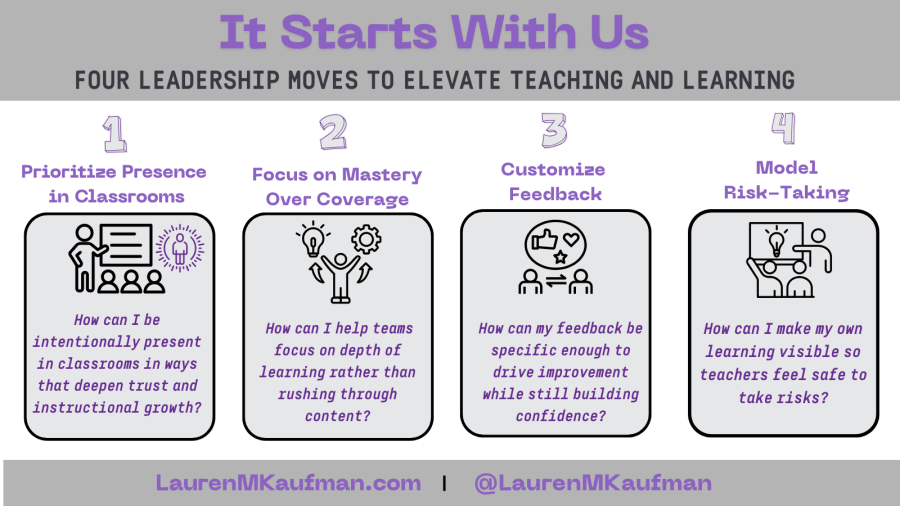
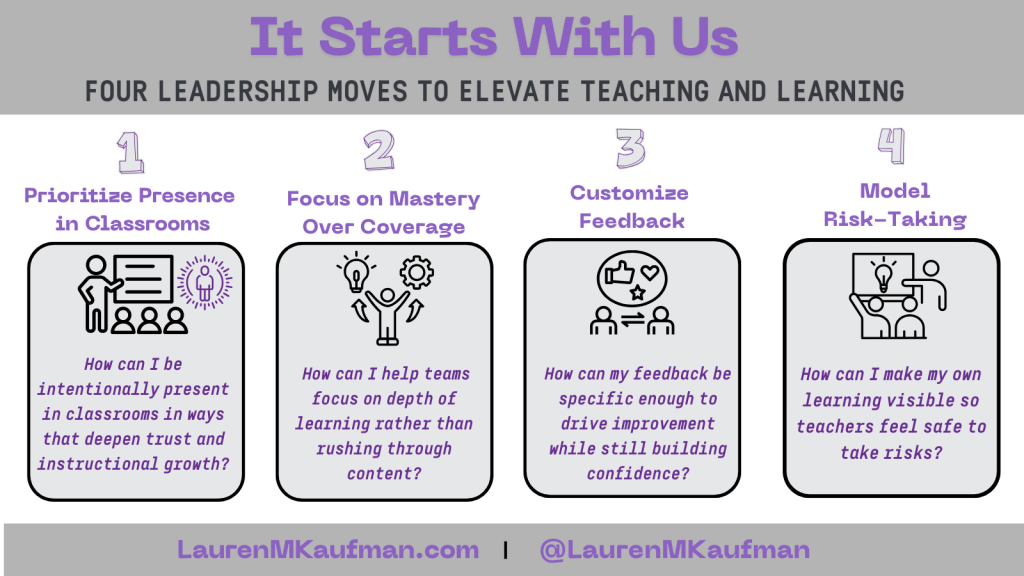
The following four moves are practical ways this mindset can take root in classrooms, shape the culture of a school, and elevate teaching and learning.
Four Leadership Moves to Elevate Teaching and Learning
CLICK HERE TO USE THIS IMAGE WITH YOUR PROFESSIONAL LEARNING COMMUNITIES
1. Prioritize Presence in Classrooms
Driving Question: How can I be intentionally present in classrooms in ways that deepen trust and instructional growth?
Example: During a reading instruction, sit alongside a small group of early readers to model decoding CVC words by isolating, segmenting, and blending individual sounds (e.g., /c/ /a/ /t/ → cat). Use Elkonin boxes to help students visually map each sound to its corresponding letter. For example, say each sound slowly as students place a chip in each box, then sweep their finger under the boxes to blend the word. As the teacher observes, narrate your prompts aloud (“Let’s say each sound slowly—now let’s blend them together”). Immediately after, hold a quick hallway debrief to reflect on what worked and what could be refined.
Language You Might Use:
“I noticed how the students’ confidence grew when we used the Elkonin boxes to isolate each sound before blending them together. What did you notice from your vantage point? How might we build on that tomorrow—perhaps by adding a few more CVC words with the short ‘a’ sound and introducing another vowel to expand the range of words students can build, using the Fundations letter tile boards for additional hands-on practice?”
2. Focus on Mastery Over Coverage
Driving Question: How can I help teams focus on depth of learning rather than rushing through content?
Example: Work with grade-level teams to identify two or three priority standards as they design their next unit. Create checkpoints where students can demonstrate deep understanding, such as:
- Performance tasks (e.g., designing an experiment in science, writing an opinion piece citing multiple sources in ELA)
- Student-led conferences where learners explain their thinking to families using work samples and reflections
- Common formative assessments aligned to the standards, such as constructed-response questions or problem-solving tasks
- Exit tickets that require higher-order thinking, like applying a concept in a new context rather than recalling a fact
- Portfolio artifacts that show progress toward mastery over time
Language You Might Use:
“If we zoom in on these two standards, what could mastery look like by the end of the unit? What checkpoints, like a performance task, portfolio entry, or student-led conference can we build in so students have multiple ways to show us they’ve really got it?”
3. Customize Feedback
Driving Question: How can my feedback be specific enough to drive improvement while still building confidence?
Example: Instead of a generic “Great job,” offer targeted, actionable feedback tied to what you observed in the lesson. For example:
- Questioning and Wait Time
Feedback Example: “When you gave students an extra 5 seconds to think before calling on them, I noticed more students raised their hands and gave complete answers. Let’s plan for two intentional pauses like that in tomorrow’s Socratic seminar.”
Language You Might Use: “That extra pause gave students space to think, and the quality of answers went up. How can we build that in tomorrow?” - Small-Group Comprehension Instruction
Feedback Example: “When you guided students to annotate the text by circling key vocabulary and jotting margin notes about the main idea, their discussion responses became more accurate and text-based. How can we build in more of that targeted annotation in your next small-group comprehension lesson?”
Language You Might Use: “I noticed a difference when students annotated—marking vocabulary, underlining main ideas, and jotting questions. How can we make that routine in future lessons?” - Discussion Protocols
Feedback Example: “During the ‘Turn and Talk,’ you reminded students to use evidence from the text, and I saw them flipping back to find it. Tomorrow, what if we also provide a few sentence stems to scaffold their thinking—like ‘According to the text…,’ ‘I agree with you because…,’ or ‘Another example is…’? I think we’d hear even richer conversations.”
Language You Might Use: “Those stems could push students to build on one another’s thinking. Which ones should we try first?” - Modeling Writing
Feedback Example: “When you modeled writing your own opening sentence in front of the class, thinking aloud as you chose a strong hook, used descriptive language, and connected it to the main idea—students immediately improved the leads in their own pieces. I noticed several began with vivid images or questions instead of ‘This is about….’ Next time, after your model, let’s select a few strong student leads to share under the document camera. This will elevate and empower those students while inspiring others to try similar craft moves. We could then co-plan another model in the next writing block, perhaps focusing on adding sensory details or varying sentence structure so they see multiple ways to strengthen their writing.”
Language You Might Use: “Your model inspired them, and sharing student work will take it further. Who might we feature next time to get everyone excited?”
4. Model Risk-Taking
Driving Question: How can I make my own learning visible so teachers feel safe to take risks?
Example: During a department or grade-level meeting, introduce and facilitate a new discussion protocol for, for example, “Save the Last Word for Me”, using an article or short text on an instructional topic relevant to your team. Share the directions briefly, then model being the first participant so staff can see how it works. Acknowledge that you’re trying it for the first time and that there may be bumps along the way. Afterward, debrief with the group about what felt effective and what could be adjusted, inviting everyone to help refine it before they try it in their own classrooms. This shows that experimentation and reflection are part of the professional culture, not just for students but for adults too.
Language You Might Use:
“I’ve never utilized this protocol before, so we’ll learn together. I’m curious to see how it helps us unpack this text and what we might tweak for next time. As we go, notice how the structure affects participation, then we can think about where it might fit in our classrooms.”
Moving Forward
So as we step into this school year, let’s ask ourselves:
- How will I make my presence felt where learning happens?
- How will I remove barriers so teachers can focus on what matters most?
- How will my actions reflect the belief that every educator in my building makes a difference?
It starts with us and with the trust we build, the example we set, and the belief that together, we can create the conditions where both teachers and students flourish.
 Empower. Collaborate. Connect.