Some leaders manage. Others direct. But the ones who have left a lasting imprint on me are those who coach…not once, not only when asked, but as a way of leading in all they do.
This year, I had the privilege of onboarding our new literacy coach. From the outside, her transition from classroom teacher to coach might have looked seamless. But as many of us know, growth often begins in quiet discomfort. I know this because I’ve lived that transition myself, feeling the full range of emotions as I stepped outside the familiarity of my own classroom to become an instructional coach.
When I moved into a formal leadership role, I carried those lessons with me. I was committed to leading like a coach, bringing with me the mindset I had cultivated through listening, presence, and partnership. It became a true privilege to support someone else through that very same journey.
If you’re a leader who’s ever supported someone stepping into a new role, you know how powerful it can be, not just for them, but for you. It’s a reminder that our job isn’t to hand over answers, but to walk beside people as they grow into their own voice.
I still remember those early months walking into buildings together, facilitating and planning for professional learning, modeling side-by-side, unpacking curriculum, and mapping out goals. I wasn’t just there to provide answers. I was there to ask questions, to listen, to name the strengths I saw, and to help her begin to see them for herself. Having walked the coaching path before, I knew that the shift from teacher to coach isn’t only about learning new practices, it’s about stepping into a new identity.
Where in your leadership are you naming the potential others haven’t yet seen in themselves?
As our coach wrote in her reflection:
“We spent significant time together. I learned the essentials of literacy instruction, the instructional shifts guiding our decisions, and the dynamics of education outside the classroom. This foundation prepared me for our work in schools… I deeply appreciated your patience and the time you dedicated to helping me begin thinking like a coach.”
This moment reminded me of a sentiment I share in my book The Leader Inside:
“Gifts live within exceptional educators, waiting to be unwrapped at the right place, at the right time, with the right people.”
As a leader, you may already see those gifts in others. But the question is, are you giving them the space, the time, and the trust to unwrap them?
Her words affirm that coaching others to coach is about presence more than power. It’s about guiding, then gradually stepping back. That’s what I saw come to life this spring.
At the end of the school year, we had scheduled several meetings to plan summer curriculum work. I had blocked time to support the facilitation, ready to help structure the conversation and lead our next steps.
But what happened next showed me how far she’d come.
Although I opened the meeting, it quickly became hers. Our coach came prepared, not just with ideas, but with thoughtful models, concrete examples, and a strong sense of purpose. She led with clarity, asked the right questions, and facilitated from a place of vision, not just preparation.
Are you making space for others to step into leadership, even when it would be faster to lead yourself?
What I thought would be a planning session became something far more meaningful: a culmination. A moment that captured the quiet, gradual transformation of a teacher into a coach.
You’re leading like a coach when the people you support begin to lead without you.
“The final shift came after our leadership meeting in an elementary building—a turning point,” she reflected. “You helped me stop thinking like a teacher and start thinking like a coach.”
That shift didn’t happen overnight. It was built through small, consistent moves, offering insight without instruction, modeling without micromanaging, and most of all, believing in her capacity to lead.
Coaching is more than a role—it’s a way of leading.
In a recent Harvard Business Review article, executive coach Ruchira Chaudhary writes:
“Many leaders think they’re coaching when they’re actually just giving instructions… Coaching is a learnable skill, and like a muscle, it grows stronger with practice.”
She defines coaching as maximizing the performance of others through “non-directive and self-enabling actions,” blending push (modeling, feedback) with pull (reflection, open-ended questions). This combination invites growth from within, not compliance from above.
When are you using push (guidance, modeling) and when are you using pull (curiosity, reflection)? Do you know when to shift?
In his book, Instructional Coaching: A Partnership Approach to Improving Instruction, Jim Knight reinforces this when he says:
“Coaching done well may be the most effective intervention designed for human performance.”
Because coaching honors the potential of others before it’s fully visible, even to themselves.
In her book, The Art of Coaching, Elena Aguilar deepens this idea:
“Coaching is not just about improving instructional practice, it’s about identity, agency, and emotional resilience.”
That’s what I witnessed in our coach’s journey. Yes, she learned our systems. She internalized evidence-based practices. She modeled lessons, curated and rolled out decodable resources, and created interdisciplinary curriculum units (just to name a few). But what stood out most was her willingness to grow, her readiness to step beyond her comfort zone and into her calling.
Are you creating the conditions for identity growth, not just skill development?
“I am not a classroom teacher, and I am not an administrator, but I am a coach,” she wrote. “I love being able to model, create, and collaborate to help make thoughtful, positive change.”
That is the kind of leadership that emerges when we choose to coach as a way of leading, when we trust the process and the person.
This is what it means to lead like a coach.
Coaching is more than a role—it’s a way of leading.
And when we embrace that mindset with clarity, compassion, and curiosity, it doesn’t just transform others, it helps us grow into the leaders we’re meant to become.
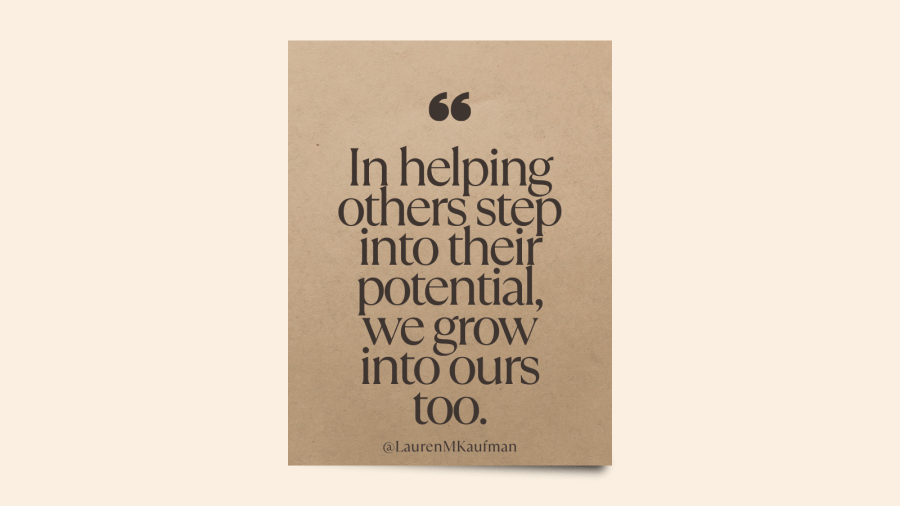
Because in helping others step into their potential, we grow into ours too.
Three Actions for Leaders Who Want to Lead Like a Coach
Balance Push and Pull
Model when needed. Guide with purpose. But trust others to stretch into the work. As you shift from directing to discovering, you’ll unlock potential you didn’t expect.
Build the Container
As Elena Aguilar teaches, psychological safety precedes instructional risk. Create space for vulnerability, reflection, and honest dialogue. Growth lives there.
Shift Your Stance
There is no one-size-fits-all approach. Chaudhary’s coaching matrix reminds us that responsive coaching means knowing when to lead, when to partner, and when to step back.
 Empower. Collaborate. Connect.