Recently I’ve been thinking a lot about what makes learning, leading, and educational ecosystems thrive. Over my two decades of serving in many roles in education, I have been witness to receiving change, implementing change, and leading change. All are hard. As Richard Gerver shares in his book Change, “You cannot thrive alone. Innovation and creativity, in order to be realized, are collaborative processes. The most important professional growth cannot take place in isolation. We need to be stimulated, challenged, and supported.”
Have you ever thought back to what makes a lesson work, an initiative move forward, a mission and vision take shape?
From classroom teacher to reading specialist to instructional coach to building and district leader, I have seen this through multiple lenses. But what makes learning thrive?
For me, it’s the people at the heart of it. It’s the educators, the students, the leaders, and the communities working together toward something meaningful. But it’s also the people who put the structures and systems in place to make those aspirations possible.
Lately, I have been living this work alongside our district office team, building leaders, literacy coaches, teachers, and families as we pilot new literacy resources. As I was planning with our literacy coaches this week, it became clear once again how essential systems are to making this kind of work successful.
There are many moving parts. Coordinating with consultants to ensure materials arrive on time and professional learning is aligned. Designing schedules so coaches can be in classrooms alongside teachers. Creating clear and consistent communication so all stakeholders understand the purpose and process. Gathering feedback from students, teachers, administrators, and families, and then making sense of it in a way that informs next steps.
None of this happens by chance. And none of it happens alone.
As George Couros shares in his book Forward, Together, “Often, when we fear trying something new, it’s not because of an abundance of information but a lack of it.” Systems help provide that clarity. They create the conditions for people to feel supported enough to try, reflect, and grow.
When I stepped into a formal leadership role five years ago, I began to more clearly understand two types of systems that must work together for learning to thrive: operational systems and academic systems. Let me help define them:
Operational systems are the day to day processes that support the functioning of schools. They include scheduling, staffing, resource allocation, technology systems, and communication structures.
Academic systems are directly connected to teaching and learning. They include curriculum, instructional practices, assessment systems, intervention programs, and professional learning.
One cannot work without the other.
In the book Coherence, Michael Fullan and Joanne Quinn reminds us, “The goal is coherence—a shared depth of understanding about the nature of the work.”
This idea of working in concert has always stayed with me. Because when systems are aligned, you feel it. And when they’re not, you feel that too.
You see it in classrooms where instructional time is protected because schedules were thoughtfully designed. You see it when teachers are implementing new practices with confidence because professional learning was timely, relevant, and ongoing. You see it when student work reflects growth because assessment systems are being used not just to measure learning, but to inform it.
And you also feel it when systems are not aligned.
Strong instructional practices can struggle when time is fragmented. High quality resources can fall flat when professional learning is disconnected. Thoughtful assessment practices can become overwhelming when systems for analysis and reflection are not in place.
This week, as I sat with our literacy coaches who work side by side with teachers to plan, reflect, and adjust instruction, I was reminded that flexibility matters. There were moments where something wasn’t quite working as intended. And it would have been easy to assume it was an instructional issue.
But more often than not, it was a systems issue.
A schedule needed to shift to allow for more consistent instruction. Communication needed to be clarified so expectations were shared across classrooms. Materials needed to be organized in a way that made them more accessible in the moment of instruction.
Small adjustments in operational systems created space for academic systems to thrive. And that is the work. Not choosing one over the other, but ensuring both are aligned in service of something bigger.
As I’ve been thinking through this work, here is one way I’ve started to think about it:
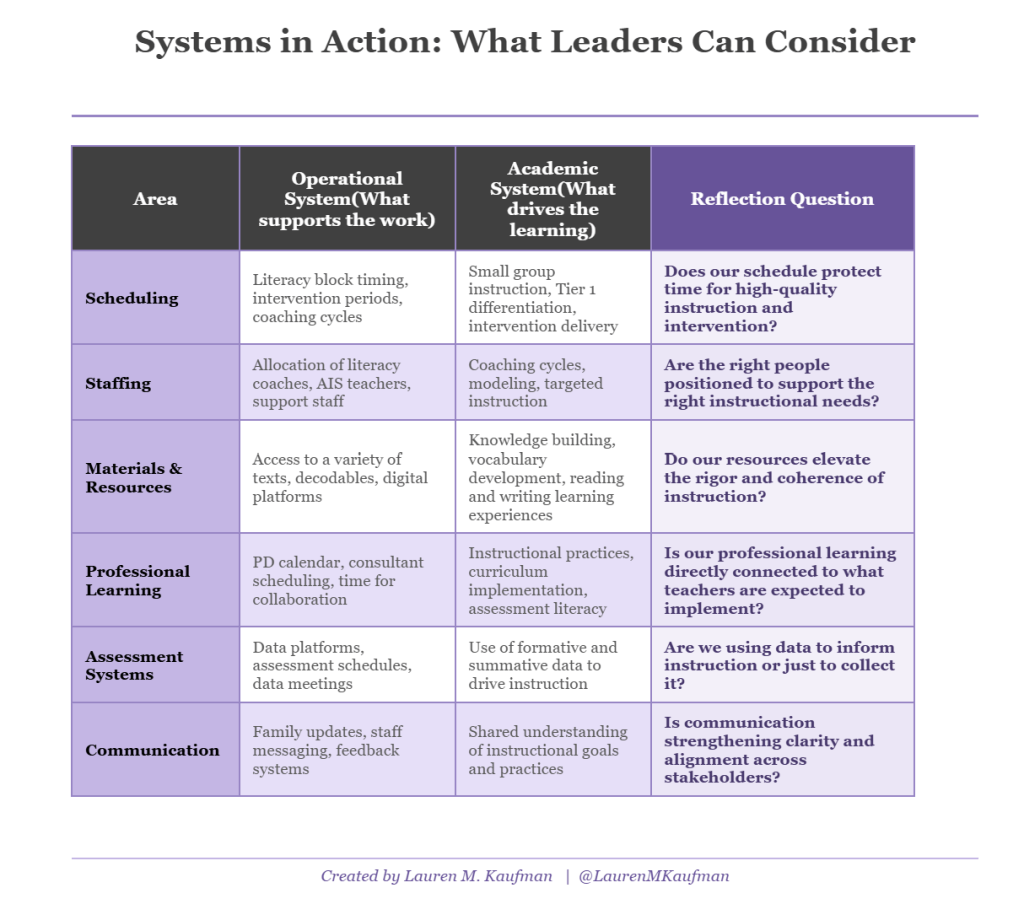
Because operational systems create the conditions. Academic systems create the learning. And people bring both to life.
So I find myself returning to the same question I started with.
What makes learning, leading, and educational ecosystems thrive?
For me, it’s still the people at the heart of it. As I share in my book, The Leader Inside, “The heartbeat of education lives inside the walls of schools. Within those walls you can find stories of kids and teachers in the mess of learning.”
But it’s also the systems they build together, refine together, and rely on to bring their vision to life.
Because no matter how strong the vision is, it cannot thrive without the structures that support it and the people who bring it to life.
And those structures cannot exist without the people who believe in what is possible and work, together, to make it happen.
 Empower. Collaborate. Connect.