I still remember the first time I stepped into a classroom as an instructional coach. I had my notebook, my questions, and my curiosity, but I also had something I did not yet have language for: the sense that I was entering magical space. At the time, coaching was a role many didn’t fully understand. I know that sentiment still remains true. Despite clear and consistent communication, some believed it was evaluative. Others thought it meant walking in to teach with a set of quick fixes. What I discovered instead was that instructional coaching is, at its core, an act of trust and collaboration. You walk alongside teachers. You listen. You learn. And you honor their craft by helping them see what is already possible inside their own classrooms.
Those early days shaped everything I believe about learning. I learned more from watching teachers teach than I had in years of traditional professional development. It was then that I wished when I was a classroom teacher I had been given more opportunities to step into other classrooms because real learning doesn’t happen in isolation. Real learning lives between people. It grows in classrooms where teachers take risks, open their thinking, and invite others into their practice. It grows in the quiet moments when a teacher leans in beside a student and asks a question that shifts the entire trajectory of a lesson.
Recently, while reading Brené Brown’s new book, Strong Ground, one idea captured my attention in a way that felt deeply familiar. She writes, “Courage begins with showing up and letting ourselves be seen.” Her chapter on pocket presence, a term borrowed from football, describes the grounded awareness leaders need when moments become complex. Pocket presence is not about looking confident. It is about being present. It is the ability to stay aware, to trust your preparation, to rely on the people around you, and to make choices that align with your purpose even as the environment shifts.
Although football isn’t something I know deeply, the more I thought about the metaphor, the more I realized that educators demonstrate pocket presence daily. They do it when a lesson pivots unexpectedly. They do it when a student asks a question that wasn’t in the plan but opens up a deeper conversation. They do it when they make instructional adjustments in real time because they sense students need something different. Pocket presence is woven into the everyday fabric of teaching and learning.
And me. I feel proud watching our coaches step into leadership. Coaching is a role I lived, and seeing it come alive in their hands makes me profoundly proud.
Now, as a leader, that belief is what grounds my commitment to professional learning inside classrooms. I believe that the richest learning happens with students at the center. It happens when teachers observe one another. It happens when they connect the dots between research, practice, and the classroom realities they navigate. And it happens in the spaces where practice comes to life, not in the places where we talk about it from afar.
This is why our recent classroom intervisitations mattered so much.
With me as a thought partner, grounding the planning in district and building priorities, our primary literacy coach centered her work on high-impact small group instruction tied to evidenced-based foundational reading skills. Our elementary literacy coach designed learning focused on interdisciplinary interactive read alouds that support vocabulary, content knowledge, oral language, and critical thinking.
But the real impact came from the systems that made these experiences possible. When leaders create time and structures for teachers to step outside their own classrooms and into the classrooms of colleagues, something transformative happens. Teachers are provided with the opportunity to see what is possible for students.
They notice small but powerful decisions. They see the intentionality behind materials and talk moves. They feel the impact of tools that are aligned tightly with learning goals. These moments stretch what Brené Brown describes as our reference sets, the mental libraries we draw from when the moment becomes complex and choices matter.
Teachers left these visits energized. Many shared that they wanted time to build their own tools after seeing the clarity and preparedness evident in the classrooms they visited. Several asked for make-and-take professional learning sessions so they could design purposeful scaffolds and materials. They didn’t just observe strong teaching. They imagined themselves doing the same work. And lucky them, this is not a one and done experience, the coaches will be there to support and help with the implementation. Isn’t that the heartbeat of collective efficacy?
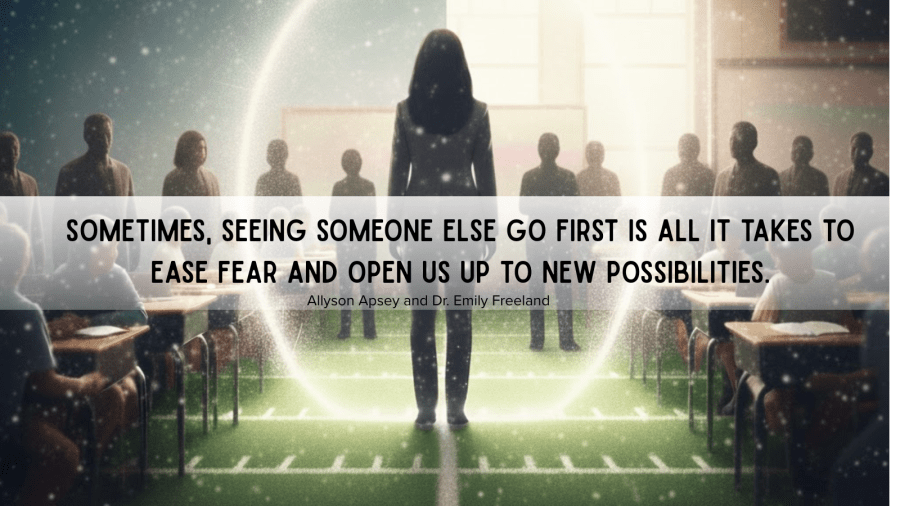
It reminds me of a powerful line from Allyson Apsey and Dr. Emily Freeland’s book Less Talk, More Action:
“Sometimes, seeing someone else go first is all it takes to ease fear and open us up to new possibilities. Imagine that playing out in our schools. Leaders modeling new practices, teachers testing ideas together, and change feeling less like a mandate and more like a shared journey.”
In many ways, that is exactly what unfolded during our intervisitations.
For intervisitations to truly flourish, the planning and communication behind them must be clear and intentional. Teachers deserve to know what the experience will look like, why it matters, and how their time will be supported. Our coaches honored that by sharing the purpose, structure, schedule, and materials in advance so teachers could step into the experience feeling prepared rather than overwhelmed. That clarity created the psychological safety that allowed the learning to take root.
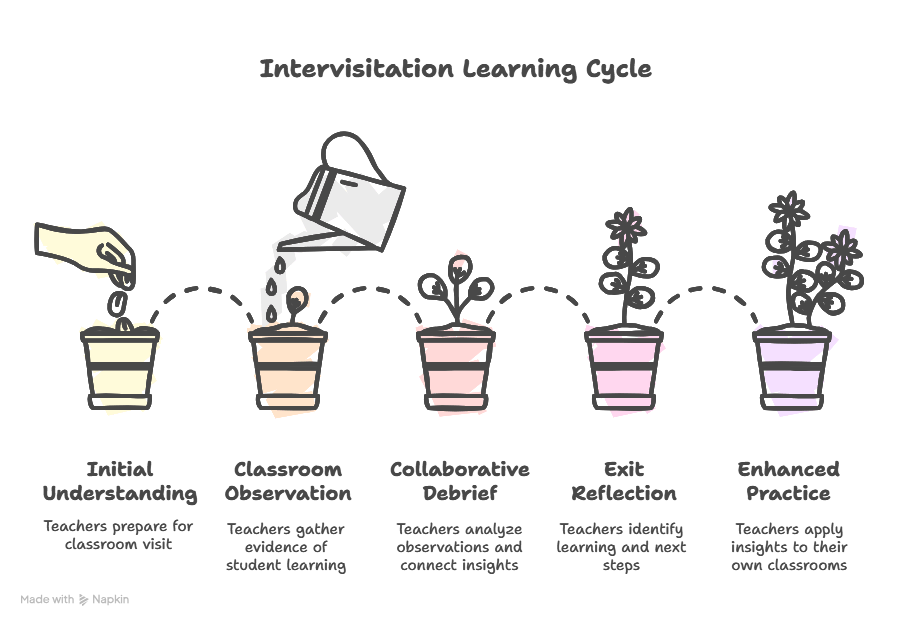
Intervisitation Structure Inside the Classroom
What I love most about this structure is its simplicity. Everything happens right inside the classroom, which means we aren’t pulling teachers away for long periods or scrambling for substitutes. Short, focused bursts of learning make the experience more digestible and immediately applicable. And because coaches stay alongside teachers throughout the process, not delivering a session and disappearing, we ensure that ideas are supported, strengthened, and carried forward in real, meaningful ways.
Pre-Meeting
Teachers meet briefly to understand the purpose of the lesson, the learning target, the essential literacy skills and priority standards, what to look for during the visit, and what success will look and feel like for students.
Observation
Teachers gather evidence of learning inside the classroom. They notice how students engage, how instruction builds toward learning goals, how materials support thinking, and how talk moves deepen understanding. They focus on noticing, not evaluating.
Debrief
Teachers come together afterward to make sense of their observations using Notice, Wonder, Reflect, and Apply. Together, they connect insights to their own classrooms and consider next steps. What do you notice? What do you wonder? How can this practice look in your classroom with your students?
Exit Reflection
Each teacher names one thing they learned, one next step they hope to take, and any support they may need. This final moment of reflection strengthens the learning cycle and honors the thinking that came before it.
[CLICK HERE for the full intervisitation template]
Moving Forward
This experience reminded me of something I wrote in my book, The Leader Inside:
“Surround yourself with people who act as mirrors, reflecting your growth.”
When teachers step into each other’s classrooms, they become those mirrors. They reflect strengths. They illuminate possibilities. They help each other see what they sometimes cannot see alone.
These are the moments that reveal who we are when we learn in community. Teachers show courage when they open their classrooms to others. They show humility when they allow someone else’s practice to shape their own. They show trust when they step into a colleague’s room with openness and curiosity. And they show pocket presence when they stay grounded and purposeful even as the moment shifts around them.
And so we return to where we began. Our classrooms are ecosystems filled with movement, complexity, possibility, and hope. They ask us to show up with courage. They ask us to stay present long enough to notice what matters. They ask us to trust ourselves and each other.
When leaders build systems that allow teachers to learn together, when coaches design structures that guide the learning, and when teachers step into each other’s practice with open hearts, something powerful takes root. Pocket presence becomes grounded confidence. Grounded confidence becomes collective strength. And the ecosystem grows stronger from the inside out.
And in all of these small, intentional acts, opening our classrooms, trusting the process, learning beside one another, we discover where pocket presence lives.
This is how we learn.
This is how we lead.
This is how we rise together.
Three Actionable Ideas for Leaders to Implement Tomorrow
- Open One Classroom Door
Invite a teacher to visit a colleague’s classroom for a five-minute walkthrough with one simple prompt: “What is one thing you notice that might strengthen your own practice?” No paperwork. No formality. Just noticing. - Anchor One Team Meeting in the Classroom
Start tomorrow’s team, grade-level, or PLC meeting standing in a classroom instead of a conference room. Ask, “What instructional moves in this space support learning?” Let the environment lead the conversation. - Send One Micro-Recognition
Before the day ends, send a short, specific note to a teacher naming a moment of pocket presence you observed. Something like: “I noticed how you shifted your questioning when students needed more support. That takes presence and skill.”
Moments noticed become moments repeated.

 Empower. Collaborate. Connect.
I knew this before, but after reading this, I feel th
LikeLike