I’ll never forget what learning looked like when I stepped out of the walls of my own classroom, into new learning spaces, and into various leadership roles. It quickly became clear that this was a unique opportunity to cross-pollinate ideas, share the magic happening inside classrooms with others, and witness how curiosity, creativity, and connection thrive when we learn alongside one another.
Those experiences taught me that leadership isn’t separate from learning, it’s an extension of it. When we expand our view beyond our own classrooms, we begin to see patterns of practice, shared language, and moments of impact that connect us to the heart of the important work we do in education. And this is when leading becomes an act of learning itself.
So what happens when you look at learning through a leadership lens?
When you step into a classroom and lean in to listen to the buzz of conversations, the exchange of ideas, and the quiet moments where thinking begins, you start to notice how leadership and learning intertwine. Seeing Learning Through Leadership Lenses begins with curiosity, not evaluation. It’s about asking what learning looks like, sounds like, and feels like when students and teachers are engaged in authentic, meaningful work.
Looking Closer, Together
Here’s what I’ve come to understand: When we, as leaders, develop a shared understanding by learning together, we can walk into classrooms and begin to notice the small details that reveal something much larger. Every question posed, every anchor chart on the wall, and every student interaction becomes a window into high-impact practices aligned with the six important attributes illuminated in New York State’s Portrait of a Graduate: Academically Prepared, Creative Innovator, Critical Thinker, Effective Communicator, Global Citizen, and Reflective and Future-Focused.
As you may be aware, the Portrait of a Graduate is a statewide vision that defines the knowledge, skills, and dispositions every student should develop to thrive in learning, work, and life. Across the country, most states have already begun this work, using their own portraits to ensure students are not only academically prepared but also equipped with the competencies, skills, and mindsets needed to succeed in a rapidly changing world. It serves as both a compass and a common language for what we value most in education.
When we walk beside our colleagues and look through shared lenses, we can name and celebrate the practices that align with these attributes. Together, we bring clarity to what matters most, strengthen coherence across classrooms, and create the conditions for collective growth around impactful teaching and learning.
Creating the Conditions for Seeing Learning
Recently, our Leadership Team gathered to explore how these attributes live inside classrooms. We revisited Active Learning Look Fors we created over the summer, using them as a guide to align what we value with what we see in our learning ecosystems.
To achieve our mission and vision, we name and look for active learning environments where students are generating ideas and questions, collaborating with peers and teachers, using their imaginations, inventing, taking responsibility for their learning, and reflecting on their work.
We promote active learning through six essential practices that make this work visible: Classroom Talk, Instruction, Assessment, Student Work, Materials and Resources, and Classroom Environment.
Below are two examples of how the six components for active learning connect to the Portrait of a Graduate attributes: Academically Prepared and Creative Innovator. These examples illustrate how active learning comes to life in classrooms and how leadership teams can use shared lenses to notice and nurture these practices.
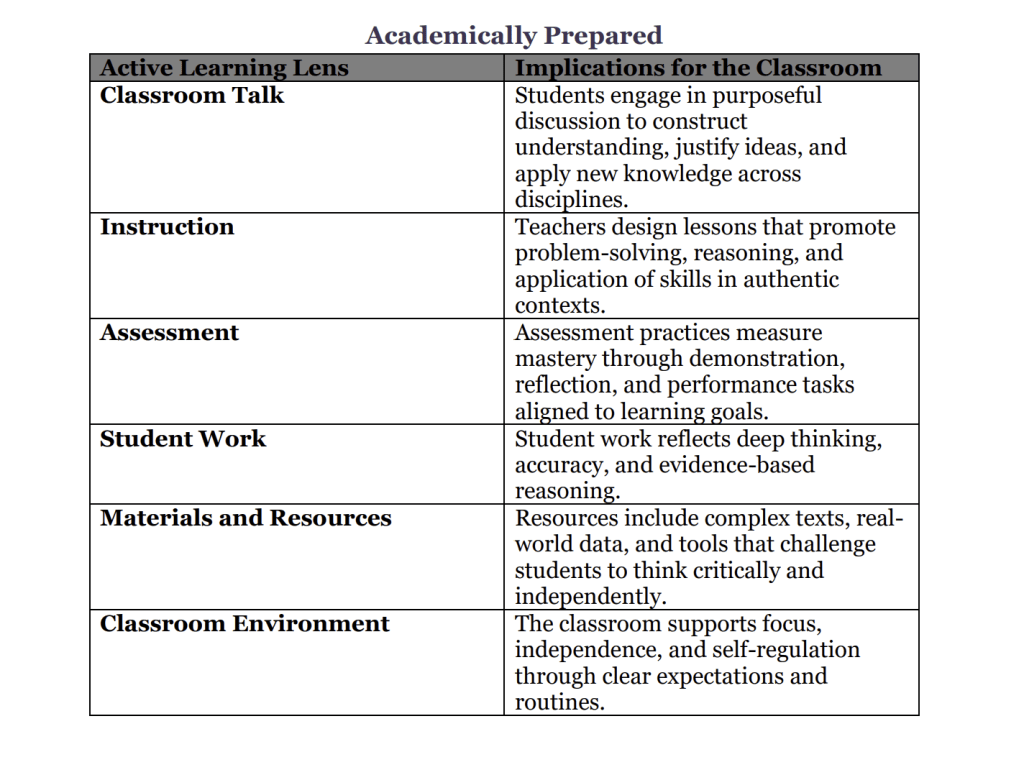
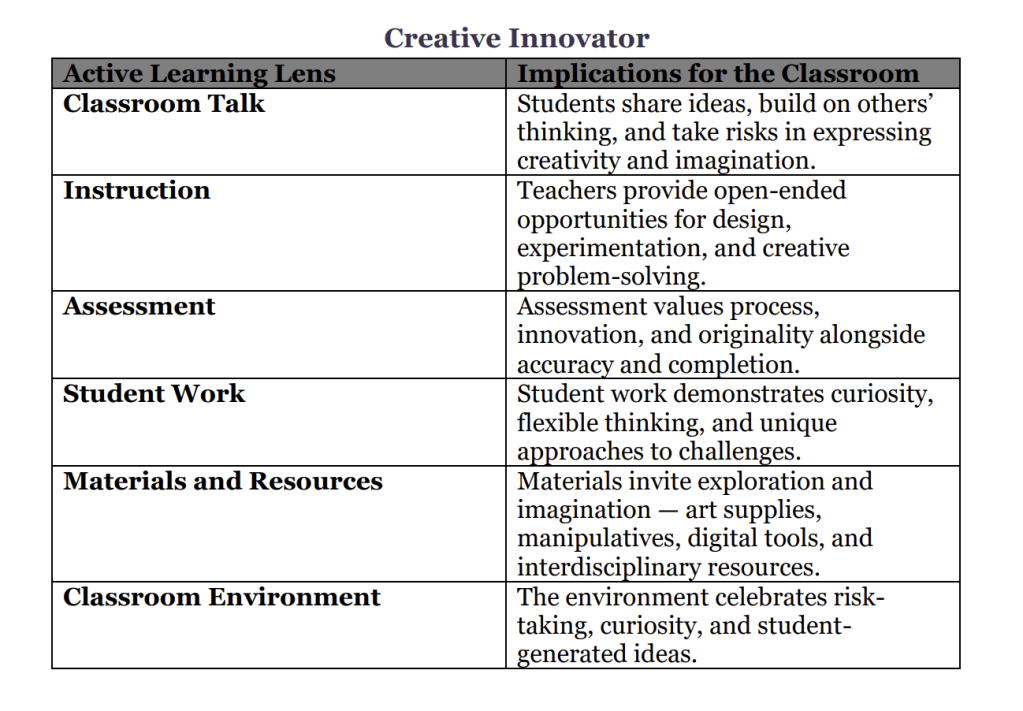
As leaders, looking through these examples helps us move from observation to understanding. When we notice how the six practices come together to support each attribute, we can name what’s working, celebrate the conditions that make learning thrive, and create opportunities for growth that are anchored in shared language and purpose.
Each grade band focused on one Portrait of a Graduate attribute to go deeper into this work. Kindergarten and first grade explored Creative Innovator, grades two through five focused on Critical Thinker, grades six through eight examined Global Citizen, and grades nine through twelve reflected on Effective Communicator. This structure helped us connect instructional practices and classroom look fors directly to how these attributes come to life for students at different developmental levels.
As we worked together, we carried one guiding question that grounded our notes and conversations:
How can we as leaders support teachers in fostering creativity and innovation in their K–1 classrooms?
How can we as leaders support teachers in fostering critical thinking in their 2-5 classrooms?
How can we as leaders support teachers to guide students to reflect on their practice of empathy, compassion, and global awareness in the 6-8 classroom?
How can we as leaders support teachers in effective communication and more student talk in their 9-12 classrooms?
That question invited us to pause and see leadership not as evaluation, but as connection. It reminded us that every classroom tells a story not only about what students are learning, but who they are becoming.
From Building Understanding to Action
In Less Talk, More Action, Allyson Apsey and Dr. Emily Freeland write,
“To truly shift beliefs about teaching and learning, we must first create new experiences. The biggest changes don’t come from data slides or inspirational speeches. They come from launching a new practice, seeing the results, and feeling the impact… Instead of aiming for buy-in, what if we asked for try-in? (p. 14).
That reflection captures what Seeing Learning Through Leadership Lenses is all about. Leadership begins with try-in. It starts when you walk into classrooms with curiosity, look for connections, and learn alongside teachers and students.
Our leadership team continues to use shared observation structures to guide this work frameworks that help us look closely, reflect together, and reimagine next steps for teaching and learning. But the most important tool is not a protocol. It’s presence. It’s the act of showing up, listening deeply, and helping others see what’s possible when we all focus on learning.
Leading Through Learning
As I reflect on this process, I return to a line from my book The Leader Inside:
“Great leaders can help others find their gifts and light a spark that ignites a sense of passion and purpose.”
That is what happens when you lead through learning. You notice, you name, and you nurture the gifts that already exist within others and in doing so, you help them shine brighter.
Seeing Learning Through Leadership Lenses reminds us that leadership and learning are inseparable. When you walk classrooms with curiosity, when you listen more than you speak, and when you invite reflection instead of evaluation, you create space for growth yours and others’.
When we lead in this way, we can see curiosity in kindergarten, persistence in fifth grade, empathy in eighth, and confidence in twelfth. Each moment builds on the next, shaping the story of learning in our schools.
When you layer your lenses, you do more than observe.
You lead. You learn. And you help bring future focused learning to life, one thoughtful action at a time.
Three Actionable Ideas to Try Tomorrow
1. Walk with Curiosity, Not Evaluation
Visit one classroom with the intention of noticing, not judging. Jot down what students are doing, saying, and creating that reflect curiosity, creativity, or connection. Share a positive observation with the teacher that highlights student engagement rather than instructional compliance.
2. Anchor Reflection in the Six Practices
After your next walkthrough or learning conversation, use the six implications for active learning: Classroom Talk, Instruction, Assessment, Student Work, Materials and Resources, and Classroom Environment as lenses for reflection. Ask yourself: Which of these practices came alive most vividly in what I observed?
3. Connect to the Portrait of a Graduate
Choose one attribute (for example, Creative Innovator or Global Citizen) and identify one way it’s visible in your classrooms. Invite your team to share examples and discuss how they might nurture that attribute more intentionally across grade levels.
 Empower. Collaborate. Connect.
This is such an inspiring perspective on how leadership and learning go hand in hand. I really appreciate how you emphasized curiosity, collaboration, and reflection as key parts of meaningful education. As someone working with an educational consultancy in Kerala, I completely relate to the idea that true growth happens when we learn and lead together. Thank you for sharing such valuable insights on fostering creativity and innovation in classrooms!
LikeLike
Thank you so much for reading and for sharing what resonated! It means the world!
LikeLike