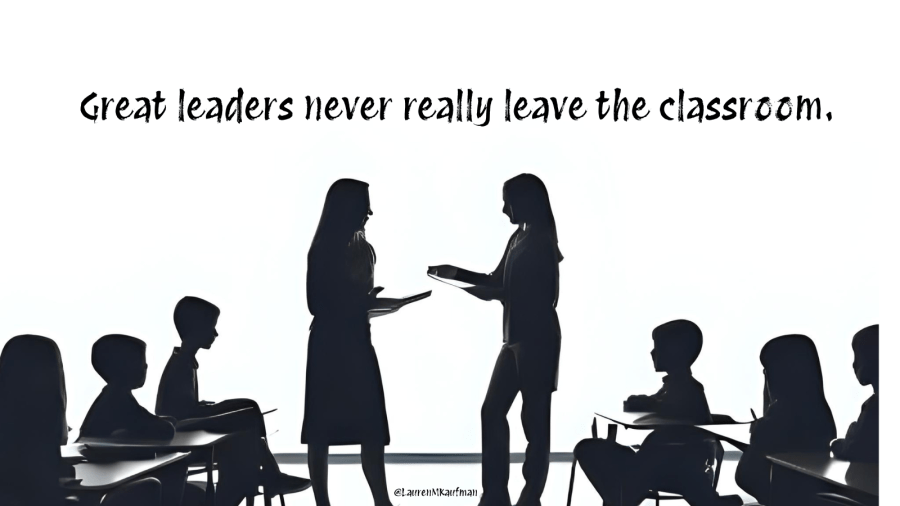
One of the most unsettling thoughts I continue to have as a leader is that I might drift too far from the classroom, too far from what’s real, what’s possible, and what’s happening in the moments that matter most.
Sure, I can do my classroom visits and walk-throughs, and I do, intentionally. I can conduct formal observations through a coaching lens and focus on high-impact instructional practices, and I do, purposefully. But there is nothing like the day-to-day interactions with students. There is nothing like creating your own learning ecosystem and watching learners blossom within it. There is nothing like seeing the small moves that make the bigger impact. There is nothing like the connections you make with your students.
So, how can we as leaders overcome the fear of losing touch with the classroom?
My answer: go inside and teach.
Go inside and notice the beautiful learning ecosystems teachers have created. Notice how students have formed friendships and navigate learning within their environment. Notice what’s working and what’s not. Teaching again reminds us what it feels like to be inside the work, to adapt in real time, to be both learner and leader.
When I’m considering a new practice or resource, I ask teachers if I can model it myself. That’s exactly what I did this week. I stepped into classrooms to model lessons using a resource that supports some complex phonics principles. Each time I taught, I refined. Each time I refined, I responded to students’ thinking and to teachers’ curiosity. Our literacy coach shadowed me and later shared that she felt more confident modeling the resource herself after watching me teach. And when I watch teachers teach, the same magic happens. That’s how capacity grows, through shared practice, trust, and presence.
Later in the week, I visited a high school classroom where a teacher implemented a move we had discussed last year in her post-observation conversation: giving students authentic opportunities to respond to literature in non-digital formats. Watching students deeply engaged in discussion, pens in hand, ideas spilling onto paper reminded me that innovation doesn’t always require a device. Sometimes, it simply requires intention.
That day, I was reminded of something I wrote in my book, The Leader Inside: “You don’t have to search for the big things to see good things happen. The small things matter, too.”
And as Brené Brown writes in her new book Strong Ground, “Individually and collectively, we are all looking for strong ground right now. We need to push into the source of our strength and sturdiness so we can navigate the world.”
Teaching again grounds me. It brings me back to the source of my strength, the classroom, where curiosity meets courage and where meaning is found in the smallest of moments.
Leadership, at its core, is not about distance, it’s about proximity. It’s about walking beside, not ahead. It’s about modeling vulnerability, curiosity, and the willingness to keep learning alongside others.
Brown reminds us that, “There is no courage without vulnerability. If there’s no uncertainty, risk, or exposure, we’re not being brave.”
When we step back into classrooms, we embrace that uncertainty not as something to fear, but as something to learn from. We are reminded that strong ground is not built through control or certainty, but through courage, connection, and presence.
So, how do we as leaders stay close to the classroom?
We go inside.
We notice.
We model.
We stay curious.
Because there is nothing like the day-to-day interactions with students.
There is nothing like creating your own learning ecosystem.
There is nothing like seeing small moves make a big impact.
There is nothing like the connections you make with your students.
And there is nothing like remembering through teaching again that great leaders never really leave the classroom.
Three Actionable Ideas for Leaders to Implement Tomorrow: Staying Close to the Classroom
1. Model a Lesson or Strategy
Step into a classroom and teach a short segment of a lesson using a new instructional strategy or resource.
- Why it matters: Modeling reinforces shared learning and communicates that leadership is rooted in practice, not distance.
- Try this tomorrow: Choose one class and co-teach or model a portion of a lesson. Invite your coach or a teacher to observe, and debrief together afterward: what worked, what could be refined, and how this connects to broader goals.
2. Create “Learning Walks with Purpose”
Transform traditional walk-throughs into intentional learning walks focused on noticing and naming instructional strengths.
- Why it matters: When leaders observe with curiosity rather than evaluation, they build trust and uncover the authentic pulse of teaching and learning.
- Try this tomorrow: Visit two classrooms with a specific focus (e.g., student engagement, vocabulary development). Leave a handwritten note or a short follow-up message via voice note celebrating something specific you noticed.
3. Facilitate a Reflective Conversation
Gather a small group of teachers for a brief, focused dialogue about classroom learning.
- Why it matters: These conversations create shared ownership of instructional growth and strengthen the bridge between leadership decisions and classroom realities.
- Try this tomorrow: Ask, “What’s something that’s working well in your classroom right now?” and “Where might we learn alongside you next?” End by identifying one shared action you’ll all take before your next conversation.
 Empower. Collaborate. Connect.
Another meaningful, well written piece of writing th
LikeLike
I appreciate you always taking the time to read my writing… Thank you!
LikeLike