This post is one of my most shared and read blogs, and as I step into my 20th year in education, I find myself reflecting on why it still resonates. I first shared these ideas when I was an assistant principal, co-presenting with my former colleague and principal at a popular local conference on shifting the narrative of observations. The room was standing-room only — not because we had all the answers, but because so many educators were eager for conversations about feedback that truly elevates practice.
As I wrote in my book The Leader Inside:
“Great leaders can help others find their gifts and light a spark that ignites a sense of passion and purpose.”
Those words still guide me today. Every time I step into a classroom, I’m reminded that leadership is about presence and partnership…standing beside teachers to help them see their own brilliance and to grow from it.
Now, several years later, my role may have evolved, but my belief in the power of authentic, collaborative feedback has only deepened. Teachers are used to me being in their rooms — observing, reflecting, and growing right alongside them. And every visit, every conversation, still reminds me of why this work matters.
Shifting the Observation Narrative
Looking back, my growth as both an educator and a human being has rested on the shoulders of those who generously asked what worked well, what didn’t, and who gave me the time and space to collaborate, think, and reflect. Over my career, I’ve been formally observed more than 35 times. Yet the observations that truly shaped my practice weren’t necessarily the ones that came with a formal write-up or a rubric.
It was the in-the-moment dialogue, the reciprocal nature of authentic, meaningful exchanges that helped me see my practice through a new lens and take actionable steps forward.
Those lessons became my foundation as I moved into leadership roles. From classroom teacher and instructional coach to assistant principal and now instructional leader, my perspective has been shaped by countless conversations with administrators, teachers, mentors, students, and families. One truth has remained clear: every educator adds value to the dialogue, and those on the frontlines have the deepest insight into where they need to grow.
As I continue to lead and coach, I often return to the same questions:
- How can I be the administrator I always needed during the observation process?
- How can I leverage my teaching and coaching experiences to elevate and support the educators I serve?
Grounding the Work
I have always valued the role of a coach, a thought partner, a trusted colleague who helps me see what I might otherwise miss. Jim Knight defines an instructional coach as:
A dedicated partner for teachers, providing evidence-based practices that improve teaching and learning so students everywhere can be more successful.
And while the work of observation is never done in isolation, it is a shared journey my commitment to viewing observations through a coaching lens has only deepened over time.
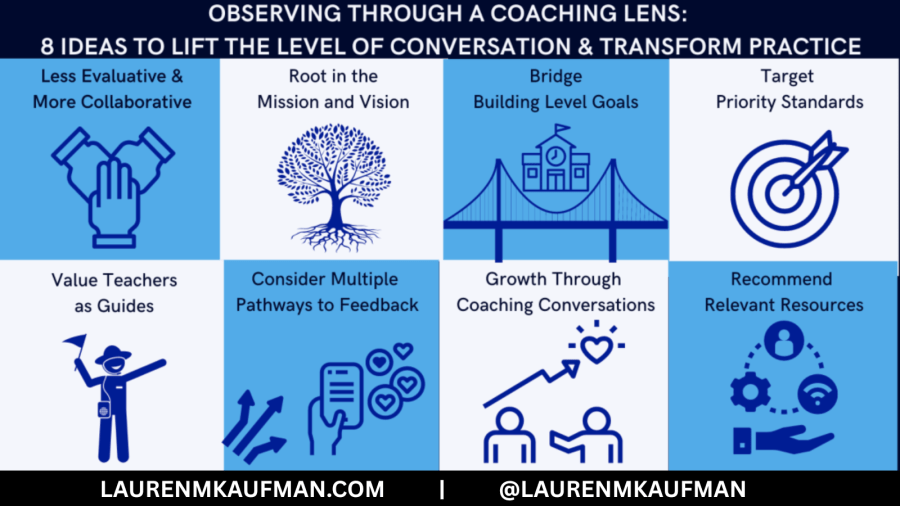
Observing Through a Coaching Lens: 8 Ideas to Lift the Level of Conversation & Transform Practice
Print the image below to share with your teams HERE or click on the image below
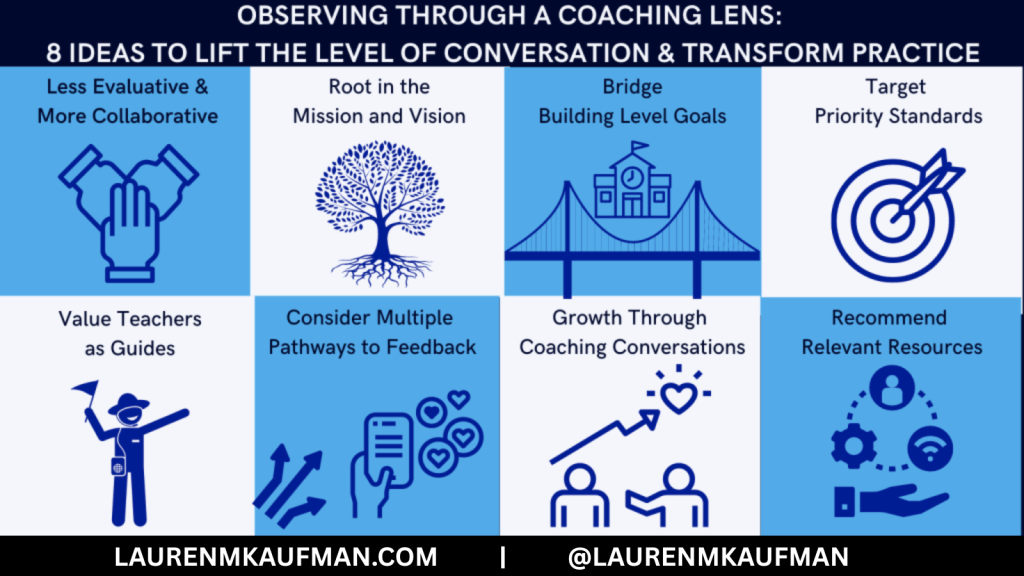
1. Less Evaluative and More Collaborative
Approach conversations as a thinking partner. There are no titles in teaching and learning discussions. Keep the conversations focused on the learner and the learning. In the book Innovate Inside the Box by George Couros and Dr. Katie Novak, George identifies three critical areas for learning by educators and why they are crucial:
- Learn about our students
- Learn for our students
- Learn from our students
The same applies during a collaborative conversation between an administrator and teacher:
- Learn about our teachers
- Learn for our teachers
- Learn from our teachers
There is no one who knows themselves and their learners better than the teacher themselves.
2. Root in the Mission and Vision
When I was onboarded to my first administrative role, the assistant principal, one of the first documents my principal shared with me was the District’s mission and vision. I am still in awe of the time, thought, and collaborative effort that had gone into creating this document. This isn’t a document that is simply just posted on the District website. This is a document that lives and breathes in every conversation we embark on. The language and meaning are easily embedded into observations, informal conversations, professional learning experiences, and presentations. In discussing teaching and learning with teachers and planning instruction, we look back at the mission and vision together and intentionally reflect on student outcomes. Is the planning, process, and evidence a reflection of what we believe in as a school District?
3. Bridge Building Level Goals
When discussing the mission and vision, it is vital to communicate and bridge the building-level goals with the discussion. As teachers are planning, executing, and responding in real time during lessons, having a building-level focus such as “student-generated questioning,” “enhancing evidence-informed practices,” or “delivering intentional small group instruction” (to name a few) can keep the goals of the conversation grounded and the planning and preparation more focused. Connected to the mission and vision, these are also district- and building-wide goals to address. For example, they reflect the high-impact practices in the Big Six skills and competencies: oral language, phonemic awareness, phonics, fluency, vocabulary, and comprehension as outlined in the New York State Science of Reading Literacy Briefs, as well as the six attributes of the Portrait of a Graduate that are reflected in the learning experiences we provide students.
4. Target Priority Standards
It’s no secret that learners are expected to be exposed to, explore, and, in many cases, master a significant number of standards by the end of a school year. In Fearless Instruction by Creative Leadership Solutions, the authors note, “Since the start of the standards movement, bitter controversies have divided educators, leaders, and policymakers about standards. However, one issue garners widespread agreement: There are too many standards with too little time to teach them all effectively.” Start by asking the teacher: What should students know and be able to do by the end of this lesson? Then, zoom in on the priority standards, those that are most critical for helping learners access more complex skills. Consider creating a shared digital folder of standards that teachers can reference while planning lessons to keep everything organized in one space. This not only supports intentional planning but also helps guide conversations around assessment. It naturally leads to the next reflective question: How will you know if students are accessing and working toward mastering the standard during and after the lesson and transferring those skills across other content areas?
5. Value Teachers as Guides
Allow the teachers to guide the observation conversations. Let them talk about the teaching and learning that transpires in their rooms. Encourage them to share their data — diagnostic, formative, and summative assessments as well as insights from classroom observations. In Fearless Instruction by Creative Leadership Solutions, the authors remind us: “The most impactful formative assessments are designed to be a continuous and integrated process in daily instruction, to continually monitor student progress so that educators can shift and adapt in the moment, and allow educators to have systems of data collection that are part of their daily routines with students.” When teachers share what they are most proud of and where they see opportunities for growth based on evidence, these authentic discussions become even more meaningful. They show teachers that you value their expertise and create the conditions for a more organic, collaborative experience.
6. Consider Multiple Pathways to Feedback
After an observation, I never leave a classroom without naming the goodness I saw. I don’t make the teacher wait for a formal observation write-up to learn the impact they had during that lesson. As a former teacher, I remember how the waiting often created unnecessary anxiety and that’s the last thing educators need with everything else on their plates. Instead, I make it a point to talk directly with the teacher and students before I leave, naming the specific work I observed:
“It was amazing to see you using accountable talk stems to lift the level and build on each other’s thinking together. I can see you and your teacher have been working hard at actively listening to one another so you can add on to the discussion in meaningful ways.”
I also like to follow up with a digital note, a handwritten message, or even a quick Voxer (walkie-talkie app) message sent right to the teacher’s email immediately after the lesson. This not only reinforces that their efforts were noticed and valued but also shows that I see myself as a true learning partner in the process.
7. Growth Through Coaching Conversations
Ask good questions that will spark learner-driven conversations. They will lead you to identifying and focusing on a problem of practice. Questions such as:
- What worked well for you during our collaboration and observation process?
- How has your teaching been positively impacted?
- How do you feel our collaboration has positively impacted the students?
- What were any challenges or missed opportunities during our work together?
- What are some next steps in your teaching?
8. Recommend Relevant Resources
Like teachers, every instructional leader should have a “bag of tricks” ready to support and grow educators during any conversation. Staying well-versed in up-to-date articles, books, and practical resources that teachers can implement in their classrooms tomorrow is an invaluable investment in the teaching and learning process. Outside of the observation cycle, I make it a priority to share relevant articles — and when I can’t find one that fits, I write one to capture my thinking, grounded in district priorities and teacher goals. I did that recently in a post titled Bringing the Portrait of a Graduate to Life Through the Canon, where I explored how the six attributes of the Portrait of a Graduate can be brought to life in the English classroom. I shared that post during our first department meeting to spark conversation and reflection. Now, I’m not suggesting that every leader needs to write an article, but there is tremendous value in curating and sharing resources that align with your vision and the needs of your team.
A few years ago, for example, I recommended Evolving Education by Dr. Katie Martin to a teacher after observing a lesson that was learner-driven, personalized, and innovative. I wanted to help this seasoned teacher find ways to make small but powerful shifts in her already strong practice. As she read the book, she began sharing which parts resonated with her and how she was applying those ideas. One example stood out: she used the School Learner Profile exemplar from page 16, alongside our district mission and vision, to create a customized learner profile that reflected the values of her classroom community.
Moving Forward
This post has stood the test of time because the message is simple and true: every interaction is an opportunity to build trust, deepen dialogue, and transform practice.
As I revisit these words in my 20th year of education, my belief in this work is stronger than ever. Observing through a coaching lens isn’t about evaluation, it’s about partnership, presence, and possibility.
So, I invite you, whether you are a teacher, coach, or administrator, to step into classrooms, engage in authentic conversations, and name the strengths you see. Build on what’s working. Lean into curiosity. Create moments where teachers feel seen, valued, and supported.
As my colleague and former principal once shared with our staff, “Michael Phelps’ coach is not better than him at swimming; he is there to support his growth and provide feedback so he can be better.” That is the essence of this work: helping educators see what they may not see on their own and walking beside them as they rise.
 Empower. Collaborate. Connect.