Years ago, I met two educators at a conference where I presented regularly. I remember them well because, individually and at different times, they attended my sessions and stayed afterward to speak with me about all things education.
There is something about an educator who takes the time to do that that has always stayed with me. To me, it signals excitement, curiosity, and engagement in one of the most noble professions. These are learners who want to evolve and grow. They certainly do not want to remain stagnant in a space that is always evolving and changing.
Over time, we stayed connected, and I had the privilege of mentoring each of them in different capacities as they embarked on their teaching careers.
I remember those interactions leaving me better too.
I was sharing advice I was given or would have liked to receive myself. I shared my own wins, mistakes, and obstacles. But I was also listening to their stories, and those stories caused me to reflect on the leader I was still becoming and how I wanted to lead.
That is the thing about mentorship. You never know who you are helping become. And sometimes, you do not realize how much they are helping you become too.
Years later, I now have a front row seat to the growth and development of these two educators in my own district. There is something wonderfully serendipitous about that.
Recently, I spent part of a morning shadowing one of them as she administered new reading assessments to students. Since we updated our assessment suite, I wanted to experience both the administration process and how students were responding to and navigating the assessment.
If you come to this space to read my reflections each week, you know I believe we can roll up our sleeves, get into classrooms, and learn alongside educators by experiencing the work we are asking them to do themselves.
Before the assessment, she reviewed each component with me. She shared what she had been observing with students. As she administered, I sat alongside her. We discussed how students were interacting with the assessment, what we were learning from their responses, where our administration guide could be refined, and updating it in real time.
That guide had already been shaped by feedback from other educators administering the assessment, and now we were learning from the experience again in real time.
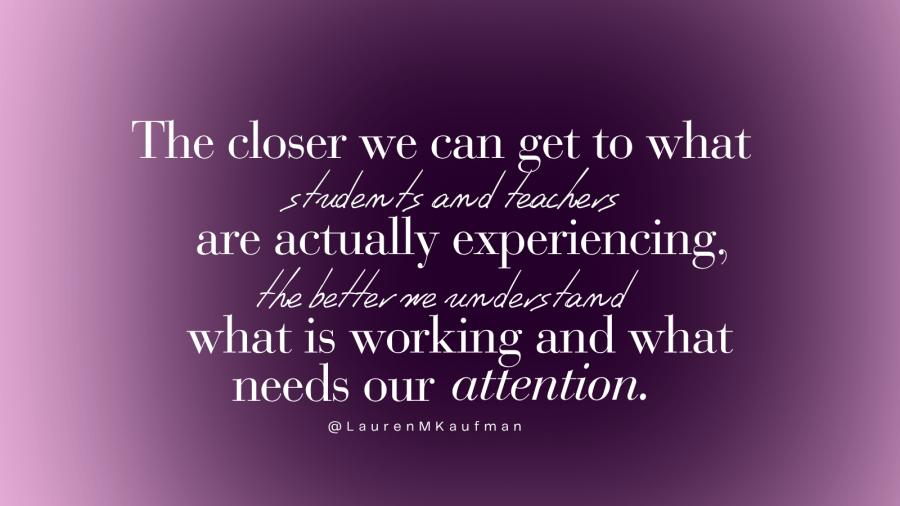
This work matters. We are in year one of implementing a new literacy resource, and curriculum, instruction, and assessment need to come into alignment. The closer we can get to what teachers and students are actually experiencing, the better we understand what is working and what needs our attention.
But there was another part of the morning I had not planned for.
It just so happened that we were administering the assessment in the classroom of the other educator I had met all those years ago.
How lucky was I to be in one space with two educators so close to my heart? While I sat beside one, I had the gift of watching the other teach.
Her room was calming. Her tone was encouraging. I noticed how intentional she was with her minutes. From bucket filling and the attention she gave to social-emotional learning, to the strong sense of belonging she created, to the engaging lessons that made management feel seamless, there was so much happening and yet no one was skipping a beat when it came to learning.
When she moved into her phonics instruction and then the reading lesson from our new resource, I was struck by the personal touches she added and the high expectations she held throughout.
During a phonics drill warm-up, I quickly pulled out my phone and recorded a short video. I immediately sent it to a few leaders in my district.
And almost instantaneously, what seemed like an explosion of ideas and enthusiasm came streaming throughout the text thread.
How could we share this? How could these instructional practices be cross-pollinated throughout the district?
I found myself thinking how glad I was that I had been there to see it and illuminate some of the goodness happening in that room.
And that is largely because I know this kind of goodness is happening regularly in classrooms.
It is not always shared because there is not always someone in the room to notice it, capture it, and help others learn from it. There are so many competing priorities in schools, but imagine if leaders intentionally carved out more time to simply sit in classrooms uninterrupted, without typing away for an observation.
Just watching. Listening. Wondering. Learning.
You never know who you are helping become.
I believe so deeply in the power of mentorship that I dedicated an entire section of my book, The Leader Inside to it. Much of that writing grew out of my own experiences serving as a mentor coordinator and thinking about the people who had shaped me along the way.
I wrote about how people can enter our lives “for a few moments, a few hours, a few days, weeks, or years” and can still influence our growth.
I also wrote that “the journey to becoming a great educator and leader is an ongoing process of self-discovery and growth.”
Recently, as I read Angela Duckworth’s Situated, I found myself thinking about these ideas all over again. In her chapter about attracting mentors, Duckworth describes people who become “mentor magnets.” They are curious. They seek opportunities to learn. They ask questions. They show up.
I immediately thought about these two educators.
Years ago, they showed up. They stayed after. They asked questions. They wanted to learn. And then they kept growing.
Duckworth also explores the importance of mentors believing in people, sometimes before those people completely believe in themselves. That connected to something I wrote in The Leader Inside about recognizing the gifts in others and helping them see “the leader inside” themselves.
Maybe mentorship is not always as complicated as we make it. Sometimes it is seeing something. Naming it. Nurturing it. And creating the space for someone to grow into it.
So I wonder: Who saw something in you before you fully saw it in yourself?
And perhaps the more important question is, who might need you to see something in them right now?
Here Are 3 Actionable Ideas for Leaders to Implement
- Capture and share the goodness you see.
When you notice a strong instructional practice, take a quick photo or video, with appropriate permissions, and share it with colleagues. Use it to spark conversation, cross-pollinate ideas, and help strong practice travel beyond one classroom. That is exactly what happened when you recorded the phonics warm-up and shared it with district leaders. - Spend time in classrooms without an evaluative lens.
Carve out time to simply be present. No observation form. No laptop. No rush to document. Watch, listen, wonder, and learn. Being close to the work helps leaders understand what teachers and students are actually experiencing. - Learn alongside educators.
Roll up your sleeves and experience the work you are asking others to do. Sit beside teachers, ask questions, notice what is working, and refine systems together in real time. Leadership becomes more responsive when we learn with people instead of only leading from a distance.
Years ago, I was standing in conference rooms talking with two educators who stayed behind to ask one more question.
I could never have known where those conversations would lead. Years later, I found myself sitting in a classroom with both of them. One was beside me, thoughtfully studying students and learning alongside me. The other was teaching in front of me, creating the kind of learning environment I know she had spent years becoming ready to create.
And for a moment, I could almost see those younger educators standing in front of me again. Except now, I had a front row seat to the educators and leaders they had become.
What they may not realize is that somewhere along the way, they helped me become too.
You never know who you are helping become. And every once in a while, if you are lucky, you get to find out.
Discover more from Empower. Collaborate. Connect.
Subscribe to get the latest posts sent to your email.

