Before I stepped into a formal leadership role and even before my career in education began as a teacher, I thought a leader’s role was to be a manager. I believed their work was about organization, structure, and oversight. It wasn’t until I encountered leaders who inspired me to become the best version of myself that I began to see leadership differently.
Later, reading books such as The Innovator’s Mindset by George Couros, The 7 Habits of Highly Effective People by Stephen R. Covey, Good to Great by Jim Collins, Dare to Lead by Brené Brown, and How to Win Friends and Influence People by Dale Carnegie (just to name a few to help you fill your Amazon cart) reaffirmed that shift. Each reminded me that leadership is not defined by authority, but by the ability to influence, empower, and elevate others. Can you relate?
If you have been following my writing, you know that through this blog and in my book The Leader Inside, I often return to one guiding question: What type of leader do you wish to become, Lauren? My answer has always remained steadfast: To become the leader I always needed. The kind of leader who leads through both inspiration and impact.
Reading Brené Brown’s conversation with Ginny Clarke in chapter nine of her new best-selling book, Strong Ground reminded me why that answer still holds true. But, Clarke describes managing as planning, organizing, delegating, and problem-solving, the steady and necessary work that keeps systems running. Leading, she explains, is guiding, influencing, and inspiring others through a shared vision. One ensures that things function, while the other ensures that people flourish.
I also remember studying these ideas years ago in my leadership courses, learning about the differences between transactional and transformational leadership. Even then, I felt drawn to the kind of leadership that does not just maintain systems but moves hearts and minds.
I’ve come to realize that this balance between managing and leading closely mirrors the concepts of transactional and transformational leadership. I do believe that both play an important role in how we build schools and develop people.
The chart below provides a side-by-side comparison, with examples of what each approach might look like in schools:

In schools, you live in that tension every day. How often do you find yourself moving back and forth between managing and leading? Do you notice when you are focused on creating systems and when you are nurturing the spirit behind them? You manage curriculum maps, assessments, and meetings, but you lead through listening, noticing, and responding. Managing helps you bring clarity and order to the work. Leading helps you bring purpose and heart to it. The real power of leadership lives in your ability to recognize when to ground your work in structure and when to lift it through inspiration and to move between the two with intention.
Still, somewhere along the way, we began to conflate compliance with care. We became cautious about clarity when, as Brené reminds us, “Clear is kind. Unclear is unkind.”
What if, instead of softening our feedback to stay comfortable, we embraced clarity as a form of kindness?
Clarke’s words stay with me: “True leaders develop other people. Strong managers do too.” Both roles require courage. They ask us to give feedback that is honest and hopeful at once. When was the last time you told someone, “I believe in you and here’s what will make you even better?” How often do we step close enough to help someone grow instead of staying safely on the sidelines?
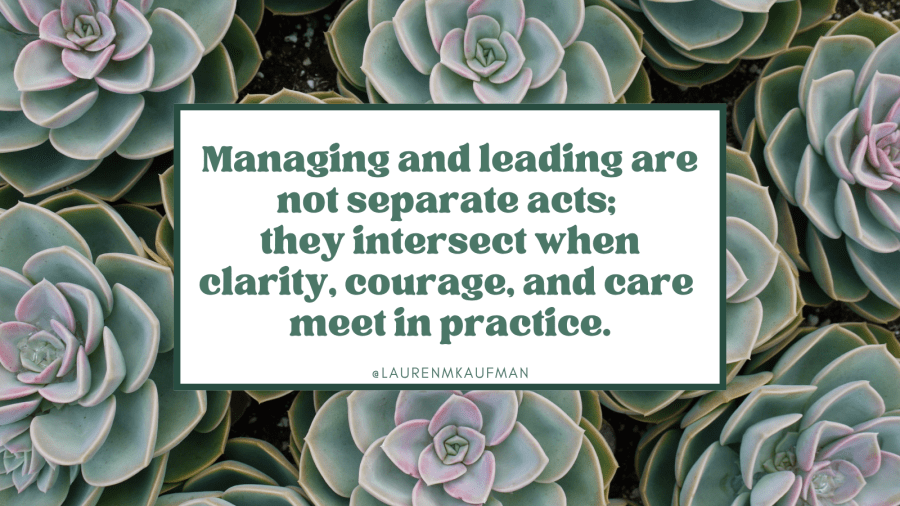
I see this in motion all around me. I’ve watched teachers kneel beside a student’s notebook and ask, “What are you trying to say here?” instead of immediately fixing the sentence. I’ve seen instructional coaches pause before offering advice and ask, “What did you notice?” I’ve listened to administrators begin difficult conversations with curiosity and empathy, helping colleagues reframe challenges as opportunities for growth. Each of these moments reminds me that managing and leading are not separate acts; they intersect when clarity, courage, and care meet in practice.
Moving Forward
So, here’s what I’m thinking, maybe what we need is not to choose between being a manager or a leader, but to bring integrity and humanity to both. To manage with empathy so that systems serve people, and to lead with honesty so that vision connects to purpose.
When we do that, managing does more than keep things running, it builds trust. Leading does more than inspire, it creates growth. Together, they create strong ground where feedback fuels progress, clarity strengthens connection, and people feel both supported and seen.
That’s where leadership truly begins: when managing meets meaning.
3 Actionable Ideas for Leaders to Implement Tomorrow
1. Bring clarity to the work.
Choose one routine, such as a meeting or feedback cycle, and take time to explain its purpose. When people understand the why, they connect more deeply to the work.
Reflection: How might greater clarity strengthen trust and alignment on your team?
2. Connect systems to people.
For every process you manage, find one way to make it personal. Celebrate progress, start with gratitude, or listen before leading.
Reflection: How can you remind your team that every system exists to support the people within it?
3. Give feedback that grows.
Choose one person to offer feedback that is both honest and hopeful. Begin with belief, name what can improve, and follow up with care.
Reflection: What would it look like for your feedback to feel like an act of support rather than evaluation?
 Empower. Collaborate. Connect.