One of the most powerful ways to bring people together in education is through a shared learning experience—one where ideas are lifted, voices are honored, and collective priorities begin to take root in meaningful ways. That’s exactly what an educational book club can offer when it’s designed with purpose and intention. It becomes a space for learning that lives beyond the book.
For me, book clubs have always been about more than just reading a text together. They’re about modeling the kinds of instructional practices we hope to see in classrooms…connection, engagement, reflection, and application. They allow us to anchor our work in research while keeping it practical, relevant, and personal.
I say this from experience. I’ve participated in many book clubs, both synchronously and asynchronously, and each one has offered something unique. These experiences have led to professional growth, personal reflection, lasting connections, and even lifelong friendships. They’ve stretched me as a learner, as a leader, and as a human being.
Most recently, I’ve embarked on a book club journey with a group of dedicated educators, using 7 Mighty Moves by Lindsay Kemeny. Together, we’ve created a space to reflect, connect, and apply high-impact literacy practices in real time, modeling exactly what we hope to cultivate for students in our classrooms.
If you’re looking to design a book club that bridges research and practice, here are a few ideas to get you started.
Idea 1: Start with Purpose and a Warm Invitation
A successful book club starts before the first page is turned. Communicate the why clearly: What are you hoping the group will learn, shift, or strengthen together? Whether you’re exploring literacy practices, leadership, or innovation, tie the book to your school or district priorities.
Then, send a warm, welcoming invitation that feels more like an opportunity than a task. Let people know this is a space for professional learning and inspiration where their voice matters and their presence will make the group stronger. When we create spaces like this, we’re laying the foundation for learning that lives beyond the book.
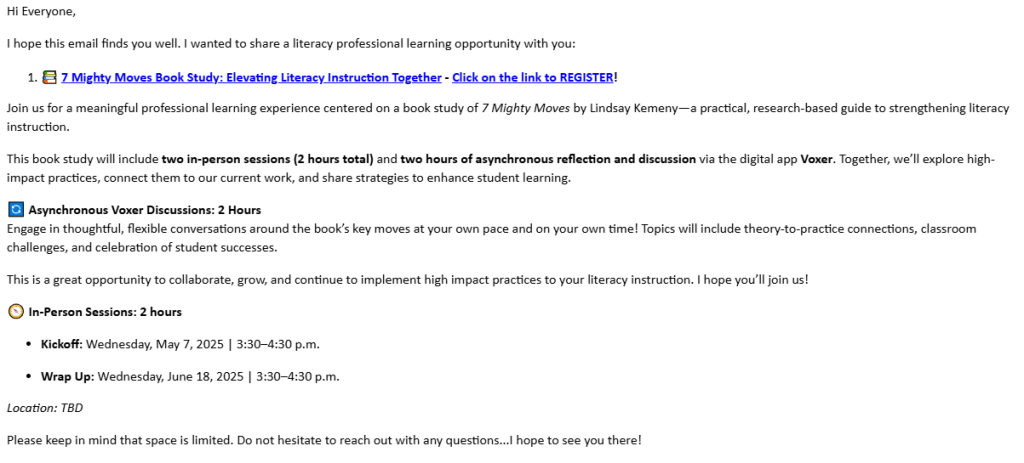
Below is an example of my email inviting teachers to participate:
Idea 2: Design a Flexible Structure (Synchronous + Asynchronous)
To meet the needs of busy educators, it’s important to offer a structure that honors their time and promotes meaningful engagement. A thoughtful blend of in-person and asynchronous experiences allows for both connection and flexibility.
- Kickoff & Closing Meetings: Use these sessions to build community, spark dialogue, and reflect on the learning journey. During the kickoff, introduce the structure of the book club, the design of the book, and explain how the practices connect to district priorities. Setting the stage early helps participants understand not just what they’re reading but why it matters.
The closing meeting is just as important. It’s a chance to reflect on the book club experience as a whole, surface takeaways, and most meaningfully—celebrate student successes. We invite teachers to share what they’ve implemented from the book and how it’s impacted their classrooms. These moments of reflection and celebration help affirm that the learning lives beyond the book. As I say in my book The Leader Inside, “It’s the small wins that add up to the big things.” - Asynchronous Discussions (Voxer): Voxer is one of my favorite oldy but goody tools to extend learning beyond the meeting room. It’s a free app that allows for short voice note responses, making the discussion feel personal, authentic, and easy to access on the go. This asynchronous format encourages deeper thinking and lets teachers engage at their own pace.
We dedicated part of our first session to a Voxer 101, walking through the app, setting expectations, and sharing helpful tips. (If you’ve ever wished for a digital space to return to for inspiration, this is it.) Every Monday morning, I would drop a visual prompt into the Voxer chat with a research-based reflection question and a classroom challenge. This is where the magic happens—where teachers bridge theory to practice and bring their learning to life in real classrooms.
Idea 3: Keep It Visible and Fun
A little design goes a long way. I created a custom Canva bookmark with the reading schedule. Not only is it practical, it adds a layer of joy and makes the experience feel special. I wanted teachers to have a simple way to stay on track with the reading but I also wanted to model how technology can be used to add a little fun to the learning experience. What I didn’t expect was the immediate ripple effect: right after our first meeting, a teacher shared that they were inspired to create bookmarks on Canva for their students to track their independent reading and build stamina. They loved the idea of making it personal, giving students the opportunity to design their own and feel more ownership over their reading journey.
You might also create a shared digital folder or Google Doc where participants can drop ideas, favorite quotes, or examples of how they’re applying the learning. These become collective artifacts of growth.

Idea 4: Use Tools That Build Engagement
Model strategies teachers can bring back to their classrooms
One of the most powerful aspects of leading a book club is the opportunity to model high-impact strategies that educators can use with their own students. Every element—from how we pose questions to the tools we use—can double as a practice worth trying in the classroom.
- Mentimeter: This interactive tool is a simple yet effective way to gather real-time thoughts and spark reflection during in-person sessions. It gives every voice a chance to be heard and allows ideas to surface visually. During our kickoff meeting, I opened with the question: “What do you hope to gain from this book club experience?” The responses not only revealed individual intentions, but also helped us build a collective purpose for our time together.
Be sure to check out the curated responses — we saved them to reflect on throughout our journey.

- “Lift a Line” Protocol: After giving participants time to read the book’s introduction in our first in person meeting to frame the purpose of the book, I asked them to “lift a line” to select a sentence that resonated with them and share why it stood out. It’s a simple, meaningful way to spark conversation and elevate voices. It was interesting to see which lines people gravitated toward some powerful, some deeply personal and how those lines opened up new perspectives in the room. You could feel the tone of the group shift as individual reflections began weaving into a shared understanding of the work ahead.
- Classroom Application Challenges: These weekly challenges are shared in the Voxer group and are designed to help bridge theory to practice. Teachers are invited to try something new connected to the book’s content and then return to Voxer to share their experiences. This is where the magic of cross-pollination happens—educators post their reflections, resources, photos, and even materials they used with students. The asynchronous nature of the space keeps the learning going and allows ideas to build off one another in meaningful, practical ways.
- Celebration Shares: End each week or discussion cycle with space to recognize successes, no matter how big or small. These moments not only build momentum, they affirm that the work is making a difference. They’re proof that the learning is living beyond the book and taking root where it matters most in classrooms.
Model What You Want to See in Classrooms
The magic of a great book club lies in what it models:
- Thoughtful planning
- Authentic engagement
- Ongoing reflection
- Collective ownership of learning
Every element, from the protocols to the tech tools can be something teachers replicate with their students. When teachers experience these practices as learners, they’re more likely to use them as facilitators.
Moving Forward
Book clubs can be more than professional learning. They can be a shared journey that builds trust, deepens understanding, and moves the work forward—one conversation at a time.
When you create space to lean into each other’s ideas and try new things together, you’re not just reading a book. You’re writing the next chapter in your learning community’s story. As I share in The Leader Inside, “Be the narrator of your story. Create what you want to be.” A well-designed book club invites each of us to do just that for ourselves, our teams, and our students.
It’s how we create learning that lives beyond the book.
 Empower. Collaborate. Connect.