What gets the best of your energy each day? And perhaps more importantly, who gets what’s left?
I’ve been thinking about these questions quite a bit lately.
There are days when I walk into work with a clear plan. I know what I need to accomplish, who I need to connect with, and where I want to focus my attention.
And then the day begins.
An email needs a response. Someone stops by with a question. A meeting runs longer than expected. Something comes up that needs immediate attention. Before I know it, I’m moving from one decision to the next, sometimes without realizing just how many I’ve made.
And while I’m doing all of this, I’m still thinking about the work ahead, the people who need support, and everything waiting for me at home.
Sound familiar?
I love what I do. I care deeply about the people I work alongside and the students we serve. But I’ve also come to recognize that loving the work doesn’t mean it can’t feel challenging.
Sometimes it’s not the big decisions that leave us feeling stretched. It’s the accumulation of all the little ones.
What needs my attention first? Who needs an answer? What can wait? What am I forgetting?
And somewhere in the middle of those questions, I think there’s another one worth asking.
Am I giving my energy to what matters most, or simply to what needs me next?
I was recently invited to join an upcoming podcast conversation about how educators and leaders can protect our leadership energy during busy seasons. I’ll share more details soon, but when the host mentioned the topic, I immediately thought about a recent post I wrote for George Couros’s 3 Things Saturday newsletter, where I reflected on leading well on full days.
Since I use this space to reflect on my learning, I often prepare for conversations and presentations by blogging about them first. Writing helps me organize my thinking and make connections. I also enjoy sharing these reflections afterward so others have a place to revisit the ideas and continue their own thinking.
So, I decided to build on that original post, but with a slightly different question in mind.
How do we protect the energy we need to keep showing up?
Here are three ideas I’ve been reflecting on as I prepare for this conversation.
1. Pay Attention to What Deserves Your Energy
Not everything that demands our attention deserves the same amount of our energy. That’s easy to write. Much harder to practice.
In schools, there will always be something that feels urgent. And often, those things really do need our attention. But when everything becomes a priority, it’s easy to lose sight of the work that matters most.
I’ve had days when I’ve spent so much time responding to what was coming at me that I realized I hadn’t made time for the work I originally hoped to accomplish.
And sometimes that work is the very reason I love being an educator. Being in classrooms. Learning alongside teachers. Listening to students. Collaborating with colleagues. Those experiences energize me, but they don’t always arrive with the same urgency as an overflowing inbox.
So, I’ve been trying to ask myself: What deserves the best of my energy today?
As a district leader, one way I try to protect that energy is by visiting a school building, often with a picture book in hand, before heading to my office to chip away at emails. When I can hold that time sacred, I get to connect with educators and students first. And if I have the opportunity to read to a class, even better!
The emails will still be there. But starting my day connected to people and purpose makes a difference in how I approach everything that follows.
Try this tomorrow: Before the day begins, identify one thing that deserves your best energy. Make room for it before the day fills up with everything else.
It doesn’t have to be something big. Sometimes ten minutes spent doing something that reconnects us with our purpose can change how we approach the rest of the day.
2. Recognize That You Don’t Have to Carry Everything Alone
One of the things I continue to learn about leadership is that just because I can do something doesn’t mean I always should.
That’s not always easy to admit.
When we care deeply about our work, we want things to go well. We want to support people, be responsive, and anticipate problems before they happen.
And sometimes, without realizing it, we begin carrying decisions and responsibilities that don’t all need to belong to us.
I’ve been fortunate to work alongside talented educators, coaches, and administrators who bring so much knowledge, creativity, and experience to the work.
Recently, as I was leaving a meeting with one of our lead English teachers, we started talking about an upcoming after-school professional learning session. I was scheduled to facilitate another session in a different building at the same time, and as much as I’d like to, I can’t be in two places at once!
So, we developed a plan together. I created the agenda and gathered the resources, and we talked through how she would facilitate the session. I have complete confidence in her ability to lead this learning with our teachers.
That experience reminded me that I didn’t need to be the person facilitating the session for the work to move forward. By planning together and trusting her to lead, we could support learning in two places at once.
That’s one of the beautiful things about collaborative leadership. We don’t need to have all the answers. And we shouldn’t be the only ones asking the questions.
In my book, The Leader Inside, I write about recognizing the greatness that lives inside others. The more I lead, the more I realize that creating space for others to contribute isn’t just about building their capacity. It’s about building something stronger together.
When we invite people into the thinking and trust their expertise, we’re not simply sharing the workload. We’re sharing the leadership. And that can be energizing for everyone.
Try this tomorrow: Think about one decision, responsibility, or challenge you’re carrying. Who could you invite into the thinking? Is there an opportunity for someone else to lead?
Sometimes protecting our energy begins with recognizing that we were never meant to do this work alone.
3. Make Room for What Restores Your Energy
I’ve noticed something about my fullest days.
When the calendar is packed, the first things to disappear are often the things that help me feel grounded. Time to reflect, an unrushed conversation, or simply a few quiet moments to think.
It’s interesting how easily we make room for one more meeting but struggle to make room for the things that help sustain our energy. I’m still learning how to do this well, and I don’t think there’s one perfect formula.
For me, that often means looking at the week ahead and making intentional choices about my time. During fall travel baseball season, I may put in longer workdays so I can be fully present for my son’s weekend doubleheaders. Other times, I may work over the weekend so I can attend my older son’s after-school basketball games.
That’s what balance looks like for me. It isn’t about dividing my time equally between work and home every day. It’s about making room for what matters in both.
Another practice I try to protect is my daily walk. I put on my weighted vest, grab my headphones, and listen to a book, podcast, or some of my favorite music (and my taste covers quite a few genres!). That time helps me reflect, clear my mind, and connect the dots.
Of course, it’s not always easy to leave the mental load of the day behind. There are conversations we replay, decisions we second-guess, and things we’re already anticipating for tomorrow.
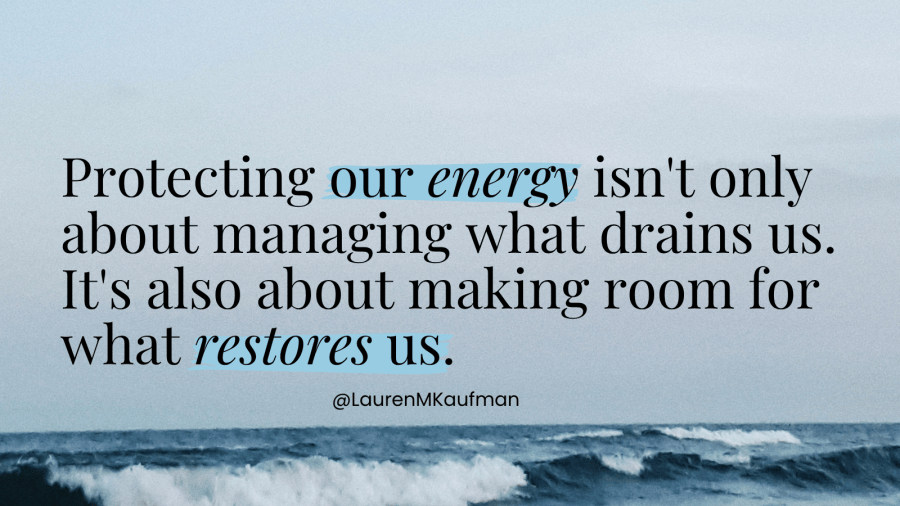
Sometimes we need to give ourselves permission to put those things down, even temporarily. Not because they don’t matter, but because the other parts of our lives matter, too. Protecting our energy isn’t only about managing what drains us. It’s also about making room for what restores us.
Try this tomorrow: Identify one thing that gives you energy and make room for it, even if it’s just a few minutes.
It might be stepping outside, checking in with someone who inspires you, or taking a moment to reflect before moving on to the next task.
Small moments matter, too.
Moving Forward
I don’t think there will ever be a time in education when the days suddenly become less full.
There will always be decisions to make, people to support, challenges to navigate, and opportunities to grow. And I wouldn’t want to lose the meaningful parts of that work.
But I’m learning that protecting my leadership energy requires me to be just as intentional about how I show up as I am about what I accomplish.
It means recognizing what deserves my attention, trusting others to lead, and making room for what restores me. And it means remembering that the people waiting for us at home deserve our presence, too.
I don’t have to give everything I have to everything that comes my way. I can be intentional. I can ask for help. I can make room for the people and experiences that sustain me.
So I’ll return to the question I started with.
What gets the best of your energy each day? And who gets what’s left?
Maybe protecting our leadership energy isn’t about having less to give. It’s about making sure we’re giving it to what matters most, while saving some of that energy for the people and moments that matter beyond our work, too.
Discover more from Empower. Collaborate. Connect.
Subscribe to get the latest posts sent to your email.

