In my last blog post of 2025, I wrote a piece titled Five Lessons I’m Carrying Forward. The first lesson I shared was this:
Confidence isn’t certainty. It’s comfort with failure.
Teaching and leading ask us to learn in public. Lessons may not always land.
Conversations may feel messy before they feel productive. Priorities may need revisiting.
And still, educators and leaders return the next moment, reflecting, adjusting, and trying again.
The educators and leaders I admire most are not the ones who avoid missteps. They understand that learning, real learning rarely arrives neatly wrapped and tied with a beautiful bow. They continue forward with curiosity and reflection.
Since writing that post, I have been thinking more deeply about what confidence truly means and how it connects to the work we do in education.
I’ll never forget a conversation I had with an educator who wanted to try something new in her classroom but hesitated. She had noticed a need. She had designed an idea to meet it. But she didn’t feel “expert enough.”
She also worried about what her colleagues might think. They had planned to approach the work differently, and she didn’t want to disrupt that rhythm.
“So what’s holding you back?” I asked.
“Fear of not getting it right,” she said. “And not having everyone on board.”
My go to reply: “But what about the kids?
You noticed something they need. You’re thinking about how to serve them better. What’s the worst that can happen?”
That is just one of many conversations that has stayed with me. Because what she was really waiting for wasn’t permission. It was certainty.
And from my experience, certainty rarely comes in education.
Recently, I revisited three definitions of confidence from books and podcasts that feel especially relevant to leadership and learning. Below are the ideas that have stayed with me and why they matter in schools.
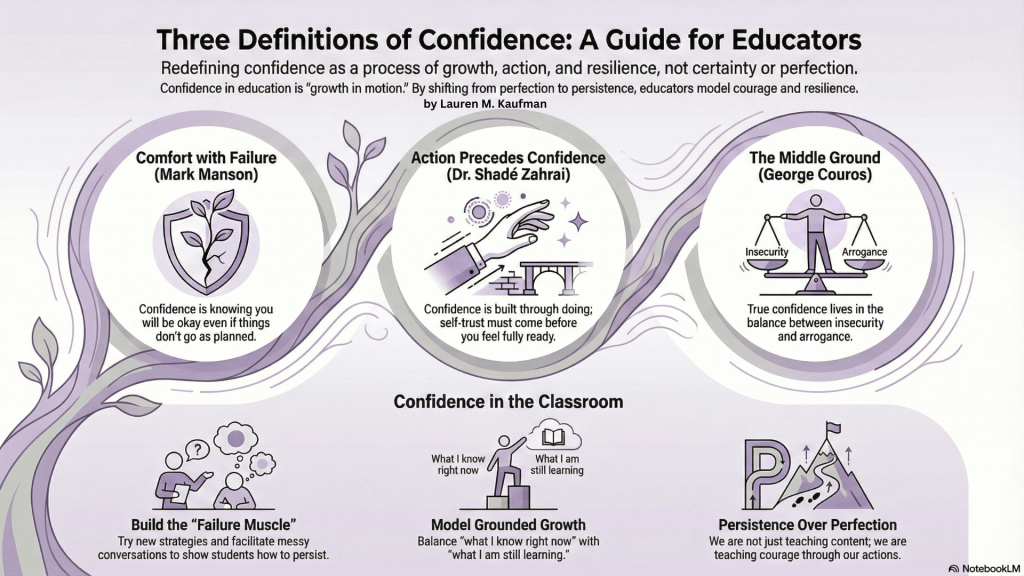
1. Mark Manson – Confidence Is Comfort with Failure
Guest on The Big Deal Podcast with Codie Sanchez
On The Big Deal Podcast, Mark Manson defines confidence in a way that directly challenges how most people think about it:
“Confidence isn’t about believing you’re going to achieve success. It’s knowing you’re going to be okay if it doesn’t turn out okay.”
He calls it comfort with failure.
He explains that the more we try to feel confident all the time, the more aware we become of all the places we aren’t confident. Perfectionism grows. Anxiety grows. Risk aversion grows.
So how do we build confidence?
By failing.
Not massive, life-altering failures first but small ones. Small risks. Small rejections. Small embarrassments. He describes it as building the “failure muscle.”
In education, this definition is powerful.
If confidence is comfort with failure, then the most confident educators are not the ones who never struggle. They are the ones who:
- Try new strategies even when they may not land.
- Lead priorities that might need revision.
- Facilitate difficult conversations knowing they won’t be perfectly scripted.
They are okay if it doesn’t work the first time.
Our students are watching how we respond when something doesn’t go as planned. That response teaches more about confidence than any motivational speech ever could.
2. Dr. Shadé Zahrai – Confidence Comes After Action; Self-Trust Comes First
Guest on The Big Deal Podcast with Codie Sanchez
In her conversation with Codie Sanchez, Dr. Shadé Zahrai makes a critical distinction:
Confidence is not something you wait for. It is something you build.
Confidence comes after action.
You gather evidence through doing.
You build competence.
Then confidence follows.
But before confidence, there is something even more important: self-trust.
Self-trust is believing you can handle what happens, even if it’s uncomfortable.
Dr. Zahrai also explains how self-doubt erodes us across four areas:
- Self-acceptance (Am I enough?)
- Agency (Can I do this?)
- Autonomy (Do I have control?)
- Emotional regulation (Can I manage what I feel?)
When I think about schools, these four areas show up everywhere.
Teachers questioning if they’re “good enough.”
Leaders wondering if they can navigate pushback.
Teams feeling like they lack control over change.
Educators overwhelmed by emotion.
Confidence is not the starting point.
Action is.
In education, we cannot wait to feel fully ready before we try something new. We build confidence by stepping forward even when our voice shakes a little.
3. George Couros – Confidence Lives Between Insecurity and Arrogance
George Couros describes confidence as existing on a spectrum.
On one end: insecurity — the belief that we are not good enough.
On the other end: arrogance — the belief that we have nothing left to learn.
Confidence lives in the middle.
It is appreciating where you are while knowing you can still improve.
That balance is essential in education.
If we operate from insecurity, we shrink back from innovation.
If we operate from arrogance, we close ourselves off to feedback.
But if we operate from confidence, we model grounded growth.
We say:
- “This is what I know right now.”
- “This is what I’m still learning.”
- “Let’s get better together.”
What These Three Definitions Share
When placed side by side:
- Mark Manson — Confidence is comfort with failure.
- Dr. Shadé Zahrai — Confidence follows action; self-trust comes first.
- George Couros — Confidence is appreciating where you are while knowing you can improve.
They all point to the same idea:
Confidence is not certainty.
Confidence is not ego.
Confidence is not waiting until fear disappears.
Confidence is growth in motion.
Moving Forward
When I think back to that educator who hesitated to try something new because she did not feel “expert enough,” I realize now that what she was waiting for was certainty.
But certainty is not the goal.
Mark Manson would remind us that confidence is being okay if it doesn’t work.
Dr. Zahrai would remind us that confidence comes after action, not before it.
George Couros would remind us that we can value who we are today while still striving to improve.
And I return to the line that started this reflection:
Confidence isn’t certainty. It’s comfort with failure.
In education, we do not need to model perfection.
We need to model persistence.
We need to show our students and our colleagues what it looks like to:
Try.
Reflect.
Adjust.
Return.
Because when educators lead with that kind of confidence, grounded, reflective, and resilient…we are not just teaching content.
We are teaching courage.
And perhaps that is the lesson I will continue carrying forward into the year ahead.
Click HERE or on the image to use with your teams.
 Empower. Collaborate. Connect.