
Time is magic.
It may be our greatest resource, and the one we never seem to have enough of. Yet it’s not magic because it appears out of nowhere; it’s magic because of what happens when leaders intentionally create it.
When leaders carve out time to learn with teachers, meaningful professional learning doesn’t just happen.
As I wrote in my book The Leader Inside, “Teaching is not just something you do; it’s a calling.” That belief shapes how we choose to spend our time as leaders. When we slow down and learn alongside teachers, we honor the heart of the work and the people living it. It shows up in classrooms, in planning conversations, and in the confidence educators feel when they walk back to their students with something they can use tomorrow.
This work is grounded in what research has long affirmed. As Dr. Jorge Valenzuela explains in his book Instructional Innovation + Cultivating Teacher Teams Through Action Research, “collective teacher efficacy is strongly correlated to student achievement and success and a positive school culture.” Efficacy, he notes, is both the desire and the belief in the ability to produce a desired effect (p. 20). When leaders intentionally create time for teachers to work together toward shared outcomes, that belief begins to grow.
Creating the Space
Recently, I facilitated professional learning sessions focused on analyzing assessments and classroom writing data. The goal wasn’t just to look at numbers, but to bridge data with practice. It was to make what can appear to be abstract or overwhelming feel meaningful, connected, and immediately actionable for teachers.
We started by slowing down.
We examined the data together and grounded our conversation in noticings and wonderings:
- What patterns do we notice across student responses?
- Where do students seem to be strong?
- Where are they struggling and why might that be?
- What questions does this data raise about our instruction?
During that time, the room was calm and open to dialogue and discussion. This wasn’t about evaluation or judgment. It was about curiosity, clarity, and shared ownership.
This time was magic.
From Data to Practice
Once the data told its story, we shifted the conversation to practice.
I modeled how teachers could use a digital tool like Notebook LM as a tool to enhance instruction, not replace it, but strengthen it. Together, we explored how AI tools could support comprehension, analysis, and student thinking when used intentionally. We created short video clips, infographics, and mind maps that were tied to priority standards that needed to be addressed.
Then, a few days later, I walked into a classroom for an observation.
The teacher was eager to show me something. She was excited to use Notebook LM to create a brief recap a story her students had already read. As a brief portion of the recap played, students were actively jotting down notes, tracking which events led to the character’s change.
Moments like this remind me of another reflection from my book The Leader Inside: “Every interaction is a learning experience that enhances your leadership lens.” When leaders are present in these moments, listening, noticing, learning alongside teachers…professional learning becomes real, relevant, and alive.
As I watched her creation come to life, her students weren’t passive learners, they were engaged, analyzing, thinking, and making meaning in real time.
And that connection from professional learning to classroom practice didn’t happen by accident.
It was the intentional time building leaders and I created to share learning and thinking that allowed that magic to show up in the classroom.
Later that week, I walked into a grade-level planning meeting.
Teachers were collaborating to bring the enhanced writing framework they created to intentionally elevate expectations for student writing. The language, structures, and decisions they were discussing were directly connected to the professional learning we had engaged in together. They were eager to show me a graphic organizer they generated to strengthen students’ writing. That’s the magic that happened.
In another professional learning session that week, I worked side by side with another grade level to create exemplar texts. Teachers designed pieces that students could assess with partners, using rubrics to identify mastery. The focus wasn’t just on scoring, it was on helping students see what strong writing looks like and name why it works to enrich their own writing.
What I know is that teachers left those sessions energized. They shared that they were excited to try new tools, eager to elevate instruction, and couldn’t wait to see how student learning and writing would grow.
So, why does this matter? As Dr. Jorge Valenzuela writes, “to cultivate a collaborative culture, teaching teams should center their shared agreements on values, beliefs, and practices essential for nurturing adaptability, cohesion, and teamwork” (p. 21). When educators feel valued, respected, and supported, a positive school climate isn’t accidental, it’s built intentionally, over time.
Moving Forward
When leaders:
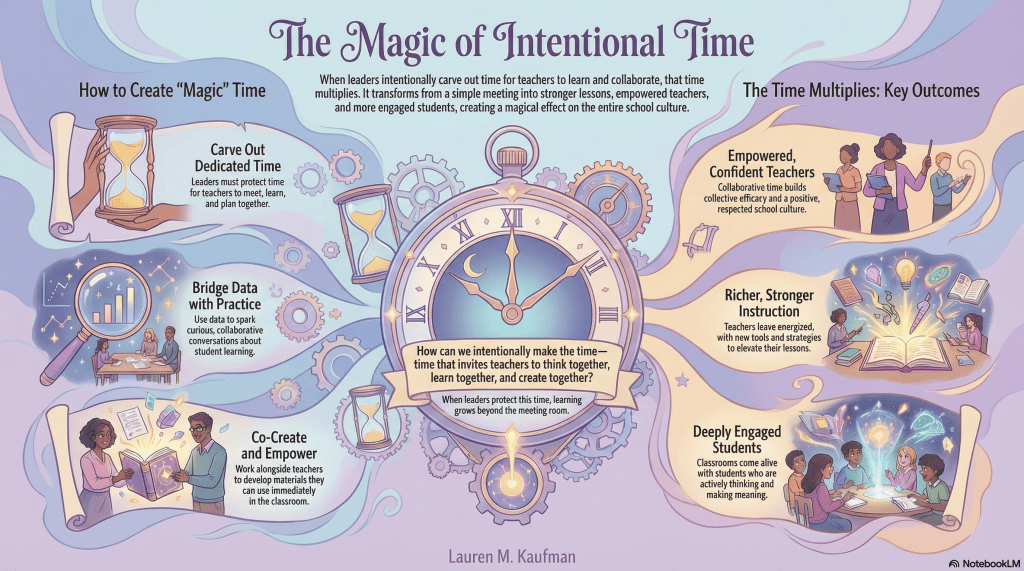
- Carve out time to meet with teachers
- Bring meaningful data to the table
- Create space for noticings and wonderings
- Discuss instructional implications together
- And co-create materials that can be used immediately
That time multiplies.
It turns into stronger lessons.
It turns into richer planning conversations.
It turns into classrooms where students are thinking deeply and teachers feel empowered.
Time is magic.
And when we use it intentionally, learning together, building together, creating together…it becomes one of the most powerful tools we have as leaders.
That is time well spent.
So I’ll return to the question I keep coming back to as a leader:
How can we intentionally make the time—time that invites teachers to think together, learn together, and create together?
Because when we choose to make that time, and protect it, the learning doesn’t stay in the room. It grows.
And that is how time becomes magic.
 Empower. Collaborate. Connect.