
Recently, I was having a conversation with an educator that stayed with me long after we finished talking. It was grounded in her being so passionate about her work, in caring so deeply, but she was unsure if her efforts were being seen. By others. She was expressing that in some spaces her work feels seen and in others she’s not sure if it’s valued. She wasn’t sure if her communications were landing the ways she intended.
As I listened to her express these feelings, I thought about my own journey in education and leadership. If you have followed my writing, you know that I have lived many roles, from classroom teacher, to literacy specialist, to instructional coach, to mentor coordinator, and into building and district leadership. These experiences have allowed me to look through different lenses and develop a deeper understanding of people and our work in education.
And in my book The Leader Inside, I express the following: Every experience you will ever have leads to the type of educator you wish to become. I have felt that sentiment over and over again as I’ve stepped into new roles, stretched into new spaces, and learned to work with others in ways that honor who we are continuously becoming.
What I have come to learn is that no matter how hard we try, we can only truly take ownership of our own actions and what is in our locus of control. We all have jobs to do. To me, one is not more important than another because we are all here for kids. And although I truly don’t believe anyone intentionally wants to make others feel unseen, the reality is that we are all wrapped up in our own worlds. In our own timelines. In our own capacities on any given day.
This simple visual from @mindfulenough__ is a reminder of what we can hold and what we can let go:
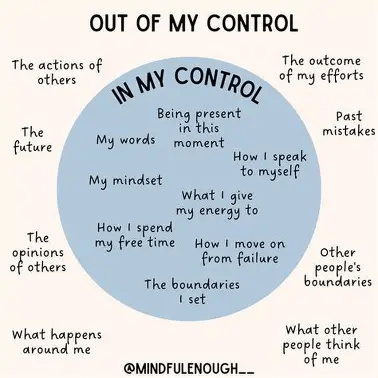
We cannot make people answer emails.
We cannot make people respond on our timeline.
We cannot make people communicate in the same ways we do.
We cannot make people see us in the ways we hope to be seen.
But what we can do, what lives fully within us, is do our best to communicate with our own clarity, intention, and care. What we can do is lead with belief, even when the outcome is uncertain. What we can do is remember that our words, our actions, and our follow-through matter… even if the response feels delayed, muted, or invisible.
Zac Mercurio captures this so beautifully in his book, The Power of Mattering:
“If we want people to contribute, they must first believe they are worthy of contributing. If we want them to use their strengths, they must first believe they have them. If we want them to share their voices, they must first believe their voices are significant. If we want them to care, they must first feel cared for. If we want something to matter to them, they must first believe they matter to us.”
When I read those words, I felt the impact of them. Feeling seen is not a luxury in this work, it is a lifeline. And that looks and feels different to every person. And yet, being seen is not always the same as being valued. And being valued is not always communicated out loud.
As she spoke, I felt that familiar tug, more like that quiet wondering many of us carry: Is what I’m doing making a difference? Is it reaching people in the way I hope? Does my communication land with the intention behind it?
Over the years, I have learned something important: when things aren’t working, when communication feels disrupted, or when alignment is slipping through the cracks, the most powerful move is to lead with curiosity. I used to take these breakdowns in communication personally. Now I pause. I wonder. I ask questions. I try to understand the why behind the silence, the delay, or the disconnect. Curiosity has softened the edges of my leadership and opened doors that frustration would have kept tightly shut.
And there is another idea I’ve come to revisit. Adam Grant writes in his book Hidden Potential:
“Coaching others to overcome obstacles can help us find our own motivation. We are more confident in our ability to surmount struggles if we guide others through them.”
That line has stayed with me. Because every time I sit beside someone who feels unseen, I find parts of myself again in the times I have felt that way. Every time I help someone clarify their message, I strengthen my own. Every time I coach someone through doubt or misalignment, I am reminded that communication and the courage to keep trying is both a mirror and a compass.
Maybe that’s the beauty of this work: we are constantly learning from the very challenges we are helping others navigate.
So yes, we may not always feel seen. Our communication may not always land the way we intend. Our impact may not always reveal itself right away. But we keep showing up rooted in purpose, grounded in curiosity, anchored in belief, because the work is still working, even when we can’t see it.
And maybe, just maybe, the real measure of being seen is how clearly we keep
seeing ourselves.
Three Actionable Ideas to Implement Tomorrow
1. Ask one person, “What part of your work feels seen right now and what doesn’t?”
A quick, meaningful way to understand their experience.
2. Ask, “How can I communicate with you in a way that works best for you?”
A simple question that promotes clarity, alignment, and trust.
3. Name one person’s strength out loud.
Tell an educator something specific you see and value about their work.
 Empower. Collaborate. Connect.