What does it truly mean to prepare students for the future? It’s a question that’s bigger than any one curriculum, assessment, or instructional strategy. It’s a question that calls us to pause and reflect, both as educators and as lifelong learners.
As our leadership team began exploring the New York State Portrait of a Graduate, we knew that understanding the seven components wasn’t just about memorizing them. It was about internalizing their meaning. It was about connecting them to the very heart of what it means to learn, to grow, and to prepare young people for a rapidly evolving world.
This led us to create a reflective protocol called “Layering Learning.” It’s an intentional journey that asks participants to think, connect, and expand their understanding in layers, just as acquiring, building knowledge, and learning happens over time.
Why This Work Matters
The seven components of New York State’s Portrait of a Graduate: critical thinking, innovative problem solver, literate across content areas, cultural competence, social-emotional competence, effective communicator, global citizenship, aren’t just aspirational. They represent the skills, mindsets, and capacities that every learner will need in a world shaped by complexity, diversity, and emerging technologies like AI.
As we designed this experience for our leadership team, we asked ourselves:
“When in our own lives have we had learning experiences that aligned with these components?”
I reflected on the experiences that shaped me, not just as an educator but as a learner, a leader, and a human being. The most meaningful learning didn’t come from memorizing information. It came from learning experiences through collaboration, curiosity, problem-solving, and authentic human connection. And that’s exactly what we hope to cultivate in our students.
A Protocol for Any Learning Context
While we designed Layering Learning to explore the Portrait of a Graduate, this protocol can be applied to any type of learning. Whether introducing a new initiative, unpacking a complex concept, diving into professional texts, or fostering reflection after a keynote or workshop, this approach supports participants in making meaning over time.
It’s a way to deepen understanding, foster human connection, and bridge knowledge with lived experience, no matter the topic.
The Layering Learning Protocol: A Process for Deepening Understanding
Layer 1: Pause and Reflect
Prompt:
We begin by presenting the Portrait of a Graduate visual. Participants are invited to reflect on two guiding questions:
- Why did New York State select these seven components?
- What does this mean for the students we serve?

This quiet reflection of jotting down ideas and sharing them opens the door for personal connection to the work.
Layer 2: Connect to Personal Experience
I share a personal story about how I made sense of these components, not through theory, but through lived experiences. For example, during my time performing in high school theater, I learned how to critically analyze the character I was portraying and problem-solve challenges like blocking and stage direction in real time. These experiences helped me develop skills that align directly with the components we’re exploring today. I invite participants to do the same…to reflect on the learning experiences in their own lives that shaped these competencies.
- When have you, as a learner, developed these competencies?
- What learning experiences shaped your own growth in these areas?
This layer is about realizing that these are not just competencies for students, they are competencies for life. Participants added to their original thinking by making their own connections.
Layer 3: Inspiration Through Media
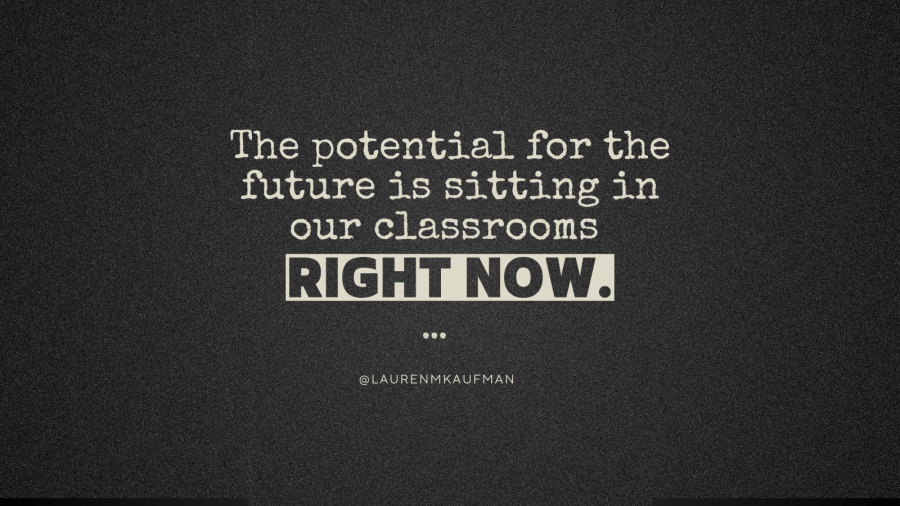
We introduce an inspirational video titled “This Hand” from the Institute of Humane Education where students in a classroom raise their hands, and a narrator imagines each hand raised as future physicians, global problem-solvers, and changemakers. It’s a powerful reminder that the potential for the future is sitting right in front of us every day, right in our classrooms, right in our schools.
Participants are asked to revisit their initial reflections and “layer their learning” by adding new insights sparked by the video.
Layer 4: Expanding the Lens – The AI Connection
We then introduce a clip from Rich Culatta’s keynote at the ASCD/ISTE Conference, where he discusses the “Portrait of an AI Graduate.” While AI readiness is part of the conversation, his emphasis remains on the irreplaceable human components—collaboration, creativity, and ethical decision-making.
Participants consider:
- How does the evolving landscape of AI further elevate the importance of these human-centered components?
- What new competencies are emerging, and how do they connect back to our core mission of preparing students?
Layer 5: Synthesize and Look Forward
The final layer asks participants to view a variety of videos of classroom instruction through the lens of a specific component of the Portrait of a Graduate and step back and look at the big picture:
- What implications does this have for how we design learning experiences?
- How do we ensure that our schools are cultivating not only academic excellence but also the mindsets and skills students need to thrive as humans in an evolving and AI-influenced world?
This is where reflection turns into action.
Why Layer Learning?
Learning is not linear, it’s iterative, reflective, and deeply personal. As educators, we must give ourselves the same space to grapple, connect, and expand that we strive to give our students.
Layering Learning reminds us that understanding grows through multiple lenses…personal experience, shared media, emerging realities, and collaborative dialogue.
When we model this as leaders, we set the tone for how our schools can do the same for students. Because preparing graduates is not about a checklist of skills, it’s about preparing thoughtful, empathetic, adaptable humans who can navigate whatever comes next.
I invite you to use the guide below with your leadership teams and educators to Layer your Learning:
Step by Step Guide to Layering Learning

Infographic created with Napkin AI
 Empower. Collaborate. Connect.