
Who is the leader you wish to become, Lauren? My answer is, I wish to become the leader I always needed.
This is a question I continuously ask myself as I navigate the ebbs and flows of education and leadership. These sentiments are woven throughout my book The Leader Inside: Stories of Mentorship to Inspire the Leader Within.
In the book, I talk about the power of mentorship and how important it is to develop a mentor program that will build a solid foundation for new teachers, setting them on a trajectory for long, meaningful careers. “Every year, school districts around the world entrust thousands of new educators to serve their communities as they hire and provide them with a special opportunity to begin long, meaningful educational careers” (p. 53).
The same is true for new administrators. Districts spend an inordinate amount of time in the search process looking for new administrators to join their team. There is a tremendous amount of thought and time that can go into this process, as many districts are searching for people who can add value to their leadership teams.
That said, this summer I was fortunate to take on an administrative intern and aspiring leader. When I say aspiring leader, I mean that one day she may choose to step into a formal leadership role. But the truth is, over the last few years I’ve known this educator, I can see she is already a leader in her approach to education. This teacher has facilitated a club, bringing together a group of high school students who want to be teachers to discuss their futures. She has taken on leading other extracurricular activities for students in music and the arts and has a deep investment in learning innovative practices that tap into the curiosity of students, leverage their strengths, and challenge them to grow.
I don’t take the responsibility of mentoring aspiring administrators lightly. This experience rests on the shoulders of those who have mentored me and the principles I have embraced in my leadership journey.
As leaders embark on this important process, I encourage you to go back to the question, “What is leadership?” When I ask this question, I turn back to my instructional coaching roots, as that role taught me so much about leading, learning, teaching, and even failing.
In Jim Knight’s book, The Definitive Guide to Instructional Coaching, he shares, “For many, leadership is about providing direction, clearly stating a vision or goal, and then motivating others to want to pursue that goal. Such a definition divides people into leaders and followers, suggesting that leadership is something people do to others by defining the direction they must take and motivating them to want to follow” (p. 60).
However, for those leaders who choose to lead through a coaching mindset, that approach mentioned above is not always the answer to moving priorities forward. In a previous post I wrote titled Embracing Coaching Principles in Leadership, I shared how Jim Knight’s Partnership Principles have anchored my work as a leader who chooses to lead through a coaching lens. Knight shares, “Leadership based on the Partnership Principles involves helping others identify for themselves what they need to do rather than getting them to do what the leader has decided they should do” (p. 60). He goes on to say that leadership coaches demonstrate involves “leading yourself” and “leading others.” We need to lead ourselves because, as Brené Brown says, “Who we are is how we lead.” We need to lead others so that we can help them discover the gifts that live inside them.
Coaching Aspiring Leaders: Applying Partnership Principles for a Pathway to Growth
Here is a pathway to growth I developed to coach aspiring leaders:
Identify the What:
In my role as a coach, I collaborate closely with aspiring leaders to involve them in essential tasks such as curriculum planning, organizing professional learning experiences, and planning summer learning activities. This hands-on approach provides them with practical experience and deepens their understanding of building effective systems and structures.
Connect to the Why:
This approach is critical because it aligns with our school’s mission to foster a collaborative and innovative learning environment. By empowering aspiring leaders through active participation and decision-making, we support the vision of developing future leaders who are capable, confident, and committed to continuous improvement. These experiences are directly tied to our school’s priorities of enhancing instructional quality, fostering professional growth, and strengthening community connections.
Show the How:
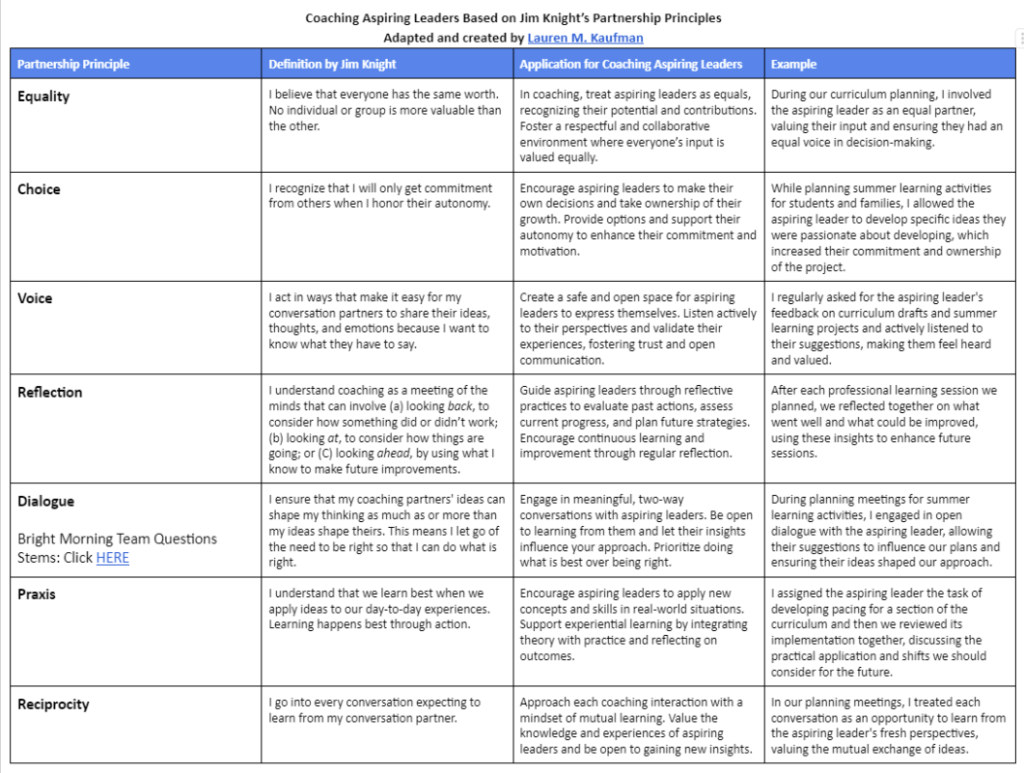
Here’s how I apply the Partnership Principles to coaching aspiring leaders in these contexts:
Click HERE or on the IMAGE to print and use with leadership teams
Moving Forward
By involving aspiring leaders in meaningful experiences and valuing their contributions, we collectively build a stronger, more innovative, and collaborative educational community. The journey of leadership is continuous, and by reflecting on the leader I wish to become, I aim to inspire and mentor the next generation of leaders, just as I was inspired and mentored by those who came before me.
So I ask, What steps will you take today to become the leader you always needed?
 Empower. Collaborate. Connect.