Over the past several months and throughout the course of the year, I’ll be diligently preparing for a series of literacy professional learning experiences, eager to facilitate and implement. When I craft these experiences, I reflect on what I would have valued as a teacher. The most valuable moments were those short bursts of learning where I gained high-impact practices I could apply immediately; that’s what I consider a win!”
That’s why I’m committed to concluding each blog post I write with precisely that – practical takeaways to implement tomorrow. I’ve always believed in encouraging educators to ask themselves, “How will these practices look in my classroom, and how will they benefit my students?” I often tell teachers that if they can take away just one idea from a professional learning experience, something they can implement immediately, then we’ve achieved success!
Innovation Can Be Simple
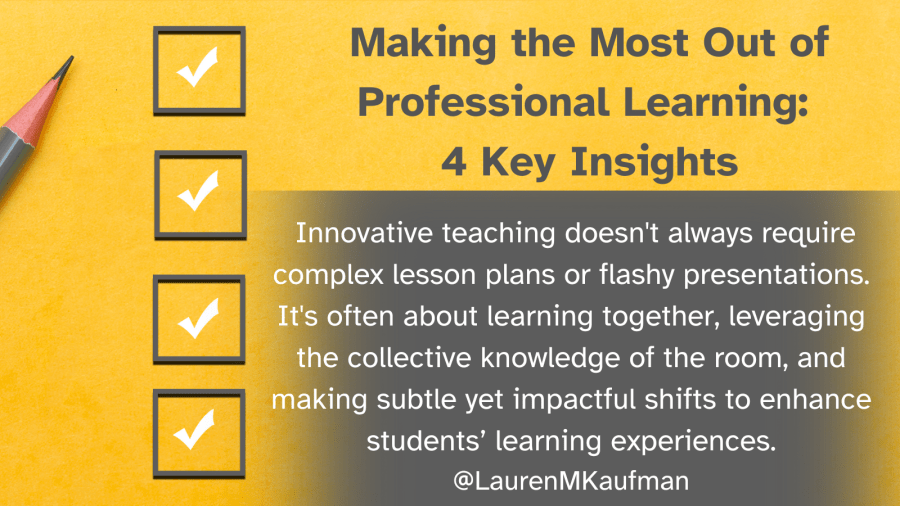
In the book The Innovator’s Mindset, George Couros emphasizes, “The innovator’s mindset is not about being an entrepreneur. It’s about seeing change as an opportunity to create something better.” Innovative teaching doesn’t always require complex lesson plans or flashy presentations. It’s often about learning together, leveraging the collective knowledge of the room, and making subtle yet impactful shifts to enhance students’ learning experiences, at times even fundamentally transforming our approach to education.
If you’re in education, you understand that time with teachers is often limited, and they have a lot on their plates. Therefore, ensuring that your time together is engaging, empowering, and immediately applicable is crucial to capturing their full attention and making a real impact on student growth!
Making the Most Out of Professional Learning: 4 Key Insights
Here, I generated questions as a framework with ideas, tailored to the preparation for professional learning experiences:
- How will I effectively organize and lead the instructional activities to promote reflection and learning?
Communicate Clearly: As a district leader, it is important for me to communicate with building leaders my intended outcomes for the professional learning experiences and seek feedback since they will be driving the learning forward in their respective buildings. By sharing the agenda and slide deck beforehand, our planning can be efficient. Also, it is vital to send communication to teachers ahead of time about what they will need to enhance their experience and make learning accessible and personal during your time together. Sending a succinct email sharing your excitement about spending time together, logistics, and items they need to bring will enhance the experience. Bullet points are the way to go! I also share a digital version of the agenda with links to the items we will be exploring that day. Click HERE for an example of a simple email communication I recently sent.
- How can I spark curiosity and facilitate productive discussions among teachers?
Explore Relevant Resources Together: The key word here is TOGETHER! Think about the resources that are already at the fingertips of your teachers and refrain from adding more that are not high-quality or meaningful. Let the teachers explore them together, ask questions, and let them know you’re there for support. For example, recently, I had teachers explore a Literacy Hub (a digital space on Google Sites) that was curated and organized by my staff developer and me with all the Literacy resources they will need to access – a one stop shop! It was helpful to point them in a specific direction and ask a reflective question. For example “I’d like to draw your attention to the Literacy Charts. How will this resource help you plan for instruction and reflect on student growth? When I did this, teachers naturally started sharing ideas about their own planning along with practical tips and tricks that work for them. Let the conversation unfold naturally and see where it takes them. I have noticed the magic that happens when colleagues think through ideas TOGETHER!
- How will participants bridge connections to district priorities, their learning, and apply it in their classrooms?
Bridge Priorities To Learning and Application: To facilitate the connection between district priorities, teacher learning, and classroom application, it’s essential to make this alignment both practical and meaningful. Teachers have busy schedules, so it’s crucial to contextualize the learning within the district’s mission, vision, and priorities. At the start of each session, reiterate the district’s mission and vision, and then explicitly link these to the day’s content. For instance, if the district emphasizes individualized and challenging learning environments, explain how the session, like a writing professional learning workshop, contributes to these goals. By keeping the focus on tangible applications, involving teachers in the process, and nurturing a long-term vision that centers on student growth, educators can better bridge these connections, making their teaching more purposeful and effective.
- What strategies will ensure that teachers take what they’ve learned and implement it in their classrooms?
Learn by Doing: In the book Teach Like A Pirate by Dave Burgess, he shares the following, “You are the lead learner in your classroom. You can’t ask your students to be risk-takers and lead learners if you are not modeling it yourself.” As educators, we must hold ourselves to the same standards we set for our students. Similarly, administrators should model the actions they expect from their teachers. For example, when it comes to teaching writing, we can’t become better instructors unless we embrace writing ourselves. In fact, the same principle holds true for any subject. To truly understand and improve the learning experience, we must first love the process of learning. Therefore, recently, I asked the teachers to write a narrative “on demand.” Simulating this student experience enabled them to step into the shoes of their students and in turn will allow them to model authenticity, provide better feedback, and inspire young writers! And now teachers have an anchor mentor text to use as an example with their students while showcasing their own writing lives.
Moving Forward
So, let’s embark on this journey of exploration together, drawing inspiration from these questions to not only guide our professional learning experiences but also to fuel our own growth as educators and writers.
 Empower. Collaborate. Connect.