What anchors your learning?
If you read my writing regularly, you may notice that I appreciate books, podcasts, articles, videos, and other mediums to learn, expand, and grow my thinking.
You may also notice that I believe deeply in the power of mentorship.
In my book, The Leader Inside, I write about mentorship as the responsibility we carry to recognize the gifts in others they may not yet see in themselves. To speak belief into someone before they fully believe in themselves.
For a long time, I viewed mentorship as something rooted only in people. It still is. The interactions we have, the moments we share, the words we remember… those anchor and stay with us.
But over time, that idea began to shift.
I started to see mentorship not only as relational, but also as instructional.
Mentorship lives in the books I return to. In the podcasts I replay. In the variety of voices I learn from, both inside and outside of education. They have become mentors too.
I wrote about this process of layered learning in a recent Edutopia article, where I share how these daily practices, reading, listening to podcasts, and applying what I learn to my practice, continue to shape how I think and lead.
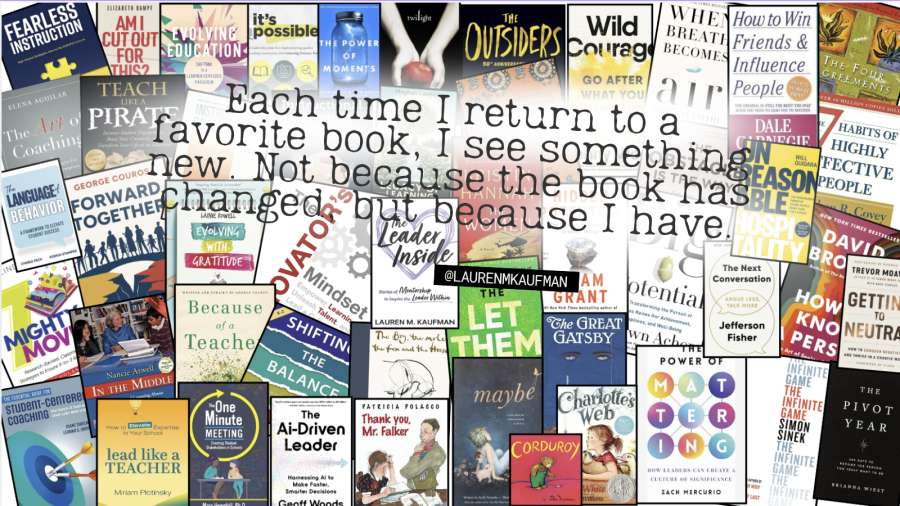
I often return to my favorite books, and if you could see my bookshelf, you would be able to identify them immediately. They are filled with sticky notes, highlighted passages, and pages that have been revisited more times than I can count. They have that real lived-in look. Each time I return to a favorite book, I see something new. Not because the book has changed, but because I have.
As I learn more, my perspectives expand and grow. I begin to notice things I may have skimmed over before. Ideas that once felt distant now feel relevant. Lines that I once read quickly now ask me to pause. What once felt like a simple takeaway now feels more layered, complex, and connected to my work in new ways.
It is almost as if the book is meeting me where I am in that moment. And maybe that is what keeps bringing me back.
Not just to the words on the page, but to the thinking they invite, the reflection they spark, and the way they continue to shape who I am becoming.
Recently, I found myself returning to Hidden Potential by Adam Grant. This time, it was not by rereading it, but by listening to him speak about it on The Oprah Podcast with Oprah Winfrey.
I was not planning to revisit the book in that moment. But pressing play felt right. And as I listened, I realized something I have experienced in my own practice again and again.
Sometimes, we do not need to reread the book. We need to hear the message at the moment we are ready to receive it.
With that in mind, I found myself returning to a few ideas that felt especially relevant for our work in education.
1. Confidence Does Not Come Before Action. It Comes From It
One idea that stayed with me was this: we often believe we need confidence before we take the leap. But in reality, confidence is built because we take the leap.
I have felt this in my own work.
There have been moments where I have walked into a room unsure, led something new, or questioned if I was fully ready.
But I have learned that waiting for confidence keeps us standing still.
Some of my most meaningful growth has come from stepping into moments before I felt ready and trusting that the confidence would follow.
And it always does.
2. Character Over Personality
Another idea that resonated deeply was the distinction between personality and character.
Personality is our instinct. Character is what we build to move beyond it.
In schools, I see this play out every day.
Students who may not naturally raise their hands, but find their voice over time.
Teachers who step into leadership roles they never imagined for themselves.
Leaders who choose to listen more, even when they feel the pressure to speak.
This is the work beneath the work.
It is not about who we are naturally.
It is about who we choose to become through intentional practice.
3. The Power of Becoming Before Arriving
There was a moment in the podcast where a chess coach shared the idea that to become something, you have to first be it.
That stayed with me.
Because I have seen this in classrooms. When students begin to see themselves as writers, thinkers, and researchers before they feel ready, something shifts.
When teachers begin to see themselves as leaders of learning, even before they have the title, their actions begin to align with that belief.
We do not arrive and then become. We become, and then we arrive.
4. Feedback as Growth, Not Judgment
Another powerful reminder was the idea of turning critics into coaches.
This one felt personal.
In my own practice, I have learned that feedback, when grounded in growth, can be one of our greatest tools.
Not all feedback is meant to be absorbed. But when it is honest and rooted in helping us improve, it has the power to move us forward in ways we cannot do alone.
In our schools, creating a culture where feedback is normalized, not feared, is essential.
Because growth lives there.
5. Potential Is Not Where You Start. It Is How Far You Travel
One of the most powerful ideas was that potential is often judged by starting point, when it should be measured by growth.
This is something I return to often in education. We do not define students or educators by where they begin.
We look at how far they have come. We create the conditions for them to keep going. Because potential is not fixed. It is something we build.
Bringing This Into Our Classrooms
As I reflect on this practice in my own learning, I find myself wondering what it could look like for our students.
What would it mean to help students develop their own anchors for learning?
To return to texts, ideas, and experiences not just once, but over time. To see their thinking evolve. To recognize that growth is not about getting it right the first time, but about coming back with a new perspective.
What if we created intentional space for students to revisit their thinking the same way we revisit the books and ideas that shape us?
What if we normalized not knowing yet, but returning again?
And what if we modeled this ourselves in visible ways?
So what are the anchors in your own learning?
And how might you make that practice visible for your students in a way that helps them see that growth is not a single moment, but something we return to again and again?
Moving Forward
As I finished listening, I found myself thinking back to where this all started.
The books.
The podcasts.
The voices that shape our thinking.
And the powerful role they play in mentoring us along the way.
I will keep returning to these sources often. Not because I do not know the ideas. But because each time I come back to them, I am different.
And maybe that is the point.
Mentorship does not always come in the form of a person sitting across from us.
Sometimes, it is a voice we press play on. A page we return to. An idea that meets us exactly where we are.
And reminds us that there is still more to learn, more to become, and more potential waiting to be uncovered.
 Empower. Collaborate. Connect.
Your writing is so rich and so real. Your humanity shows through
LikeLike
Thank you for being my biggest supporter! Starting my day with a smile!
LikeLike