Recently, I was having a conversation with a group of leaders and was asked some of the ways I approach listening, learning, and leading. I love the way the three words were organized in this question. As a leader, many may think that you have to lead first in order to listen and learn. However, through my experience, I have come to understand that it can be difficult to lead with intentionality if you aren’t paying attention to what actually needs your leadership.
How can one lead with purpose if listening and learning don’t come first?
In another conversation, I was surprised to learn that a colleague had read one of my blog posts where I mention leading with curiosity and humility. She then asked me if I would mind sharing a lived example so she could better understand what I meant. I first replied with gratitude and said that just by her sharing that she read my writing (what an honor!) and asking me to clarify was an act of humility and curiosity in itself. I then clarified my thinking with an example. When an educator approaches me with a concern, a problem, or is asking for advice on how to navigate something, I never pass judgment. Most of the time, I ask to meet them in person. Why? I cannot lead without this type of listening and learning first, and I can’t assume I would have a meaningful response without leading with curiosity and asking open-ended questions. That type of conversation cannot happen in the same way through email or text. I need to see body language, and I need to look a person in the eye when they speak to show them they matter.
In The Power of Mattering, Zach Mercurio shares that feeling seen, heard, valued, and cared for by leaders shapes how people grow, engage, and find meaning in their work. That idea stays with me because coaching, at its core, is not about fixing. It is about creating the space for someone to feel seen enough to think, reflect, and move forward. As I’ve written in my book The Leader Inside, “Gifts live within exceptional educators, waiting to be unwrapped at the right place, at the right time, with the right people.” Coaching is one of the ways we help unwrap those gifts.
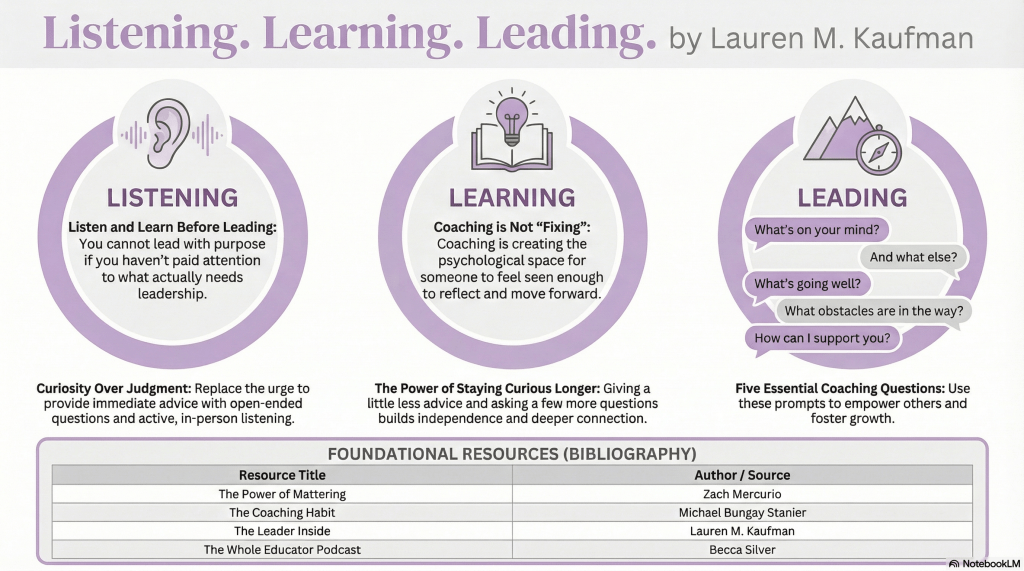
I often return to three questions in my conversations: What’s going well? What obstacles are getting in the way? And how can I support you? I talk more about these in The Whole Educator Podcast with Becca Silver. I appreciated this conversation because it brought me back to my instructional coaching roots and how I use those roots to lead now, where I share how these open-ended questions can take a conversation in so many directions. They allow you to peel back the layers and get to the heart of what someone may be experiencing. I suppose my instructional coaching background has shaped the way I approach my work like this.
This weekend, I spent some time with a best-selling book that has been on my nightstand, The Coaching Habit by Michael Bungay Stanier. One idea that stayed with me is how powerful it can be to give a little less advice and ask a few more questions. That sounds simple, but it’s not easy. Many of us have spent years being valued for having answers. Asking questions can feel slower and less certain. But coaching doesn’t have to be a formal or time-consuming process. It can happen in everyday moments, even in just a few minutes. Similarly, Stanier says, “If you know what question to ask, get to the point and ask it.” There is power in not overexplaining, but instead creating space for thinking through a well-placed question.
Stanier provides seven essential questions for leaders to consider for leading with a coaching lens and I’ve only gotten two thus far: “What’s on your mind?” and “And what else?” These questions create space. They help someone name what they are really thinking about and push their thinking just a bit further. Instead of jumping in to solve, they allow us to listen more deeply and support others in finding their own clarity.
At the same time, coaching is often one of the least used leadership approaches. It can feel like we don’t have the time, especially in fast-paced environments. But the reality is, when we move too quickly to give answers, we can unintentionally create dependence, feel overwhelmed, and lose connection to the work that matters most. Coaching helps to shift that. It helps others build independence, allows us to focus our time more intentionally, and reconnects people to meaningful work.
For me, this looks like a few simple reminders: pause before responding, ask one more question, and resist the urge to solve too quickly. Coaching doesn’t require more time. It requires more intention in the time we already have.
Which brings me back to the original question. Listening, learning, and leading. The more I think about it, the more I believe they were in the right order all along. From my personal experiences, leadership isn’t about leading first. It’s about listening closely enough to understand, learning deeply enough to see what’s possible, and then leading in a way that helps others do the same.
Listening. Learning. Leading.
Not in reverse, but exactly in that order.
CLICK HERE or on the image to use with your teams
 Empower. Collaborate. Connect.