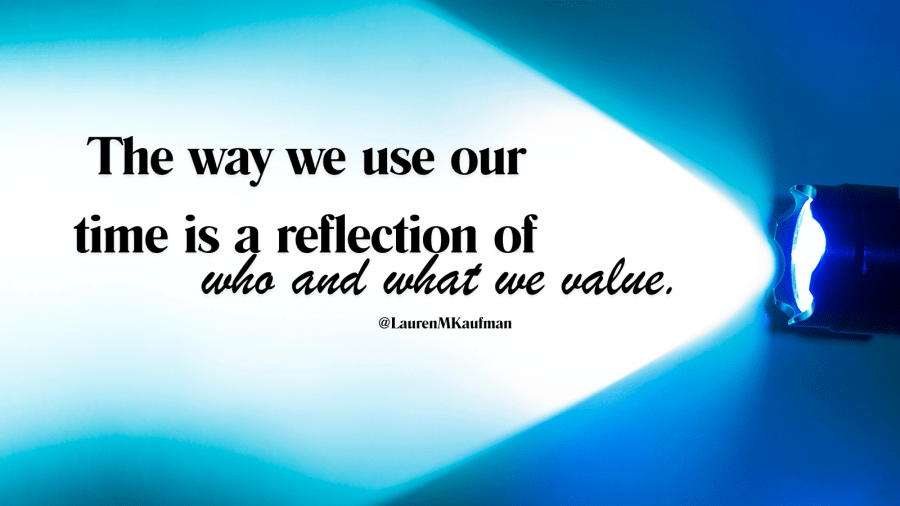
I want to start by saying that Thanksgiving is my favorite holiday. It’s because the only gifts we are expected to give are the ones that matter most…our presence, our attention, and our gratitude. And as we head into the week, I’ve been thinking a lot about where we choose to shine our “flashlight,” where we direct our time, our energy, and our care.
This idea felt important as I listened to a recent Innovator’s Mindset podcast conversation between two of my good friends, George Couros and Lainie Rowell. I’ve been fortunate enough to know them, ask them for their insights and guidance, and even contribute to both of their books, Because of a Teacher and Evolving with Gratitude. Every time I connect with them and hear them talk, I’m reminded of how lucky I am to learn alongside people who stretch my thinking and ground me in what matters most.
This episode, focused on time, attention, and connection, left me with three big takeaways that can speak directly to education. It also reminded me that when we pay attention with intention, we begin illuminating the good that is already present in our lives, our classrooms, our colleagues, and our communities.
As I listened, I found myself pausing often, thinking about how these ideas translate to the way we lead, learn, and show up for one another in our schools, and I hope they resonate for you too.
1. Excellence Breeds Excellence and It’s Rooted in Authentic Connection
One of my favorite parts of the conversation was listening to Lainie describe reaching out to people like Daniel Pink and Angela Duckworth, guests she has had on her Evolving With Gratitude podcast, not because they are “big names,” but because their work genuinely shaped her life. She didn’t approach them transactionally; she approached them with sincerity, specificity, and gratitude. And it raised an important question for me: When was the last time you told someone their work made a difference?
George echoed this idea when he talked about how creators pour their heart and soul into their work, and how meaningful it is when someone truly sees that. It’s not about celebrity; it’s about connection.
In education, this is our every day.
When we:
- Tell a colleague exactly how their lesson moved us
- Share with a mentor the impact of their guidance
- Look a student in the eye and say, “I see how hard you’re working, and it matters”
…we’re doing the same kind of work Lainie described. We’re saying: I see you. Your work has shaped me. You matter here.
In my book, The Leader Inside, I wrote the following sentiment, “Gifts live within exceptional educators, waiting to be unwrapped at the right place, at the right time, with the right people.”
George and Lainie remind us that excellence doesn’t grow in isolation. It grows in communities where we are willing to name the good we see in others, to lift one another up, and to surround ourselves with people who help us become a better version of ourselves.
For schools, that means intentionally building cultures where appreciation is not an event, it’s a habit. Gratitude shouldn’t be just a theme for November; it’s part of how we do the work, every day.
2. Guard Your Flashlight: Time, Attention, and the Myth of Multitasking
Lainie shared a powerful metaphor from Amishi Jha: attention is like a flashlight, you only get one, and you can only point it at one thing at a time.
For years, she proudly identified as a “multitasker,” only to learn that multitasking isn’t really a thing. It’s task-switching. And task-switching doesn’t just slow us down and increase mistakes, it’s emotionally exhausting.
That phrase stopped George (and me) in our tracks. Emotionally exhausting. How many educators are feeling that right now? Not just tired, but emotionally drained from constantly toggling between emails, lesson planning, parent communication, data, meetings, and all the things that pop up in between.
Lainie’s reminder challenges us to ask:
- Where is my flashlight pointing right now?
- Who or what deserves my full beam of attention at this moment?
In the classroom, this might look like:
- Being fully present during a student conference, rather than mentally composing the next email
- Protecting “sacred” blocks of time for planning, feedback, or reflection without phone notifications pinging every few seconds
- Modeling single-tasking for students, so they see what sustained focus actually looks and feels like
For leaders, it might mean designing meetings where devices are away and dialogue is deep. It might mean building in intentional pauses to listen, not just respond.
When we honor our attention as something precious, we send a powerful message to our students and colleagues: You are worth my full focus. You don’t have to compete with my distractions.
3. Design Your Speed Bumps and Rituals With Intention
Another concept that stood out was the difference Lainie drew between habits and rituals, and how we can “engineer speed bumps” in our lives.
- Habits are actions we want on autopilot, like going to the gym or waking up early.
- Rituals are the moments we savor, like dinner with family or a quiet cup of coffee before the day begins.
She talked about adding “speed bumps” to curb unhelpful habits (like time limits on social media or using a sunrise alarm clock instead of a phone by the bed) and removing speed bumps from the things that move us toward our goals (laying out gym clothes the night before, so there’s one less excuse).
In education, we can design similar speed bumps and rituals:
Speed bumps for what drains us:
- Setting boundaries for email (for example, not checking it during instructional time)
- Turning off nonessential notifications so we’re not constantly pulled out of the moment
- Pausing before saying “yes” to every request, so our time aligns with our purpose
Rituals for what sustains us:
- Beginning class or professional learning experience with a quick gratitude share or check-in
- Ending meetings with, “Who do we want to appreciate before we leave?”
- Building weekly rituals of looking at student work together, not just to analyze data, but to celebrate growth
These small, intentional moves reshape our days. They remind us that we are not just surviving time, we are designing it.
Coming Back to Gratitude and the Leader Inside
Listening to George and Lainie talk about noticing, evolving, and thriving brought me back to a simple truth: the way we use our time is a reflection of what and who we value. I’ll admit, I can be better at this. Can’t we all? Because leadership, at its core, is about illuminating the good in others and in ourselves.
As educators, we have the incredible privilege of choosing where we point our flashlight:
- Toward students who are still discovering their gifts
- Toward colleagues who quietly pour their hearts into this work
- Toward our own “leader inside,” who nudges us to keep learning, stretching, and growing
I am profoundly grateful for friends like George and Lainie who continue to shape my thinking through their conversations and the way they live their values.
And I am equally grateful for every educator who shows up day after day—to teach, listen, design, reflect, and love kids into becoming who they are meant to be.
As we celebrate Thanksgiving, I hope you give yourself permission to:
- Slow down the task-switching
- Protect the rituals that matter most
- Reach out and tell someone how they’ve impacted your life and your practice
Because when we choose to notice, we begin to nurture. When we nurture, we help others thrive. And when we help others thrive, we’re reminded that the leader inside each of us is always there, quietly waiting for the right place, the right time, and the right people to bring it to life.
So, this Thanksgiving and beyond, may your flashlight land on what matters most: your people, your purpose, and the gifts you help unwrap every single day.
 Empower. Collaborate. Connect.