Coaching is a vehicle to creating lasting impact in educational organizations, especially when districts are fully invested in allowing a coaching mindset to flourish. From my perspective, if you work in an educational setting, you are a coach and an instructional leader for the kids, colleagues, and communities you serve.
What I have come to understand is that developing a coaching leadership lens at any level of an organization starts with understanding people first, then content. Providing care and support is essential to moving important priorities forward within your ecosystems. This balance of knowledge and compassion is critical to driving lasting change and growth.
This idea is closely tied to what I express in my book, The Leader Inside: “Leadership rests on the shoulders of influence and inspiration, not compliance and control. Leadership is not a title, but an opportunity to recognize the greatness that lives inside others” (p. 92).
I see that firsthand now as I onboard our new literacy coach. But, just like with any growth, seeing the greatest impact takes time. For the important work to happen, every educator deserves to feel connected to their purpose and understand how they serve both students and colleagues each day. We all deserve to flourish.
I remember looking at our new literacy coach during the first week of school. I could sense the unfamiliarity she felt not having a classroom of her own anymore. It took me back to when I made the same transition, and even now, at times my heart aches knowing I may not be leaving the same legacy I once did in the classroom.
That feeling hit me hard again just the other day when I ran into Olivia, one of my former students working at a local ice cream shop. When I looked at her face, I could envision the eight year old girl who was learning how to read sit before me. Now she has graduated high school and her young face was that of a more mature version of her younger self, exuding a confidence that must have been shaped by her experiences in between.
We talked for a bit, and when I asked how she was doing, she asked me the same. At that moment, something shifted. She could barely contain her excitement as she shared how she had just enrolled in cosmetology school and an interest turned into a passion she’d like to pursue. “It’s fun, Mrs. Kaufman. And you can make people feel good about themselves. I can’t wait to start. Just like your class. You made me feel important. I couldn’t wait to be in your classroom every day. That’s how I want to make people feel.”
Even after eleven years without seeing or speaking to Olivia, we reconnected instantly as I shared my own journey—from the cosmetics industry to education—something she could never have imagined. But what stood out most was hearing her enthusiasm and realizing that I had played a small role in making her feel seen, helping ignite that passion, and watching her flourish. It was a powerful reminder that while I may no longer be in the classroom, the impact we leave as educators stretches far beyond the walls we once called our own.
I see that same spark in my new literacy coach and I’m grateful to coach and support her as she makes her own transition. From the moment she learned she would be serving in this role, she had been proactive, jumping in to help her colleagues and me, eager to make a difference. While I saw a bit of uneasiness as she embarked on an unfamiliar start to the school year, I looked at her and said, “That passion you have for education is going to influence and impact more kids than you know because you’re going to be impacting the teachers.” I could see her eyes light up, and I knew that since I am committed to leading with a coaching mindset, I was helping her find her own path forward.
Flourishing happens when we feel calm and capable, even in unfamiliar territory. It happens when we feel empowered to create, when our core values align with the purpose of our work. We flourish when our connections are strong, when we can speak freely without fear of judgment, and when we know we are making a difference. In her book Arise, Elena Aguilar says, “We thrive when we feel a sense of belonging, when our skills and gifts are appreciated by others. We thrive when we trust ourselves, when we feel genuine self-esteem, and when we feel like we’re being our best selves” (p. 32).
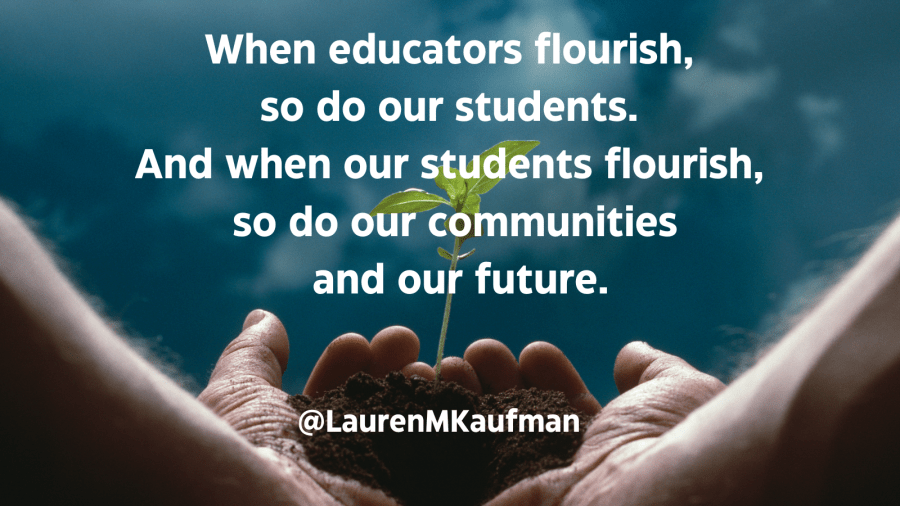
When educators flourish, so do our students. And when our students flourish, so do our communities and our future.
As educators, we hold high expectations for ourselves and others. Sometimes, the goals seem out of reach, and the responsibility feels overwhelming. But we continue to do the work, learning from each moment, reflecting, and moving forward with a mindset of infinite learning. We live in these moments, no matter how challenging they may be.
Aguilar’s words resonate deeply: “Coaching teachers is the greatest leverage point in transforming our education system; transformation happens when we coach behaviors, beliefs, and ways of being. Coaching happens in conversations, and transformation requires attending to the core human need for connection and belonging” (p. 33).
If we take care of each other, we’ll be better equipped to take care of our students. If we support our educators in their growth and believe in their ability to flourish, we will give every child what they need to succeed.
So, as I continue to onboard our new literacy coach, I’m reminded that even though we are both no longer in the classroom, our legacy isn’t lost.
It’s just different.
We’re helping educators flourish, and in doing so, we’re helping students flourish, too.
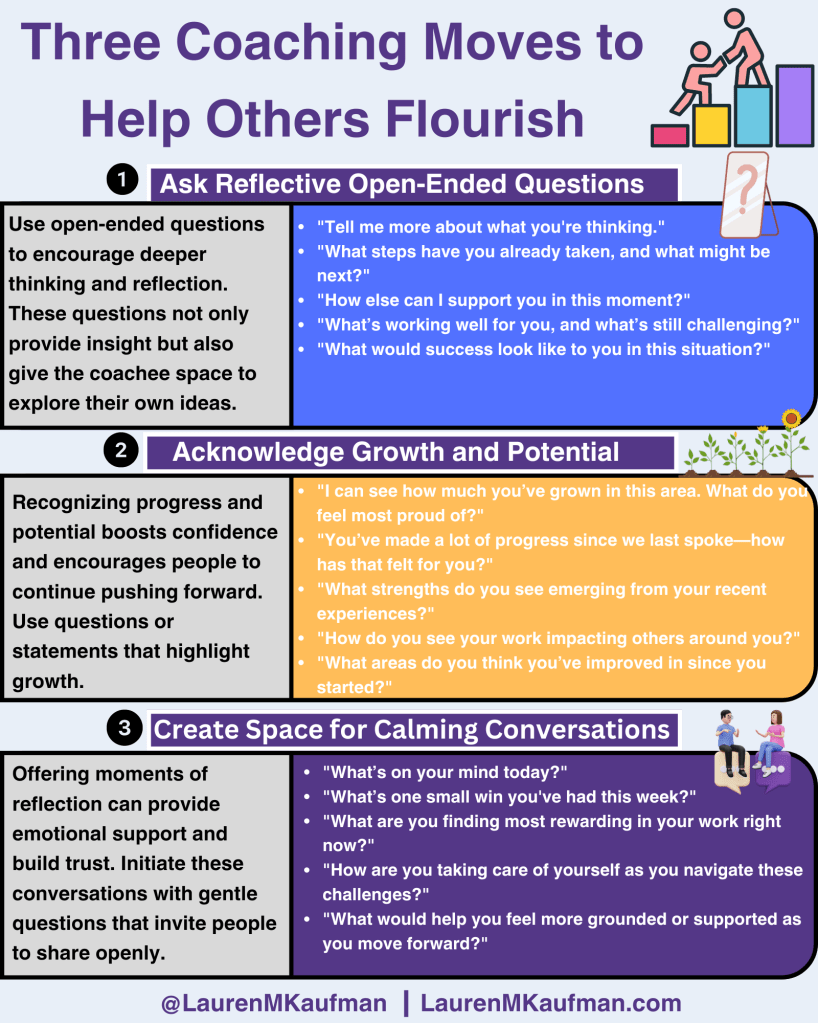
Three Coaching Moves to Help Others Flourish Tomorrow
CLICK HERE OR ON THE IMAGE TO PRINT FOR CONVERSATIONS IN YOUR PROFESSIONAL LEARNING COMMUNITIES
 Empower. Collaborate. Connect.