
“I believe that everyone is born with the desire to do something beyond themselves.” I recently heard this sentiment shared by entrepreneur and college professor Ed Zschau, on an episode of Tim Ferriss’ podcast. This insight reminded me that there will be moments in our lives that confirm that we are destined for things we hadn’t imagined for ourselves. These moments often occur in the right place, at the right time, with the right people. The essence of my journey and the roles I’ve embraced along the way have illuminated the idea that I can step out of my comfort zone, do hard things, and stretch my capacity as a human being, learner, leader, and educator. Can you relate to this sentiment?
Zschau goes on to share, “A lot of people say, ‘Wouldn’t it be neat if we can do this?’ Entrepreneurs say, ‘Wouldn’t it be neat if we can do this,’ and then they do it.” When I first took on the role of instructional coach, I embraced this entrepreneurial mindset. At first, I didn’t know if I would make the impact I was entrusted to carry out, but I stepped forward with the determination to turn that vision into reality. It took me a few years to recognize that my influence had made a difference. To this very day, I have viewed that role as so much more than a stepping stone to a formal leadership role. It was an opportunity to make an educational impact on a broader scale while building will, skill, knowledge, and the capacity of others. To me, it was an opportunity to breathe life into the aspirations of educators, leaders, and the futures of the students I served.
Since I stepped into a formal leadership role three years ago, I have dedicated a significant amount of time continuously asking myself, Lauren, who is the leader you wish to become? My answer has always been: The leader I always needed. I delve into this deeply in my upcoming book, The Leader Inside: Stories of Mentorship to Inspire the Leader Within, set to release on July 12. Drawing from my experiences as an instructional coach, I have used everything I’ve learned in that space as a bridge to my current role, allowing me to make a broader impact while staying true to my core values and vision.
Districts who embrace instructional coaching are committed to investing in job-embedded professional learning and have dedicated thought partners to see their district priorities through. I am deeply grateful for the leaders who took the time to coach the coach so to speak. Without their support and guidance, I would not be the leader who is able to lead through the coaching lens I strive for today.
As I get ready to onboard a new literacy coach, I am committed to providing them with the necessary support, coaching, and guidance needed to be successful in the role. Through reflection in my writing, I will share my process as I believe that a coach will only be as effective as the leader who believes in their ability to strengthen instruction and collectively move instructional priorities forward.
In revisiting this journey, I will turn to Jim Knight, author of Definitive Guide to Instructional Coaching as his Partnership Principles have been an anchor for my work as a coach and leader. They have also grounded me when I have felt that my work has gone off course and there was a misalignment to my belief systems. In his book, he shares the Oxford English Dictionary definition of a principle as a “fundamental source from which something proceeds… the ultimate basis upon which the existence of something depends” (Oxford University Press, 1981, p. 2303).
In other words, principles influence our actions, often without us realizing it, and are more clearly demonstrated through our behavior than our words. For example, an instructional coach who values collaboration might organize consistent grade-level meetings, actively seek input from teachers, and implement their suggestions in practice. This behavior clearly demonstrates the coach’s principles of teamwork and shared leadership, rather than just talking about the importance of these values.
Knight’s thoughtful work on having the ability to humanize conversations has helped me understand that in order to be an effective coach and leader, it starts with you. In his book, Knight shares, “… the way coaches interact with others frequently determines whether their coaching is successful. If coaches see themselves as superior to others, they may find that others are not interested in hearing what they have to say” (p. 5). Think about this, doesn’t the same insight apply to the relationships leaders build with their coaches?
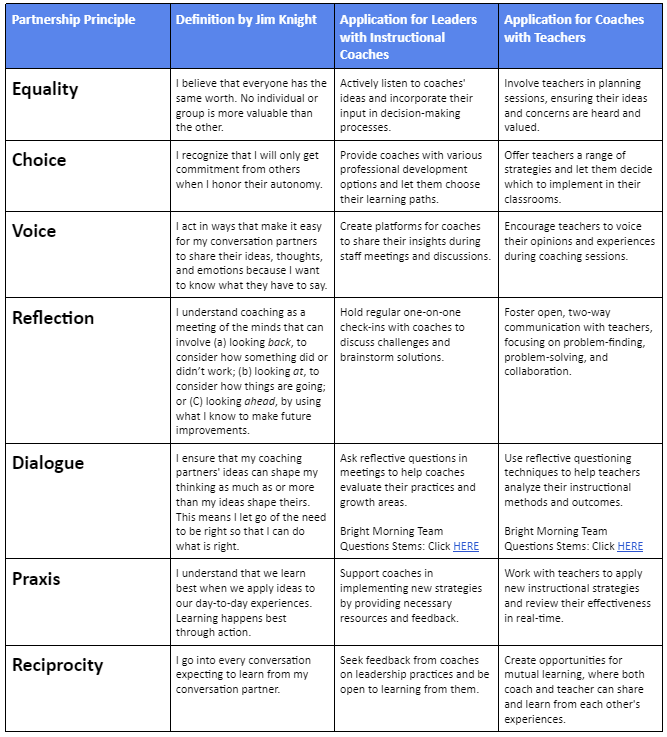
Below, I have taken Jim Knight’s definitions of each of his Seven Partnership Principles and connected each one with how leaders can develop conversations with instructional coaches. In turn, this can help coaches strengthen their conversations with teachers:
Leading Conversations Through a Coaching Lens Based on Jim Knight’s Partnership Principles
CLICK HERE TO PRINT THIS CHART
Moving Forward
I am committed to embodying these principles in my interactions with both coaches and teachers. It starts with understanding that, as Jim Knight suggests, the success of our coaching and leadership often hinges on the quality of our interactions and the principles that guide them.
“I believe that everyone is born with the desire to do something beyond themselves.” This brings us full circle to Zschau’s profound insight. So, I leave you with this question:
How will you harness your innate desire to make a difference, and what principles will guide you on this journey?
 Empower. Collaborate. Connect.